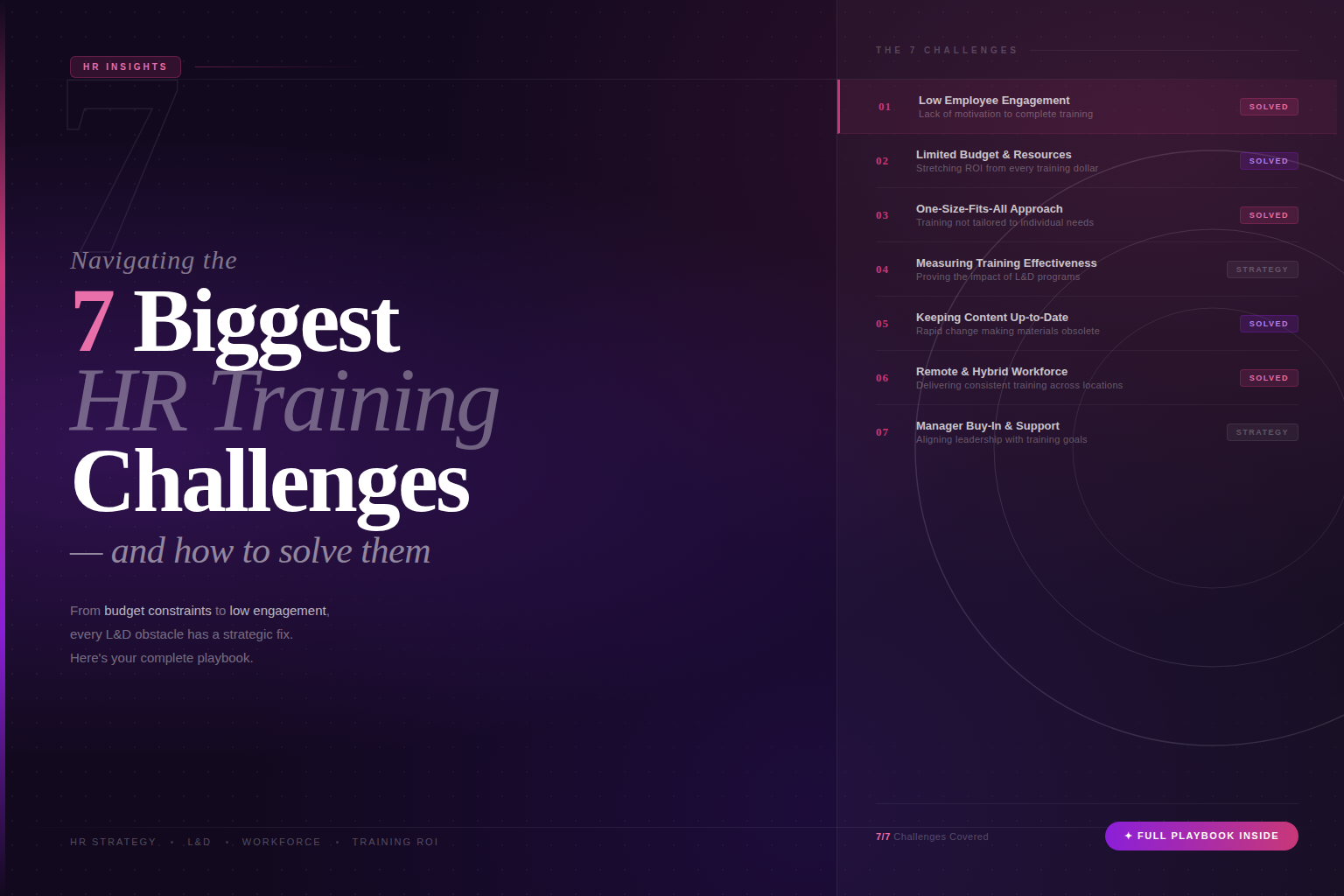
The 7 Biggest Challenges HR Leaders Face in Employee Training (And How to Solve Them)
In today’s rapidly evolving business landscape, organizations are under constant pressure to adapt to technological change, market competition, and shifting workforce expectations. One of the most critical factors determining whether companies succeed in this environment is the ability of employees to continuously develop new skills.
This responsibility largely falls on Human Resources (HR) and Learning & Development (L&D) leaders. These professionals are tasked with designing training programs that improve employee performance, strengthen leadership capabilities, and prepare organizations for future challenges.
However, implementing effective employee training initiatives is far from simple. HR leaders face multiple obstacles that make it difficult to deliver impactful learning experiences. From identifying the right skills to developing training programs that employees actually apply in their work, these challenges can significantly impact organizational productivity.
Understanding these HR training challenges is essential for companies that want to create successful employee development programs. By recognizing the barriers that exist and implementing strategies to overcome them, organizations can build learning cultures that drive long-term business success.
In this comprehensive guide, we explore the seven biggest challenges HR leaders face in employee training and discuss practical strategies to overcome them.
The Growing Importance of Employee Training in Modern Organizations
Employee training is no longer viewed as an optional activity that organizations implement occasionally. Instead, it has become a strategic necessity. Businesses operate in a world where knowledge becomes outdated quickly, technologies evolve rapidly, and new skills are required to remain competitive.
Companies that invest in employee development experience several advantages:
- Improved employee productivity
- Better leadership development
- Higher employee engagement
- Stronger workplace culture
- Greater innovation and adaptability
However, achieving these benefits requires carefully planned training strategies. Without addressing key challenges in learning and development, organizations may struggle to see real improvements in employee performance.
Challenge 1: Identifying the Right Training Needs
One of the most fundamental challenges HR leaders face is determining which skills employees actually need to develop. Many organizations invest in training programs without conducting proper analysis of skill gaps.
This often results in generic training initiatives that fail to address real workplace problems.
Why This Happens
Several factors contribute to this challenge:
- Lack of structured skill assessments
- Limited communication between managers and HR teams
- Assumptions about employee skill gaps
- Insufficient use of performance data
Without accurate insights, HR teams may design training programs that employees find irrelevant.
How to Solve This Challenge
Organizations should implement a structured Training Needs Analysis (TNA). This process helps identify the gap between current employee capabilities and the skills required to achieve organizational goals.
Common tools used for TNA include:
- Employee surveys
- Manager interviews
- Performance reviews
- Competency assessments
- Workplace observations
By using data-driven insights, HR leaders can design training programs that directly address skill gaps.
Challenge 2: Low Employee Engagement in Training Programs
Another major challenge HR leaders encounter is low employee engagement during training sessions. Employees often attend training programs because they are required to do so, rather than because they see genuine value in them.
When employees are disengaged, training becomes ineffective. Participants may attend sessions physically but remain mentally disconnected from the learning process.
Reasons for Low Engagement
- Training content that feels generic
- Traditional lecture-style training methods
- Lack of real-world application
- Long training sessions with minimal interaction
How to Improve Engagement
Modern corporate training programs focus on interactive learning experiences. HR leaders can increase engagement by incorporating:
- Experiential learning activities
- Role-playing exercises
- Case studies based on real workplace scenarios
- Group discussions
- Gamified learning techniques
Training that connects directly to employees’ daily work responsibilities tends to be far more engaging and impactful.
Challenge 3: Limited Training Budgets
Budget constraints remain one of the most common HR training challenges. Many organizations understand the importance of employee development but struggle to allocate sufficient financial resources for training initiatives.
HR departments often compete with other business priorities when requesting funding for training programs.
Impact of Budget Limitations
- Reduced access to expert trainers
- Limited customization of training programs
- Restricted access to learning technologies
- Fewer development opportunities for employees
Strategies to Overcome Budget Constraints
Organizations can maximize training impact even with limited budgets by focusing on high-priority skill areas such as leadership development, communication skills, and problem-solving.
Blended learning models that combine classroom training with digital platforms can also reduce costs while maintaining effectiveness.
Challenge 4: Measuring Training Effectiveness
Many HR leaders struggle to measure whether training programs actually improve employee performance. Without clear evaluation methods, it becomes difficult to determine the return on investment (ROI) of training initiatives.
Simply collecting feedback from participants does not provide sufficient evidence of training effectiveness.
The Kirkpatrick Evaluation Model
One widely used framework for measuring training effectiveness is the Kirkpatrick Model. It evaluates training impact across four levels:
- Reaction: How participants respond to training
- Learning: Knowledge or skills gained
- Behavior: Changes in workplace behavior
- Results: Impact on organizational performance
Organizations that track these metrics can continuously improve their training programs.
Challenge 5: Rapid Technological Change
Technological advancements are transforming nearly every industry. Automation, artificial intelligence, and digital platforms are constantly changing how employees perform their roles.
HR leaders must ensure that employees develop the digital skills required to remain effective in evolving work environments.
However, designing training programs that keep pace with technological change can be challenging.
Creating a Continuous Learning Culture
Organizations should promote ongoing learning rather than relying solely on occasional training sessions.
Strategies for continuous learning include:
- Microlearning platforms
- Online training modules
- Peer knowledge-sharing sessions
- Digital learning communities
Challenge 6: Training a Diverse Workforce
Modern organizations include employees from multiple generations, cultures, and professional backgrounds. Designing training programs that appeal to such diverse groups can be challenging.
For example:
- Older employees may prefer classroom training.
- Younger employees may prefer digital learning tools.
- Remote workers may require virtual learning environments.
Flexible Learning Solutions
Blended learning approaches that combine classroom sessions, digital modules, and interactive workshops can accommodate diverse learning preferences.
Challenge 7: Ensuring Long-Term Skill Application
One of the biggest problems organizations face is that employees often forget training content shortly after completing programs.
This occurs because learning is not reinforced after training sessions.
Strategies to Reinforce Learning
- Follow-up coaching sessions
- Practical workplace assignments
- Manager feedback
- Peer learning groups
- Continuous learning resources
When training is reinforced through practice and feedback, employees are more likely to apply new skills effectively.
Building a Successful Employee Training Strategy
To overcome HR training challenges, organizations must adopt strategic approaches to employee development.
Successful training strategies typically include:
- Data-driven training needs analysis
- Interactive and experiential learning methods
- Continuous learning opportunities
- Effective training evaluation systems
- Leadership involvement in employee development
Organizations that integrate these practices create learning cultures that support long-term growth.
Conclusion
Employee training remains one of the most powerful tools organizations can use to improve performance, build leadership capabilities, and drive innovation.
However, HR leaders face numerous challenges when designing and implementing effective training programs. From identifying skill gaps to maintaining employee engagement and measuring outcomes, these obstacles require strategic solutions.
By addressing these HR training challenges and implementing structured learning strategies, organizations can create impactful training programs that enhance employee capabilities and contribute to business success.
Book a Demo
Looking to overcome employee training challenges and design impactful learning programs for your organization?
Insite Learning Solutions specializes in customized corporate training programs that help organizations develop leadership capabilities, improve communication skills, and build high-performing teams.
Our expert trainers work closely with organizations to deliver practical learning experiences that address real workplace challenges.