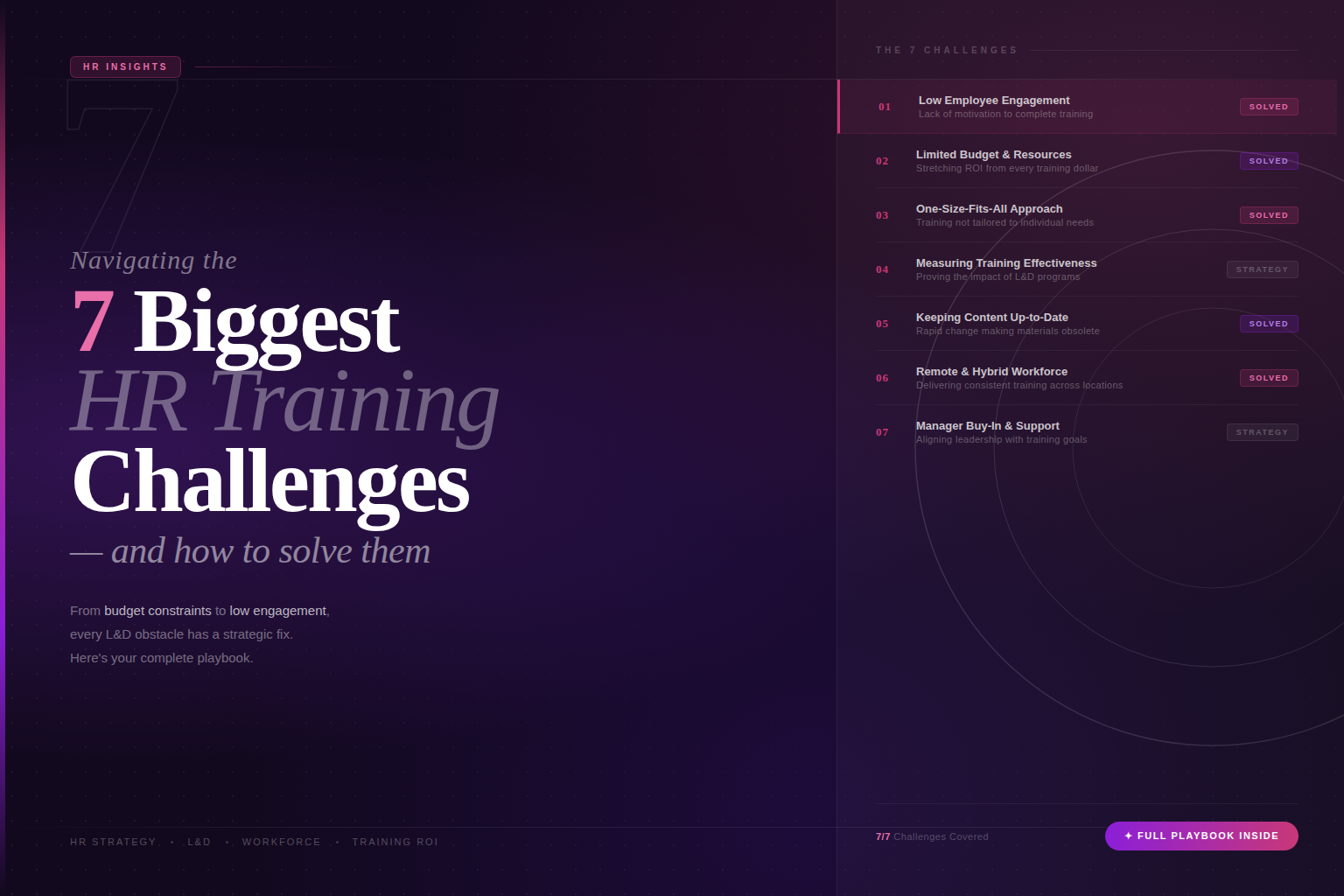
The 7 Biggest Challenges HR Leaders Face in Employee Training (And How to Solve Them)

In today’s rapidly evolving business landscape, organizations are under constant pressure to adapt to technological change, market competition, and shifting workforce expectations. One of the most critical factors determining whether companies succeed in this environment is the ability of employees to continuously develop new skills.

This responsibility largely falls on Human Resources (HR) and Learning & Development (L&D) leaders. These professionals are tasked with designing training programs that improve employee performance, strengthen leadership capabilities, and prepare organizations for future challenges.

However, implementing effective employee training initiatives is far from simple. HR leaders face multiple obstacles that make it difficult to deliver impactful learning experiences. From identifying the right skills to developing training programs that employees actually apply in their work, these challenges can significantly impact organizational productivity.

Understanding these HR training challenges is essential for companies that want to create successful employee development programs. By recognizing the barriers that exist and implementing strategies to overcome them, organizations can build learning cultures that drive long-term business success.

In this comprehensive guide, we explore the seven biggest challenges HR leaders face in employee training and discuss practical strategies to overcome them.

The Growing Importance of Employee Training in Modern Organizations

Employee training is no longer viewed as an optional activity that organizations implement occasionally. Instead, it has become a strategic necessity. Businesses operate in a world where knowledge becomes outdated quickly, technologies evolve rapidly, and new skills are required to remain competitive.

Companies that invest in employee development experience several advantages:

  • Improved employee productivity
  • Better leadership development
  • Higher employee engagement
  • Stronger workplace culture
  • Greater innovation and adaptability

However, achieving these benefits requires carefully planned training strategies. Without addressing key challenges in learning and development, organizations may struggle to see real improvements in employee performance.

Challenge 1: Identifying the Right Training Needs

One of the most fundamental challenges HR leaders face is determining which skills employees actually need to develop. Many organizations invest in training programs without conducting proper analysis of skill gaps.

This often results in generic training initiatives that fail to address real workplace problems.

Why This Happens

Several factors contribute to this challenge:

  • Lack of structured skill assessments
  • Limited communication between managers and HR teams
  • Assumptions about employee skill gaps
  • Insufficient use of performance data

Without accurate insights, HR teams may design training programs that employees find irrelevant.

How to Solve This Challenge

Organizations should implement a structured Training Needs Analysis (TNA). This process helps identify the gap between current employee capabilities and the skills required to achieve organizational goals.

Common tools used for TNA include:

  • Employee surveys
  • Manager interviews
  • Performance reviews
  • Competency assessments
  • Workplace observations

By using data-driven insights, HR leaders can design training programs that directly address skill gaps.

Challenge 2: Low Employee Engagement in Training Programs

Another major challenge HR leaders encounter is low employee engagement during training sessions. Employees often attend training programs because they are required to do so, rather than because they see genuine value in them.

When employees are disengaged, training becomes ineffective. Participants may attend sessions physically but remain mentally disconnected from the learning process.

Reasons for Low Engagement

  • Training content that feels generic
  • Traditional lecture-style training methods
  • Lack of real-world application
  • Long training sessions with minimal interaction

How to Improve Engagement

Modern corporate training programs focus on interactive learning experiences. HR leaders can increase engagement by incorporating:

  • Experiential learning activities
  • Role-playing exercises
  • Case studies based on real workplace scenarios
  • Group discussions
  • Gamified learning techniques

Training that connects directly to employees’ daily work responsibilities tends to be far more engaging and impactful.

Challenge 3: Limited Training Budgets

Budget constraints remain one of the most common HR training challenges. Many organizations understand the importance of employee development but struggle to allocate sufficient financial resources for training initiatives.

HR departments often compete with other business priorities when requesting funding for training programs.

Impact of Budget Limitations

  • Reduced access to expert trainers
  • Limited customization of training programs
  • Restricted access to learning technologies
  • Fewer development opportunities for employees

Strategies to Overcome Budget Constraints

Organizations can maximize training impact even with limited budgets by focusing on high-priority skill areas such as leadership development, communication skills, and problem-solving.

Blended learning models that combine classroom training with digital platforms can also reduce costs while maintaining effectiveness.

Challenge 4: Measuring Training Effectiveness

Many HR leaders struggle to measure whether training programs actually improve employee performance. Without clear evaluation methods, it becomes difficult to determine the return on investment (ROI) of training initiatives.

Simply collecting feedback from participants does not provide sufficient evidence of training effectiveness.

The Kirkpatrick Evaluation Model

One widely used framework for measuring training effectiveness is the Kirkpatrick Model. It evaluates training impact across four levels:

  • Reaction: How participants respond to training
  • Learning: Knowledge or skills gained
  • Behavior: Changes in workplace behavior
  • Results: Impact on organizational performance

Organizations that track these metrics can continuously improve their training programs.

Challenge 5: Rapid Technological Change

Technological advancements are transforming nearly every industry. Automation, artificial intelligence, and digital platforms are constantly changing how employees perform their roles.

HR leaders must ensure that employees develop the digital skills required to remain effective in evolving work environments.

However, designing training programs that keep pace with technological change can be challenging.

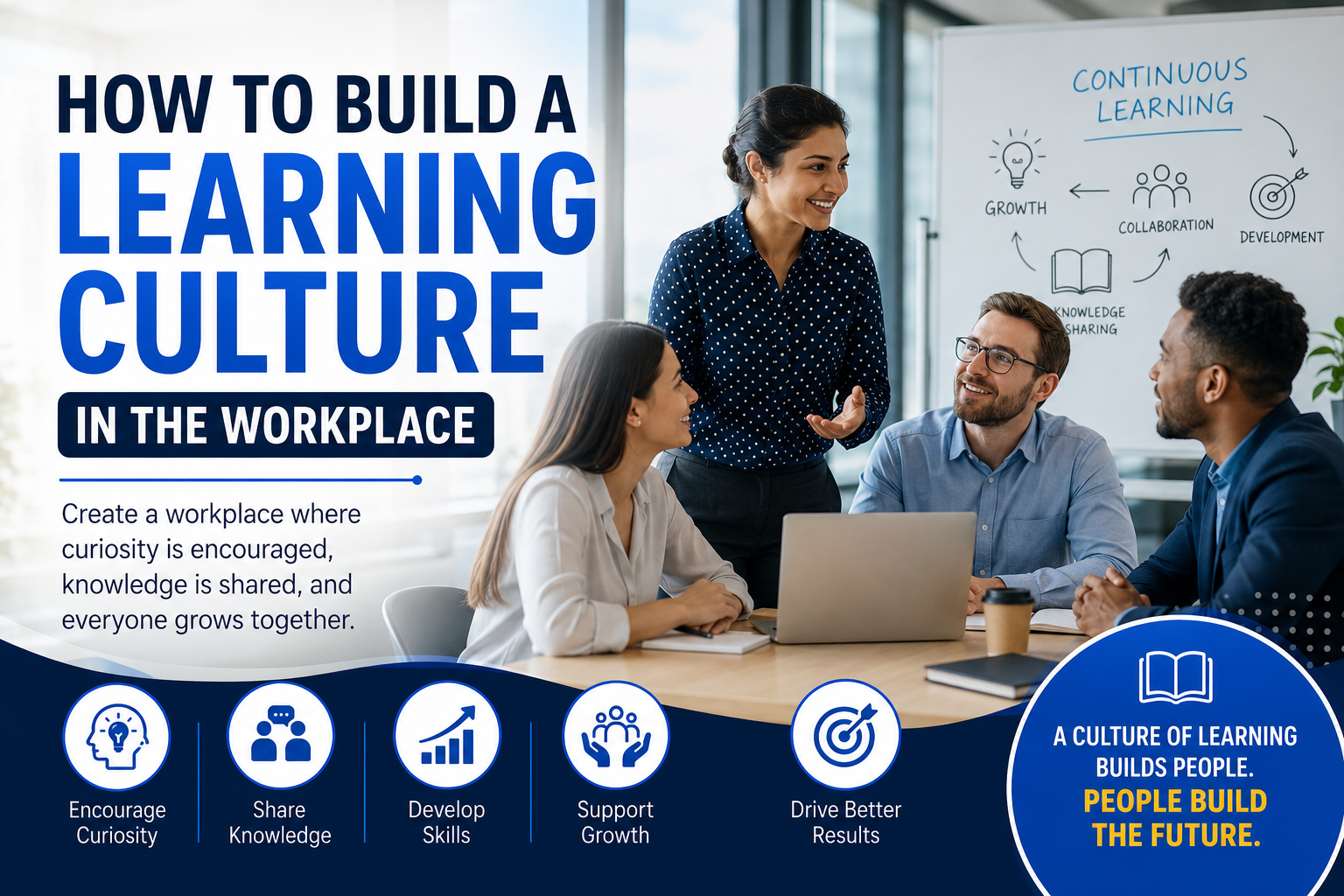
Creating a Continuous Learning Culture

Organizations should promote ongoing learning rather than relying solely on occasional training sessions.

Strategies for continuous learning include:

  • Microlearning platforms
  • Online training modules
  • Peer knowledge-sharing sessions
  • Digital learning communities

Challenge 6: Training a Diverse Workforce

Modern organizations include employees from multiple generations, cultures, and professional backgrounds. Designing training programs that appeal to such diverse groups can be challenging.

For example:

  • Older employees may prefer classroom training.
  • Younger employees may prefer digital learning tools.
  • Remote workers may require virtual learning environments.

Flexible Learning Solutions

Blended learning approaches that combine classroom sessions, digital modules, and interactive workshops can accommodate diverse learning preferences.

Challenge 7: Ensuring Long-Term Skill Application

One of the biggest problems organizations face is that employees often forget training content shortly after completing programs.

This occurs because learning is not reinforced after training sessions.

Strategies to Reinforce Learning

  • Follow-up coaching sessions
  • Practical workplace assignments
  • Manager feedback
  • Peer learning groups
  • Continuous learning resources

When training is reinforced through practice and feedback, employees are more likely to apply new skills effectively.

Building a Successful Employee Training Strategy

To overcome HR training challenges, organizations must adopt strategic approaches to employee development.

Successful training strategies typically include:

  • Data-driven training needs analysis
  • Interactive and experiential learning methods
  • Continuous learning opportunities
  • Effective training evaluation systems
  • Leadership involvement in employee development

Organizations that integrate these practices create learning cultures that support long-term growth.

Conclusion

Employee training remains one of the most powerful tools organizations can use to improve performance, build leadership capabilities, and drive innovation.

However, HR leaders face numerous challenges when designing and implementing effective training programs. From identifying skill gaps to maintaining employee engagement and measuring outcomes, these obstacles require strategic solutions.

By addressing these HR training challenges and implementing structured learning strategies, organizations can create impactful training programs that enhance employee capabilities and contribute to business success.

Book a Demo

Looking to overcome employee training challenges and design impactful learning programs for your organization?

Insite Learning Solutions specializes in customized corporate training programs that help organizations develop leadership capabilities, improve communication skills, and build high-performing teams.

Our expert trainers work closely with organizations to deliver practical learning experiences that address real workplace challenges.


Book a Demo

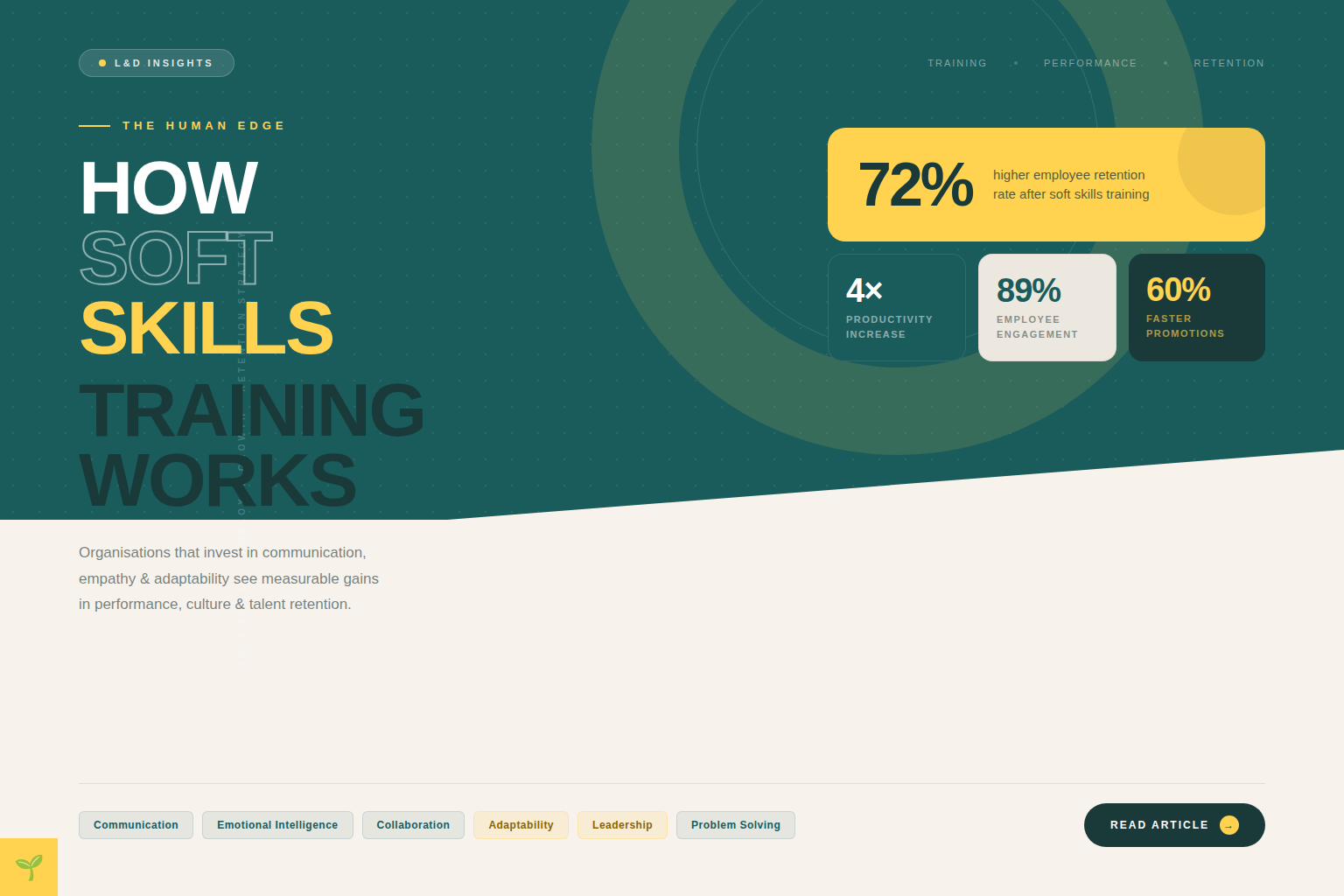
How Soft Skills Training Improves Employee Performance and Retention

In today’s modern workplace, organizations are no longer competing only through technology, infrastructure, or products. They are competing through people. While technical expertise remains essential for completing tasks, it is the human capabilities of employees that determine how effectively teams collaborate, communicate, innovate, and solve problems.

This is where soft skills play a crucial role. Soft skills include interpersonal abilities such as communication, emotional intelligence, teamwork, adaptability, and leadership. These capabilities enable employees to work effectively with others, manage workplace challenges, and contribute positively to organizational culture.

As businesses become more collaborative and customer-focused, companies across industries are realizing the importance of investing in soft skills development. Organizations that provide structured soft skills training programs often see improvements in employee productivity, workplace culture, employee engagement, and long-term retention.

This article explores the key soft skills training benefits for organizations and explains how developing these capabilities can significantly improve employee performance and retention.

Why Technical Skills Alone Are Not Enough

Technical skills are essential for performing job-specific responsibilities. Engineers must understand technical systems, accountants must understand financial processes, and software developers must understand coding languages. However, technical knowledge alone does not guarantee success in today’s collaborative workplace.

Employees rarely work in isolation. Most roles require constant communication with colleagues, clients, managers, and cross-functional teams. Without strong interpersonal abilities, even highly skilled professionals may struggle to work effectively with others.

For example, an employee may have excellent analytical skills but may struggle to present ideas clearly during meetings. Another employee may have strong technical expertise but may find it difficult to collaborate with team members or manage workplace conflicts.

In such situations, soft skills become the bridge between technical knowledge and practical workplace effectiveness.

The Modern Workplace Requires Human-Centered Skills

The nature of work has changed dramatically over the last decade. Organizations now operate in environments characterized by rapid technological change, global collaboration, and hybrid work models. Employees are expected to communicate across digital platforms, collaborate with diverse teams, and respond quickly to changing circumstances.

These workplace realities require skills such as adaptability, communication, empathy, and problem-solving. Soft skills training helps employees develop these capabilities so they can navigate modern workplace challenges effectively.

Technical Expertise + Soft Skills = High Performance

When employees combine technical expertise with strong interpersonal abilities, they become significantly more effective contributors. They can share ideas clearly, collaborate with colleagues, manage conflicts constructively, and maintain positive workplace relationships.

Organizations that invest in both technical training and soft skills development create balanced professionals who can perform tasks effectively while also strengthening team dynamics.

Top Soft Skills Companies Are Investing In

As organizations recognize the importance of interpersonal competencies, they are increasingly investing in training programs that focus on developing essential soft skills.

Some of the most important soft skills organizations prioritize include the following.

Communication Skills

Communication is one of the most fundamental workplace skills. Employees must be able to clearly convey ideas, listen actively to others, and provide constructive feedback. Poor communication can lead to misunderstandings, delays, and workplace conflicts.

Communication training typically focuses on:

  • Active listening techniques
  • Clear and structured messaging
  • Presentation skills
  • Providing and receiving feedback
  • Handling difficult conversations

Employees who communicate effectively help create transparent workplaces where information flows smoothly and collaboration becomes easier.

Emotional Intelligence

Emotional intelligence refers to the ability to understand and manage one’s own emotions while recognizing and responding appropriately to the emotions of others.

Employees with strong emotional intelligence demonstrate empathy, self-awareness, and emotional control. These qualities help them manage workplace relationships more effectively.

Organizations often include emotional intelligence training in leadership development programs because leaders who understand emotions can motivate teams, manage conflicts, and build stronger relationships.

Team Collaboration

Modern organizations rely heavily on teamwork. Employees must collaborate with colleagues from different departments, backgrounds, and skill sets.

Soft skills training helps employees develop collaboration abilities such as trust-building, constructive feedback, and collective problem-solving. These skills enable teams to work together effectively and achieve shared goals.

Problem-Solving and Critical Thinking

Workplace challenges often require creative solutions. Employees with strong problem-solving skills can analyze complex situations, evaluate different options, and develop effective strategies.

Training programs that focus on critical thinking encourage employees to approach challenges systematically and develop innovative solutions.

Adaptability and Resilience

Organizations constantly face change driven by technology, market conditions, and customer expectations. Employees who are adaptable and resilient can adjust quickly to new situations while maintaining productivity.

Adaptability training helps employees remain confident and proactive even during uncertain or rapidly changing circumstances.

Impact of Soft Skills on Workplace Productivity

One of the most measurable benefits of soft skills training is improved productivity. When employees possess strong interpersonal capabilities, they collaborate more effectively, resolve issues faster, and maintain positive workplace relationships.

Several productivity improvements occur when organizations prioritize soft skills development.

Better Team Coordination

Teams with strong communication and collaboration skills coordinate tasks more effectively. Employees understand expectations clearly, share information quickly, and support each other during projects.

Reduced Workplace Conflicts

Conflicts can disrupt productivity and create negative work environments. Employees who have developed emotional intelligence and communication skills are better equipped to resolve disagreements constructively.

Faster Problem Resolution

Employees who possess critical thinking and problem-solving skills can identify solutions quickly. This reduces delays and helps teams maintain project momentum.

Improved Customer Interactions

Many roles require employees to interact directly with customers. Communication and empathy skills help employees understand customer needs and deliver better service experiences.

When employees perform more effectively in their roles, overall organizational productivity increases.

Soft Skills and Employee Engagement

Employee engagement has become one of the most important factors influencing workplace performance. Engaged employees are more committed to their work, contribute more actively to team success, and demonstrate higher levels of motivation.

Soft skills training significantly influences employee engagement by strengthening workplace relationships and improving organizational culture.

Stronger Workplace Relationships

Employees who develop interpersonal skills build stronger relationships with colleagues and managers. These positive relationships create supportive environments where employees feel comfortable sharing ideas and seeking assistance.

Improved Leadership Effectiveness

Managers who develop leadership communication and emotional intelligence skills create teams where employees feel valued and respected. Strong leadership increases employee trust and engagement.

Encouraging Employee Participation

Soft skills training encourages open communication and collaboration. Employees feel more confident participating in discussions, offering suggestions, and contributing innovative ideas.

When employees feel heard and appreciated, they become more engaged in their work.

How Soft Skills Training Improves Employee Retention

Employee retention is a major concern for organizations across industries. High turnover rates increase recruitment costs and disrupt team productivity.

Soft skills training helps address retention challenges by improving workplace culture and supporting employee growth.

Providing Professional Development Opportunities

Employees are more likely to stay with organizations that invest in their professional development. Soft skills training signals that the organization values employee growth and long-term career development.

Creating Positive Workplace Culture

Training programs that focus on communication, empathy, and collaboration contribute to healthier workplace cultures where employees enjoy working.

Strengthening Manager-Employee Relationships

Managers who develop leadership soft skills build stronger relationships with their teams. Employees who feel supported by their managers are more likely to remain committed to their organizations.

Real Corporate Training Examples

Example 1: Communication Skills Training

A technology company conducted communication training for its project managers after internal surveys revealed misunderstandings between technical teams.

After the training program, the company observed improved collaboration and faster project completion times.

Example 2: Emotional Intelligence Workshops

A financial services organization introduced emotional intelligence workshops to help employees manage workplace stress and build stronger relationships.

Following the training program, employee engagement scores increased significantly.

Example 3: Customer Interaction Training

A customer support organization provided soft skills training focused on empathy and communication. Customer satisfaction ratings improved dramatically after employees applied these skills.

Long-Term Organizational Benefits of Soft Skills Training

Organizations that consistently invest in soft skills development often experience long-term advantages.

  • Improved employee morale
  • Higher productivity levels
  • Better collaboration between teams
  • Stronger leadership pipelines
  • Enhanced customer experiences

These benefits contribute to sustainable organizational growth.

Conclusion

Soft skills have become essential for success in today’s modern workplace. While technical skills enable employees to perform tasks, soft skills determine how effectively they collaborate, communicate, and contribute to organizational goals.

Organizations that invest in soft skills training create workplaces where employees thrive, teams collaborate effectively, and leaders inspire innovation.

As businesses continue to evolve, developing interpersonal capabilities will remain a critical factor in building resilient and high-performing organizations.

Book a Demo

Looking to improve employee performance and build stronger teams through soft skills training?

Insite Learning Solutions offers customized corporate training programs designed to develop communication skills, leadership capabilities, and emotional intelligence within organizations.

Our expert trainers deliver practical and engaging learning experiences that help employees apply soft skills effectively in real workplace situations.


Book a Demo

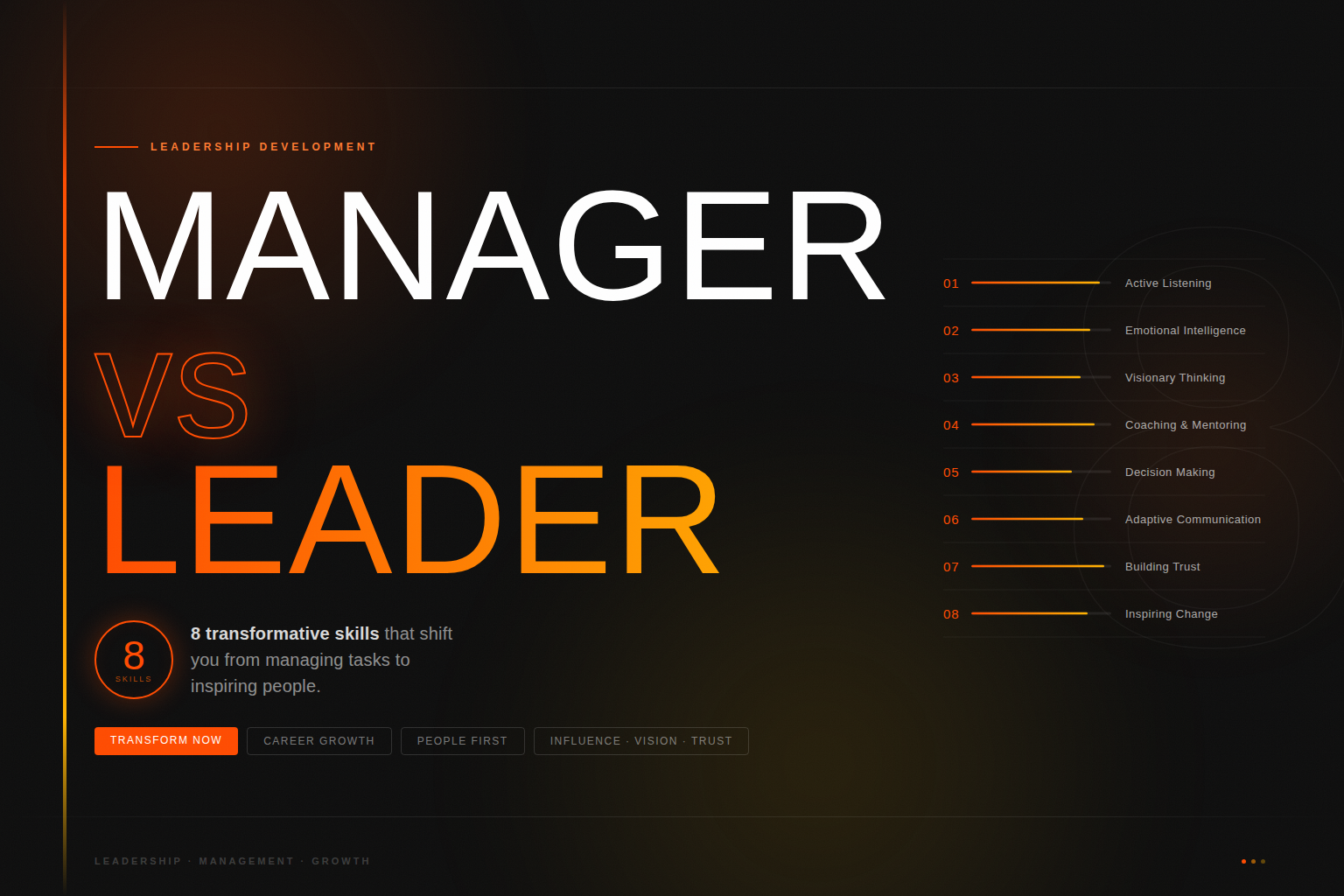
Manager vs Leader: 8 Leadership Skills That Transform Managers into Great Leaders

In today’s competitive and fast-changing business environment, organizations are realizing that management alone is not enough to build high-performing teams. Companies need leaders who can inspire employees, guide teams through uncertainty, and create a culture of collaboration and innovation.

Many professionals are promoted into managerial roles because of their technical expertise or operational excellence. However, managing tasks and leading people are two very different capabilities. While managers focus on processes, efficiency, and execution, leaders focus on vision, influence, and people development.

This distinction is why developing leadership skills for managers has become a top priority for organizations around the world. Managers who develop leadership capabilities are better equipped to motivate teams, handle complex workplace challenges, and drive sustainable organizational growth.

In this comprehensive guide, we will explore the difference between managing and leading, discuss the most important leadership skills managers must develop, and explain how organizations can help managers evolve into impactful leaders.

Difference Between Managing and Leading

The terms “manager” and “leader” are often used interchangeably, but they represent distinct approaches to guiding teams and achieving results.

What Does a Manager Do?

A manager is responsible for planning, organizing, and supervising work activities to ensure tasks are completed efficiently. Managers focus on maintaining operational stability, ensuring employees follow procedures, and meeting performance targets.

Typical responsibilities of managers include:

  • Assigning tasks and responsibilities
  • Monitoring employee performance
  • Managing schedules and resources
  • Ensuring processes are followed correctly
  • Maintaining operational efficiency

Management is essential for maintaining structure and ensuring that daily operations run smoothly.

What Does a Leader Do?

Leadership, on the other hand, focuses on inspiring people, setting direction, and encouraging innovation. Leaders influence others to work toward a shared vision and empower teams to perform at their best.

Effective leaders typically:

  • Create a compelling vision for the future
  • Motivate and inspire employees
  • Encourage innovation and creativity
  • Develop and mentor team members
  • Build trust and strong relationships

While managers focus on controlling processes, leaders focus on empowering people. The most successful professionals combine both management and leadership capabilities.

Why Leadership Skills for Managers Are Critical Today

The workplace has changed dramatically over the past decade. Organizations are dealing with digital transformation, global competition, remote work environments, and constantly evolving employee expectations.

In such a dynamic environment, simply managing tasks is not enough. Managers must develop leadership capabilities that help them guide teams through change, motivate employees, and create high-performance cultures.

Organizations that prioritize leadership development often experience several benefits:

  • Higher employee engagement and satisfaction
  • Stronger collaboration between teams
  • Improved decision-making across departments
  • Better adaptability during change and uncertainty
  • Greater innovation and problem-solving capabilities

When managers develop leadership skills, they become catalysts for organizational growth.

8 Leadership Skills That Transform Managers into Leaders

To become effective leaders, managers must develop a range of interpersonal, strategic, and emotional competencies. Below are eight essential leadership skills that help managers transition into impactful leaders.

1. Communication Skills

Communication is the foundation of effective leadership. Leaders must clearly articulate goals, expectations, and organizational vision while also listening actively to their teams.

Strong communication skills allow leaders to:

  • Provide clear instructions and direction
  • Share organizational vision with employees
  • Encourage open dialogue within teams
  • Resolve conflicts effectively
  • Build trust through transparency

Managers who communicate effectively create an environment where employees feel informed, valued, and motivated.

2. Vision and Strategic Thinking

Managers typically focus on short-term goals and daily operations. Leaders, however, must think strategically and plan for the long-term success of the organization.

Strategic thinking helps leaders anticipate challenges, identify opportunities, and guide teams toward future growth.

Leaders with strong strategic thinking capabilities can:

  • Align team goals with organizational objectives
  • Anticipate market trends and industry changes
  • Make proactive decisions
  • Guide teams through complex challenges

Strategic leaders help organizations remain competitive in rapidly evolving industries.

3. Emotional Intelligence

Emotional intelligence is the ability to understand and manage one’s own emotions while recognizing and influencing the emotions of others.

Leaders with high emotional intelligence build stronger relationships, manage conflicts effectively, and create supportive workplace environments.

Key elements of emotional intelligence include:

  • Self-awareness
  • Self-regulation
  • Empathy
  • Social awareness
  • Relationship management

Emotional intelligence enables leaders to connect with employees on a deeper level, which improves collaboration and engagement.

4. Coaching and Mentoring

Great leaders focus on developing their team members rather than simply directing them. Coaching involves guiding employees to discover solutions, build confidence, and improve performance.

Managers who adopt a coaching mindset can:

  • Empower employees to take ownership of their work
  • Encourage continuous learning
  • Help employees develop new skills
  • Build stronger professional relationships

Organizations that promote coaching leadership styles often experience higher levels of employee engagement and retention.

5. Decision-Making Skills

Leaders are frequently required to make complex decisions that impact teams, projects, and business outcomes. Effective decision-making involves evaluating data, considering multiple perspectives, and choosing the best course of action.

Strong decision-making skills allow leaders to:

  • Handle uncertainty with confidence
  • Address challenges quickly
  • Minimize risks
  • Guide teams toward effective solutions

Leaders who make thoughtful and timely decisions build credibility and trust within their teams.

6. Adaptability and Change Management

Modern organizations operate in environments of constant change. Leaders must be adaptable and capable of guiding teams through uncertainty.

Adaptable leaders:

  • Embrace new technologies and ideas
  • Encourage flexible thinking
  • Support employees during change
  • Maintain productivity during transitions

Organizations need leaders who can remain calm and focused even during periods of disruption.

7. Accountability and Ownership

Effective leaders take responsibility for both successes and failures. They create cultures where employees understand their responsibilities and take ownership of their work.

Leaders who demonstrate accountability inspire trust and encourage teams to perform at higher levels.

8. Building Trust and Collaboration

Trust is the foundation of strong leadership. Employees perform better when they trust their leaders and feel supported in their work.

Leaders build trust by:

  • Demonstrating integrity and honesty
  • Communicating openly with teams
  • Recognizing employee contributions
  • Supporting employees during challenges

Trust-based leadership creates positive workplace cultures where teams collaborate effectively.

Coaching vs Controlling Teams

One of the most important shifts managers must make when becoming leaders is moving from a controlling approach to a coaching approach.

Controlling Approach

Managers who rely heavily on control often focus on monitoring every detail of employee work. They provide strict instructions and expect employees to follow predefined processes.

While this approach may ensure short-term efficiency, it can reduce employee motivation and limit creativity.

Coaching Approach

Leaders adopt a coaching mindset that focuses on empowering employees rather than controlling them.

Coaching leaders:

  • Encourage independent thinking
  • Help employees develop problem-solving skills
  • Provide guidance rather than commands
  • Create environments where employees feel confident sharing ideas

Coaching leadership styles encourage innovation, collaboration, and continuous learning.

Strategic Thinking and Decision Making

Strategic thinking enables leaders to connect daily operations with long-term business objectives. Leaders who think strategically can evaluate opportunities, anticipate risks, and guide teams toward sustainable growth.

Strategic leaders focus on:

  • Understanding market trends
  • Analyzing business data
  • Identifying new opportunities
  • Aligning team efforts with organizational strategy

Decision-making is closely tied to strategic thinking. Leaders must evaluate information, consider multiple viewpoints, and choose the best path forward.

Organizations benefit greatly from leaders who can combine analytical thinking with sound judgment.

Emotional Intelligence in Leadership

Emotional intelligence is one of the most critical leadership competencies in the modern workplace. Leaders who understand emotions can build stronger relationships and manage workplace dynamics more effectively.

Emotionally intelligent leaders demonstrate empathy, patience, and awareness of how their behavior affects others.

They also:

  • Recognize employee challenges and concerns
  • Handle workplace conflicts constructively
  • Create supportive work environments
  • Encourage collaboration and respect

Organizations increasingly incorporate emotional intelligence training into leadership development programs.

Conclusion

The transition from manager to leader requires a shift in mindset, skills, and leadership approach. While management focuses on efficiency and task execution, leadership focuses on inspiring people, building trust, and driving long-term success.

Managers who develop leadership skills such as communication, emotional intelligence, strategic thinking, coaching, and decision-making can transform teams and organizations.

Companies that invest in leadership development programs not only build stronger leaders but also create cultures where employees feel motivated, engaged, and committed to organizational success.

Book a Demo

Looking to develop leadership capabilities within your organization?

Insite Learning Solutions offers customized leadership development programs designed to help managers build essential leadership skills, improve communication, and create high-performing teams.

Our expert trainers deliver practical, results-driven training programs tailored to the needs of your organization.


Book a Demo

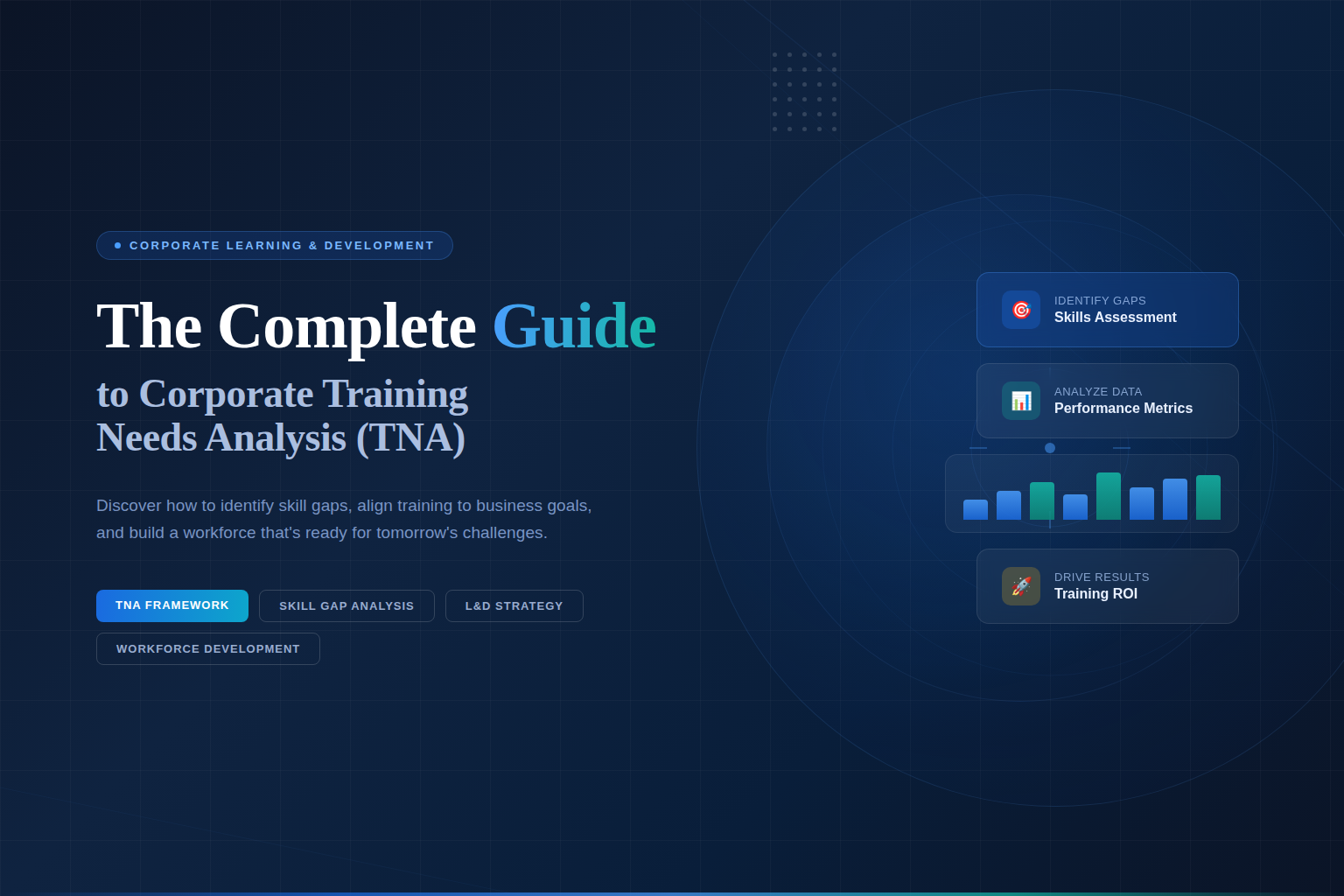
The Complete Guide to Corporate Training Needs Analysis (TNA)

In today’s rapidly evolving business environment, organizations constantly face new challenges related to workforce skills, technology changes, leadership development, and employee productivity. Companies invest significant resources in corporate training programs to improve employee performance, develop future leaders, and maintain competitive advantage. However, many training initiatives fail to deliver measurable results because they are not aligned with the actual needs of the organization.

This is where Training Needs Analysis (TNA) becomes a critical step in the learning and development process. Training Needs Analysis helps organizations identify skill gaps, determine the right training interventions, and ensure that learning initiatives align with business objectives.
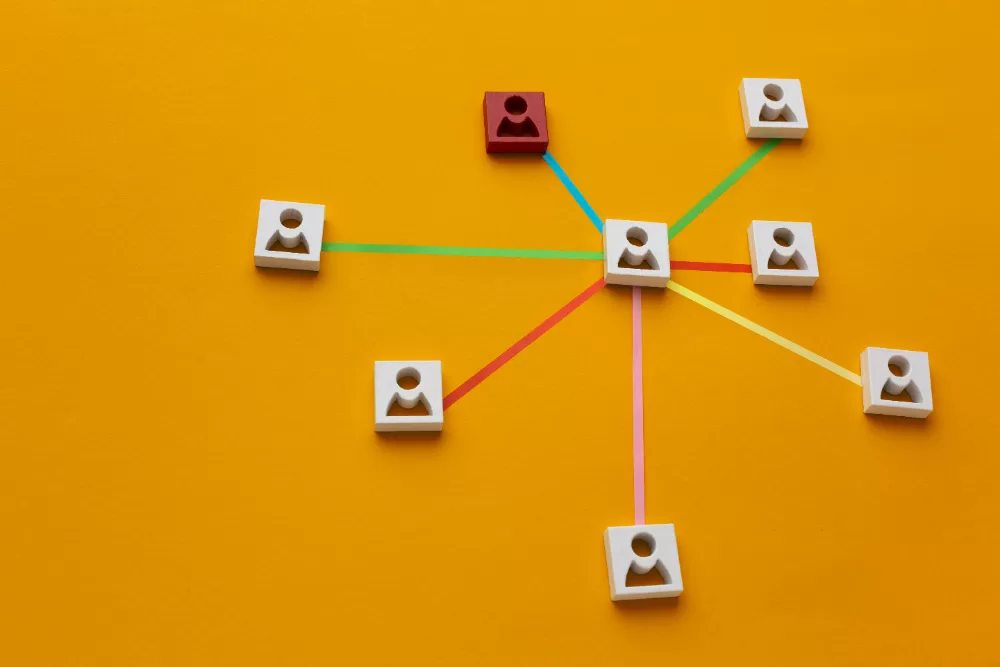
When companies skip this important step, they often implement generic training programs that fail to address real challenges employees face in their daily work. As a result, training budgets are wasted, employee engagement decreases, and organizations struggle to see a return on investment.

In this comprehensive guide, we will explore everything organizations need to know about Training Needs Analysis. We will discuss what TNA is, why it is essential for successful corporate training programs, the steps involved in conducting an effective needs assessment, and the tools organizations can use to identify learning gaps.

What is Training Needs Analysis (TNA)?

Training Needs Analysis (TNA) is a systematic process used by organizations to identify the gap between the current skills and competencies of employees and the skills required to achieve organizational goals. It helps determine what training is necessary, who needs the training, and how the training should be delivered.

The main objective of TNA is to ensure that training programs are not implemented randomly but are strategically aligned with business priorities and employee development needs.

A well-executed Training Needs Analysis helps organizations answer several critical questions:

  • What skills and competencies are required to achieve business goals?
  • What skills do employees currently possess?
  • Where are the gaps between current performance and expected performance?
  • Which employees or teams require training?
  • What type of training intervention will address the identified skill gaps?

By identifying these factors, organizations can design targeted learning interventions that improve performance and contribute directly to business success.

Why Training Needs Analysis is Important for Corporate Training

Corporate training programs are designed to improve employee skills, enhance productivity, and develop leadership capabilities. However, training programs that are not based on actual needs often fail to deliver meaningful results.

Training Needs Analysis ensures that learning initiatives are relevant, strategic, and impactful.

1. Aligns Training with Business Objectives

One of the biggest advantages of Training Needs Analysis is that it connects learning initiatives with business goals. When training programs support organizational objectives such as improving customer experience, increasing sales performance, or developing leadership capabilities, they deliver measurable value.

2. Identifies Skill Gaps

TNA helps organizations identify gaps between the current capabilities of employees and the skills required to perform effectively. These insights allow organizations to focus their training efforts on areas that require improvement.

3. Improves Employee Performance

By addressing specific skill gaps, training programs become more practical and relevant. Employees gain the skills they need to perform their roles more effectively, leading to improved productivity and performance.

4. Optimizes Training Budgets

Organizations often spend large budgets on training programs that do not deliver results. Training Needs Analysis ensures that investments are directed toward the most impactful learning initiatives.

5. Increases Employee Engagement

Employees are more likely to engage in training programs that address real workplace challenges. When training programs are relevant and practical, employees see them as valuable opportunities for professional growth.

Common Reasons Why Corporate Training Fails Without TNA

Many organizations implement training programs without conducting a proper needs assessment. As a result, the training fails to address actual performance challenges.

Some common reasons why training initiatives fail include:

  • Training programs are not aligned with organizational goals.
  • Employees receive training that is not relevant to their roles.
  • Training content is too generic.
  • There is no clear measurement of training effectiveness.
  • Managers are not involved in the training process.

Training Needs Analysis helps prevent these issues by ensuring that training initiatives are carefully planned and aligned with organizational priorities.

The 5 Step Process to Conduct Training Needs Analysis

Conducting an effective Training Needs Analysis requires a structured approach. Organizations typically follow a five-step process to identify training requirements.

Step 1: Identify Organizational Goals

The first step in Training Needs Analysis is understanding the strategic objectives of the organization. Training programs should support these goals and contribute to business success.

Examples of organizational goals may include:

  • Improving customer satisfaction
  • Increasing sales performance
  • Developing leadership capabilities
  • Enhancing communication and collaboration
  • Strengthening employee engagement

By aligning training initiatives with these goals, organizations ensure that learning programs contribute to measurable business outcomes.

Step 2: Analyze Job Roles and Competencies

The next step is to analyze the skills and competencies required for different job roles within the organization. Each role requires specific knowledge, technical abilities, and behavioral competencies.

This analysis typically includes reviewing:

  • Job descriptions
  • Performance expectations
  • Key responsibilities
  • Required technical and behavioral skills

Understanding these requirements helps organizations define the skills employees must possess to perform their roles effectively.

Step 3: Assess Current Employee Skills

Once the required competencies are identified, organizations need to assess the current capabilities of employees. This helps determine where skill gaps exist.

Common methods used for skill assessment include:

  • Employee surveys
  • Performance reviews
  • Manager feedback
  • Self-assessments
  • Skill testing

These evaluation methods provide insights into employee strengths and areas that require improvement.

Step 4: Identify Skill Gaps

The comparison between required skills and current employee capabilities reveals the skill gaps that need to be addressed through training.

For example:

  • Managers may need leadership development training.
  • Employees may require communication skills training.
  • Sales teams may need negotiation and persuasion training.
  • Teams may need conflict resolution or emotional intelligence training.

Identifying these gaps ensures that training programs are targeted and effective.

Step 5: Design and Implement Training Programs

After identifying training needs, organizations can design learning programs that address the specific skill gaps.

Training interventions may include:

  • Instructor-led training workshops
  • Leadership development programs
  • Communication skills training
  • Emotional intelligence training
  • Coaching and mentoring sessions
  • Online learning modules

The key objective is to create training programs that are practical, engaging, and aligned with workplace challenges.

Tools Used for Training Needs Analysis

Organizations use various tools and techniques to conduct Training Needs Analysis effectively.

Employee Surveys

Surveys help collect insights directly from employees about the challenges they face and the skills they want to develop.

Performance Data Analysis

Analyzing productivity data, sales performance, and customer feedback can reveal areas where employees need training.

Manager Interviews

Managers provide valuable insights into team performance and skill gaps.

Focus Group Discussions

Group discussions allow employees to share experiences and identify common challenges.

Skill Assessment Tests

Structured assessments help evaluate specific competencies such as communication, leadership, and problem-solving.

Real Example of Training Needs Analysis in Leadership Development

Consider an organization experiencing declining team productivity and employee engagement. Management suspects that leadership capabilities among mid-level managers may be contributing to these challenges.

The organization conducts a Training Needs Analysis using employee surveys, manager interviews, and performance data analysis. The results reveal three major skill gaps among managers:

  • Communication and feedback skills
  • Conflict resolution capabilities
  • Emotional intelligence in leadership

Based on these insights, the organization implements a targeted leadership development program focusing on these competencies.

Within six months of the training intervention, the company observes:

  • Improved team collaboration
  • Higher employee engagement
  • Better conflict resolution
  • Increased productivity

This example demonstrates how Training Needs Analysis ensures that learning programs address real organizational challenges.

Measuring the Effectiveness of Training Programs

After implementing training programs based on TNA, organizations must measure their effectiveness to determine whether the training achieved its objectives.

The most widely used model for evaluating training effectiveness is the Kirkpatrick Model.

Kirkpatrick Model

  • Reaction: Participant feedback about the training program.
  • Learning: Knowledge or skills acquired during training.
  • Behavior: Changes in workplace behavior after training.
  • Results: Impact on business outcomes.

Measuring training effectiveness ensures continuous improvement in learning initiatives.

Best Practices for Effective Training Needs Analysis

Organizations can maximize the effectiveness of Training Needs Analysis by following these best practices:

  • Align training initiatives with strategic business goals.
  • Involve leadership and managers in the assessment process.
  • Use multiple data sources to identify skill gaps.
  • Focus on practical workplace challenges.
  • Continuously review and update training strategies.

A strategic approach to Training Needs Analysis ensures that training programs remain relevant and impactful.

Conclusion

Training Needs Analysis is a critical step in designing effective corporate training programs. By identifying skill gaps, aligning training initiatives with business objectives, and implementing targeted learning interventions, organizations can significantly improve employee performance and business outcomes.

Organizations that prioritize structured learning and development strategies are better positioned to build high-performing teams, develop strong leaders, and achieve sustainable growth.

In today’s competitive business environment, companies that invest in the right training initiatives gain a significant advantage by developing skilled, confident, and motivated employees.


Book a Demo

Looking to identify the right training needs for your team and design impactful learning programs?

Insite Learning Solutions specializes in customized corporate training programs that help organizations develop leadership capabilities, improve workplace communication, and build high-performing teams.

Our expert trainers work closely with organizations to conduct Training Needs Analysis and design tailored training solutions that deliver measurable results.

Book a Demo

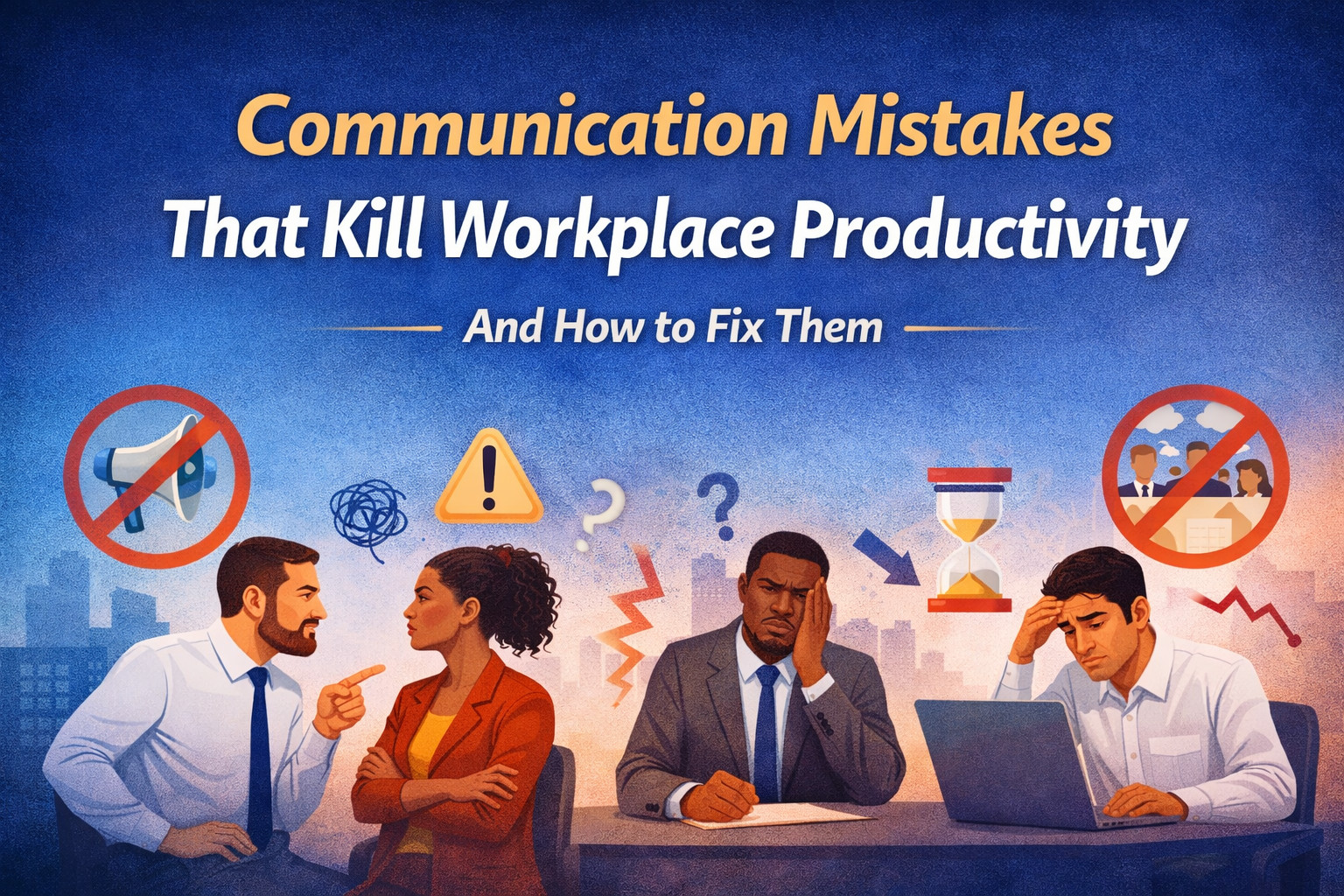
Communication Mistakes That Kill Workplace Productivity (And How to Fix Them)

Communication is the backbone of every successful organization. Yet, despite advanced collaboration tools, structured reporting systems, and regular meetings, workplace productivity continues to suffer due to one major issue — poor communication.

In 2026, businesses operate in hybrid environments, cross-functional teams, and fast-moving markets. In such an ecosystem, even small communication gaps can lead to project delays, low employee engagement, duplication of work, and costly misunderstandings.

The reality is simple: productivity does not decline because employees lack skill. It declines because expectations are unclear, feedback is inconsistent, and conversations are ineffective.

This article explores the most common communication mistakes that kill workplace productivity and provides practical solutions leaders and managers can implement immediately.

Why Communication Directly Impacts Productivity

Before diving into mistakes, it is important to understand why communication is directly linked to performance.

Effective communication ensures:

  • Clarity of expectations
  • Alignment of goals
  • Faster decision-making
  • Reduced conflict
  • Higher engagement
  • Stronger collaboration

When communication breaks down, teams lose focus, morale declines, and productivity suffers. Now let’s examine the communication mistakes that silently damage workplace efficiency.

1. Lack of Clear Expectations

One of the biggest productivity killers is unclear direction. When managers fail to clearly define roles, deliverables, timelines, and success criteria, employees are left guessing.

This often results in:

  • Rework and corrections
  • Missed deadlines
  • Confusion about priorities
  • Low confidence in leadership

How to Fix It

Leaders must communicate expectations clearly and confirm understanding. This includes:

  • Defining measurable outcomes
  • Setting realistic deadlines
  • Clarifying roles and responsibilities
  • Encouraging questions for alignment

Clarity eliminates ambiguity, and clarity drives productivity.

2. Poor Listening Skills

Communication is not just about speaking; it is about listening. Many managers listen to respond, not to understand.

Poor listening leads to:

  • Misinterpretation of employee concerns
  • Overlooked ideas and innovation
  • Decreased morale
  • Repeated mistakes

How to Fix It

Practice active listening:

  • Maintain eye contact (even in virtual meetings)
  • Avoid interrupting
  • Paraphrase for clarity
  • Ask follow-up questions

When employees feel heard, engagement and accountability increase.

3. Overcommunication Without Structure

While undercommunication is harmful, overcommunication without structure is equally damaging.

Too many meetings, excessive emails, and constant notifications overwhelm employees and reduce deep work time.

How to Fix It

  • Set clear meeting agendas
  • Limit meeting duration
  • Use written updates instead of unnecessary calls
  • Define communication channels for specific purposes

Smart communication improves focus and efficiency.

4. Avoiding Difficult Conversations

Many leaders avoid difficult conversations related to performance issues, behavioral concerns, or conflicts. This avoidance creates resentment and lowers team standards.

Unaddressed issues often escalate, affecting overall productivity.

How to Fix It

Address issues early and constructively:

  • Focus on behavior, not personality
  • Be specific and solution-oriented
  • Maintain respect and professionalism
  • Provide improvement pathways

Direct conversations prevent long-term damage.

5. Inconsistent Feedback

Employees perform better when they receive regular feedback. Inconsistent or delayed feedback leads to confusion and disengagement.

Without feedback, employees do not know if they are meeting expectations.

How to Fix It

  • Provide ongoing feedback, not just annual reviews
  • Balance positive reinforcement with constructive input
  • Recognize achievements publicly
  • Offer developmental guidance privately

Feedback fuels growth and performance improvement.

6. Communication Silos Between Departments

In many organizations, departments operate independently with limited cross-functional communication. This creates duplication of efforts and strategic misalignment.

How to Fix It

  • Encourage cross-department meetings
  • Use collaborative project tools
  • Align goals across teams
  • Promote transparency in updates

Collaboration enhances efficiency and innovation.

7. Emotional Reactions Instead of Professional Responses

Leaders who react emotionally during stress damage team morale. Emotional outbursts create fear and reduce open communication.

How to Fix It

  • Pause before responding
  • Practice emotional intelligence
  • Maintain professionalism under pressure
  • Address issues calmly and constructively

Emotional control strengthens leadership credibility.

8. Lack of Transparency

When leadership withholds information unnecessarily, employees feel disconnected from organizational direction.

Lack of transparency leads to rumors and distrust.

How to Fix It

  • Share relevant updates openly
  • Communicate business goals clearly
  • Explain the reasoning behind decisions
  • Encourage open Q&A sessions

Transparency builds trust and alignment.

9. Ignoring Non-Verbal Communication

Non-verbal cues such as tone, body language, and facial expressions significantly influence communication effectiveness.

In virtual environments, tone becomes even more critical.

How to Fix It

  • Be mindful of tone in emails and messages
  • Maintain positive body language
  • Observe team reactions during discussions
  • Use video calls when clarity is essential

Non-verbal awareness enhances clarity and connection.

10. No Communication Training for Managers

Many organizations assume managers naturally possess strong communication skills. However, communication is a skill that must be developed intentionally.

Without structured training, leaders repeat ineffective patterns.

How to Fix It

  • Invest in communication skills training
  • Conduct leadership development programs
  • Offer coaching and mentoring support
  • Measure communication effectiveness through feedback surveys

Training transforms communication from reactive to strategic.

The Business Cost of Poor Communication

Communication breakdowns can result in:

  • Reduced employee engagement
  • Higher turnover rates
  • Lower productivity
  • Increased conflict
  • Project delays
  • Reputational damage

Improving workplace communication is not just a soft skill initiative—it is a business performance strategy.

Building a Culture of Effective Communication

Organizations must foster a culture where open dialogue, feedback, and collaboration are encouraged at every level.

This includes:

  • Encouraging psychological safety
  • Promoting transparency
  • Training leaders in emotional intelligence
  • Implementing structured communication systems

When communication improves, productivity naturally increases.

Conclusion: Communication Drives Organizational Success

Communication mistakes silently erode productivity, morale, and performance. However, with intentional effort and structured leadership development, these challenges can be corrected.

Organizations that prioritize communication skills training empower managers to lead with clarity, empathy, and strategic alignment.

Strong communication does not just improve conversations—it transforms culture and results.

Contact Us to Strengthen Workplace Communication

If your organization wants to eliminate communication gaps and improve team productivity, we can help.

Our structured communication skills training and leadership development programs are designed to enhance clarity, emotional intelligence, and cross-functional collaboration.

We partner with organizations to create customized training solutions that drive measurable impact.

Ready to transform communication across your organization?

Contact us today to explore how we can support your communication and leadership development initiatives.

Top 10 Essential Leadership Skills Every Manager Must Master in 2026

Leadership in 2026 looks very different from what it did a decade ago. The role of a manager is no longer limited to supervising tasks, tracking KPIs, or ensuring deadlines are met. Today’s leaders are expected to inspire teams, manage complexity, navigate digital transformation, and build cultures rooted in trust and accountability.

As organizations adapt to hybrid work models, artificial intelligence, diverse workforces, and rapidly changing markets, the demand for strong leadership skills has never been higher. Businesses that invest in structured leadership development and leadership training programs are the ones building sustainable competitive advantage.

This comprehensive guide explores the 10 essential leadership skills every manager must master in 2026 to drive employee engagement, performance excellence, and long-term organizational growth.

The Evolution of Leadership in the Modern Workplace

The workplace has undergone a massive transformation. Managers today operate in environments defined by:

  • Hybrid and remote work ecosystems
  • Technology-driven collaboration
  • Multi-generational and cross-cultural teams
  • Higher employee expectations for purpose and flexibility
  • Continuous change and innovation cycles

In such a dynamic environment, leadership is no longer about authority—it is about influence, emotional intelligence, and adaptability. The managers who thrive in 2026 are those who can align people, strategy, and culture seamlessly.

1. Emotional Intelligence: The Foundation of Effective Leadership

Emotional intelligence (EQ) is widely recognized as the cornerstone of modern leadership. Managers with high emotional intelligence understand their own emotions and can effectively manage interpersonal relationships.

Key Components of Emotional Intelligence

  • Self-awareness: Understanding personal strengths, weaknesses, and triggers.
  • Self-regulation: Managing emotions in high-pressure situations.
  • Empathy: Recognizing and responding to others’ emotions.
  • Social skills: Building trust and strong relationships.

Leaders with strong emotional intelligence create psychologically safe environments where employees feel heard and valued. This directly impacts retention, collaboration, and productivity.

2. Advanced Communication Skills

Communication is one of the most critical leadership skills in 2026. Managers must navigate virtual meetings, cross-functional collaboration, crisis communication, and performance feedback with clarity and confidence.

Effective communication involves:

  • Active listening
  • Clear and concise messaging
  • Managing tone and body language
  • Delivering constructive feedback
  • Handling difficult conversations professionally

Organizations often underestimate the cost of poor communication. Misalignment, delays, and disengagement are frequently the result of unclear messaging. Strong communication skills enable leaders to align teams around shared goals.

3. Adaptability and Change Leadership

Change is constant. Whether it is digital transformation, restructuring, new technologies, or market disruption, managers must lead teams through uncertainty.

Adaptable leaders:

  • Remain calm during disruption
  • Communicate the purpose behind change
  • Encourage innovation
  • Support employees through transitions

Resistance to change often stems from fear of the unknown. Leaders who communicate transparently and provide support can reduce resistance and build resilience within teams.

4. Coaching and Talent Development

In 2026, managers are expected to develop people, not just manage performance. Employees seek growth opportunities, mentorship, and skill development.

Coaching-focused leaders:

  • Provide regular and actionable feedback
  • Encourage self-reflection
  • Support career progression planning
  • Recognize and nurture strengths

Organizations that prioritize leadership coaching see higher engagement and stronger succession pipelines.

5. Strategic Thinking and Decision-Making

Managers must think beyond daily operations and align team activities with long-term strategic objectives.

Strategic leadership involves:

  • Analyzing data effectively
  • Balancing short-term needs with long-term vision
  • Evaluating risks and opportunities
  • Making timely, informed decisions

In an AI-driven business environment, decision-making requires both analytical capability and human judgment. Strong leaders combine data with insight.

6. Conflict Resolution and Difficult Conversations

Conflict is inevitable in diverse teams. What differentiates strong leaders is how they manage it.

Effective conflict resolution requires:

  • Addressing issues early
  • Maintaining objectivity
  • Encouraging open dialogue
  • Focusing on solutions rather than blame

Managers who handle difficult conversations with empathy and clarity strengthen team trust and collaboration.

7. Influence Without Authority

In matrix organizations and cross-functional environments, managers often lead stakeholders without direct reporting relationships.

Influential leaders:

  • Build credibility through expertise
  • Establish strong professional relationships
  • Align interests across departments
  • Communicate value effectively

Influence is earned through trust and consistency, not position alone.

8. Inclusive and Empathetic Leadership

Diversity drives innovation, but inclusion drives performance. Managers must foster environments where every individual feels respected and valued.

Inclusive leaders:

  • Encourage diverse perspectives
  • Create psychological safety
  • Address bias consciously
  • Promote equal opportunity

Empathetic leadership builds belonging, which directly impacts team morale and productivity.

9. Accountability and Ownership

High-performance cultures are built on accountability. Leaders must set clear expectations and model responsibility.

Strong accountability practices include:

  • Defining measurable goals
  • Monitoring progress consistently
  • Encouraging ownership mindset
  • Recognizing achievements

When leaders hold themselves accountable, teams mirror the behavior.

10. Continuous Learning and Self-Awareness

Leadership development is an ongoing process. The most effective managers are lifelong learners.

Future-ready leaders:

  • Seek constructive feedback
  • Invest in leadership training programs
  • Stay updated with industry trends
  • Reflect on leadership effectiveness regularly

Self-awareness enhances decision-making, communication, and adaptability.

The Business Impact of Strong Leadership Development

Organizations that invest in structured leadership development programs experience measurable business benefits:

  • Higher employee engagement
  • Reduced attrition
  • Improved productivity
  • Stronger innovation culture
  • Better cross-functional collaboration
  • Enhanced customer satisfaction

Leadership capability directly influences organizational growth. Companies that neglect leadership training often struggle with disengagement, poor communication, and low morale.

Preparing Leaders for the Future of Work

The future of work demands leaders who are emotionally intelligent, strategically aware, and adaptable to rapid change. Organizations must move beyond one-time workshops and implement structured leadership development journeys that include coaching, experiential learning, and measurable outcomes.

Building leadership capability is not an expense—it is a strategic investment in long-term success.

Conclusion: Leadership is Defined by Impact

In 2026, leadership is not defined by title or authority. It is defined by the ability to influence, inspire, and empower others.

Managers who master these 10 essential leadership skills will build resilient teams capable of navigating uncertainty and delivering sustained results.

The future belongs to leaders who combine clarity with empathy, strategy with adaptability, and confidence with humility.

Contact Us to Build Future-Ready Leaders

If your organization is looking to strengthen leadership capability and prepare managers for the future of work, we can help.

Our structured leadership development and corporate training programs are designed to enhance emotional intelligence, communication, strategic thinking, and people management skills.

We partner with organizations to create customized leadership journeys that drive measurable impact.

Ready to build stronger leaders?

Contact us today to explore how we can support your leadership development initiatives and transform managerial performance across your organization.

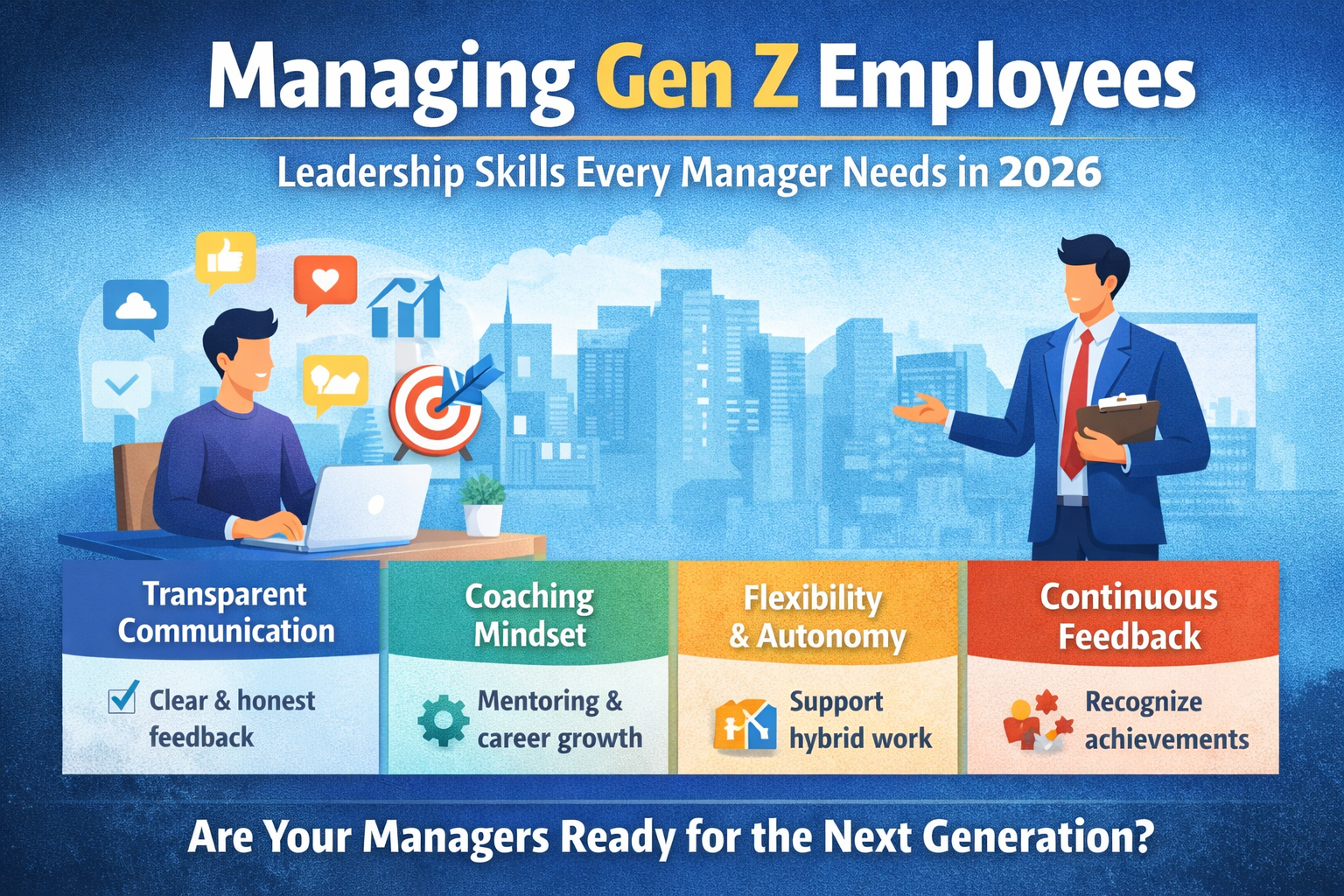
Gen Z at Work: How Managers Must Adapt Their Leadership Style

The modern workplace is going through one of the biggest generational transitions in history. As we approach 2026, Generation Z is rapidly becoming a dominant part of the global workforce. Organizations across industries are hiring Gen Z employees in large numbers, and this shift is transforming how companies think about leadership, communication, workplace culture, and employee development.

Born between the mid-1990s and early 2010s, Gen Z is the first generation to grow up fully immersed in digital technology. They entered the workforce during a time shaped by rapid digital transformation, global uncertainty, remote work, and evolving social values. As a result, their expectations from employers and managers are very different from previous generations.

For organizations, this change presents both opportunity and challenge. Companies that understand how to manage Gen Z employees effectively can unlock innovation, creativity, and long-term loyalty. Those that fail to adapt risk high turnover, disengagement, and talent shortages.

This comprehensive guide explores how Gen Z is reshaping the workplace, why traditional management approaches no longer work, and the leadership skills managers must develop to build high-performing, future-ready teams.

Understanding Gen Z in the Workplace

Gen Z employees are often described as digital natives, but their identity goes far beyond technology. Their upbringing in a rapidly changing world has shaped how they view work, leadership, and career growth.

They have witnessed economic uncertainty, global pandemics, and rapid technological disruption at an early age. These experiences have influenced how they define job security, success, and purpose.

  • They seek meaningful and purpose-driven work
  • They expect continuous learning and growth opportunities
  • They value diversity, inclusion, and fairness
  • They prefer open and transparent communication
  • They prioritize flexibility and work-life balance

Unlike previous generations, Gen Z does not see work as separate from personal life. They want workplaces that support well-being, growth, and personal development alongside professional success.

The Generational Shift Reshaping Leadership

For decades, organizations relied on hierarchical leadership models. Managers were expected to give instructions, monitor performance, and enforce rules. This approach worked in predictable environments but struggles in today’s dynamic, people-centric workplaces.

Gen Z expects a different kind of leadership. They value influence over authority and collaboration over hierarchy. They want leaders who listen, support, and guide rather than control.

This shift requires managers to evolve from supervisors into mentors, coaches, and facilitators.

Why Traditional Management Styles Fail with Gen Z

Many organizations still rely on outdated management practices that unintentionally disengage younger employees.

  • Top-down decision making limits participation
  • Annual feedback cycles feel outdated
  • Rigid workplace policies reduce flexibility
  • Lack of purpose decreases motivation

Gen Z employees want to feel heard, valued, and involved in decisions that affect their work. When these expectations are not met, engagement drops quickly.

Key Leadership Skills Required to Manage Gen Z Employees

1. Transparent and Authentic Communication

Communication expectations have changed dramatically. Gen Z grew up with instant messaging, social media, and real-time information. They expect the same level of transparency in the workplace.

  • Clearly communicate goals and expectations
  • Explain the “why” behind decisions
  • Encourage open discussions and idea sharing
  • Create a culture of transparency

Managers who communicate openly build stronger trust and engagement.

2. Coaching and Mentoring Mindset

Gen Z sees managers as mentors who support career growth and development. They expect guidance, feedback, and learning opportunities.

  • Provide career development conversations
  • Offer regular learning opportunities
  • Encourage skill development
  • Support long-term growth planning

3. Emotional Intelligence and Empathy

Emotional intelligence is a core leadership skill in modern workplaces.

  • Practice empathy and active listening
  • Understand employee motivations
  • Create psychological safety
  • Handle difficult conversations constructively

4. Flexibility and Hybrid Work Leadership

Gen Z values flexibility and autonomy. Hybrid and remote work models are highly attractive to this generation.

  • Focus on outcomes rather than hours
  • Support hybrid and remote work models
  • Encourage autonomy and ownership

5. Continuous Feedback and Recognition

Gen Z prefers frequent feedback rather than annual reviews.

  • Provide real-time feedback
  • Recognize achievements regularly
  • Celebrate progress and milestones

How Gen Z Is Transforming Workplace Culture

Gen Z employees are not just adapting to workplaces — they are actively transforming them.

They advocate for inclusion, mental well-being, sustainability, and meaningful work. Organizations that embrace these values build stronger cultures and attract top talent.

The Business Impact of Managing Gen Z Effectively

  • Higher employee engagement
  • Reduced turnover and hiring costs
  • Improved innovation and creativity
  • Stronger employer brand
  • Better collaboration and teamwork

Common Mistakes Managers Must Avoid

  • Assuming younger employees lack commitment
  • Providing limited feedback
  • Ignoring career development needs
  • Resisting flexible work models
  • Using outdated communication styles

Preparing Leaders for the Future Workforce

Organizations must invest in leadership development programs that equip managers with modern leadership skills. Training in emotional intelligence, communication, coaching, and hybrid leadership is essential.

Conclusion

Gen Z is shaping the future of work. Organizations that adapt their leadership strategies will attract, engage, and retain the next generation of talent.

If your organization wants to prepare managers to lead the modern workforce, we can help.

Book a free consultation to explore our leadership and communication training programs.

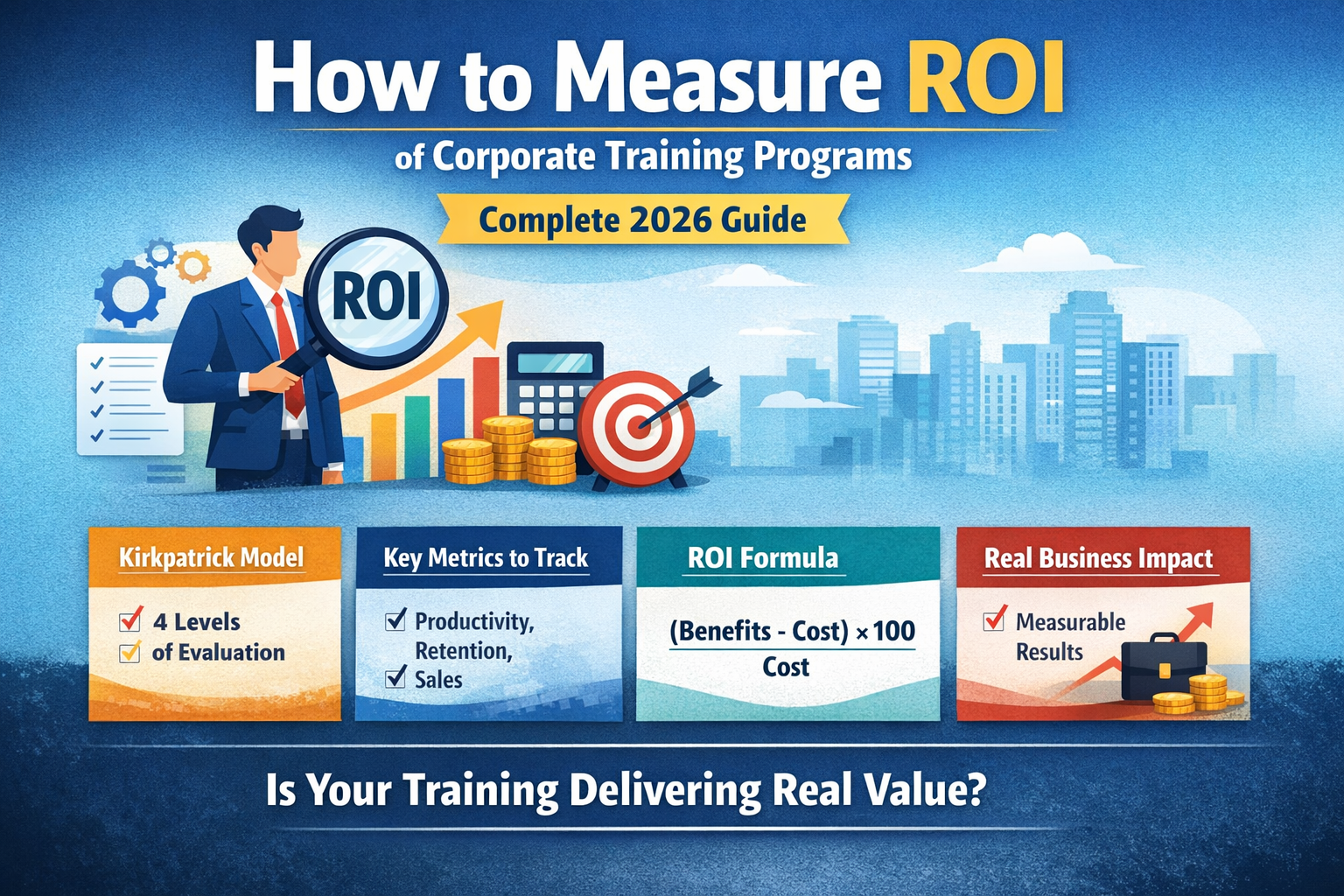
How to Measure ROI of Corporate Training Programs (Complete 2026 Guide)

Corporate training has become a strategic investment for organizations worldwide. Companies today invest heavily in leadership development, emotional intelligence, communication skills, and employee upskilling. However, one question continues to dominate conversations among CEOs, HR leaders, and business heads: How do we measure the ROI of corporate training?

As organizations move into 2026, training budgets are increasingly expected to deliver measurable results. Leaders are no longer satisfied with attendance reports and feedback forms. They want clear evidence that training programs improve productivity, reduce attrition, strengthen leadership, and contribute to business growth.

If you are an HR leader, L&D professional, or senior decision-maker looking to justify and measure the impact of your training investments, this guide will help you understand how to measure training effectiveness and connect learning outcomes to business performance.

Why Measuring Training ROI Is Now Essential

In the past, training success was often evaluated using simple feedback surveys. Participants were asked whether they enjoyed the session or found it useful. While positive feedback is encouraging, it does not demonstrate business impact.

Today’s organizations expect training to deliver measurable outcomes such as improved performance, higher engagement, better customer experiences, and stronger leadership pipelines. Without measurable impact, training budgets are often the first to face scrutiny.

Measuring training ROI ensures that learning initiatives are aligned with business goals and contribute directly to organizational success.

What Does ROI of Corporate Training Mean?

ROI, or Return on Investment, helps organizations understand the value generated from their training spend. It answers a simple but powerful question: For every rupee invested in training, how much value does the organization gain?

The basic formula used to calculate training ROI is:

ROI (%) = (Training Benefits − Training Cost) ÷ Training Cost × 100

While the formula is straightforward, the challenge lies in identifying and measuring the business benefits created by training programs.

The Kirkpatrick Model for Evaluating Training Effectiveness

The most widely used framework for measuring training ROI is the Kirkpatrick Four-Level Model. It provides a structured approach to evaluate training from participant reaction to business impact.

Level 1: Reaction – Participant Feedback

This level measures how participants feel about the training experience.

  • Training satisfaction surveys
  • Engagement levels
  • Perceived relevance of the training

Although important, positive feedback alone does not indicate business results.

Level 2: Learning – Knowledge and Skill Improvement

This stage measures what participants have learned.

  • Pre- and post-training assessments
  • Skill evaluations
  • Certification completion

This helps determine whether training has successfully built new knowledge or skills.

Level 3: Behavior – Application at Work

This level evaluates whether employees apply new skills in the workplace.

  • Manager observations
  • Performance reviews
  • 360-degree feedback

This stage connects learning to real workplace behavior.

Level 4: Results – Business Impact

This is the most important level of evaluation. It measures the impact of training on business outcomes.

  • Productivity improvements
  • Employee retention
  • Customer satisfaction
  • Sales growth

At this stage, training becomes a measurable business investment.

Key Metrics Used to Measure Training ROI

Employee Productivity

Training improves efficiency, time management, and decision-making.

  • Output per employee
  • Task completion speed
  • Error reduction

Employee Retention

Organizations that invest in employee development experience lower attrition and higher engagement.

  • Attrition rate comparison
  • Employee engagement scores

Leadership Effectiveness

Leadership training improves team performance and workplace culture.

  • Manager effectiveness ratings
  • Internal promotions
  • Team engagement scores

Customer Experience

Soft skills training directly influences customer satisfaction.

  • Customer satisfaction scores
  • Complaint reduction
  • Customer retention rates

Sales Performance

Training improves communication, negotiation, and customer engagement.

  • Conversion rates
  • Revenue growth
  • Sales cycle reduction

Example of Training ROI Calculation

Consider an organization that invests ₹10,00,000 in leadership training.

  • Reduced attrition saves ₹6,00,000
  • Improved productivity adds ₹5,00,000 value
  • Reduced customer complaints save ₹3,00,000

Total Benefits: ₹14,00,000

Training ROI: 40%

This demonstrates how training contributes directly to business results.

Common Mistakes in Measuring Training Impact

  • Measuring results too early
  • Focusing only on feedback surveys
  • Lack of baseline performance data
  • No post-training reinforcement

Best Practices to Maximize Training ROI

  • Align training with business goals
  • Define measurable KPIs before training
  • Involve managers in reinforcement
  • Track outcomes over time

Why Soft Skills Training Delivers Long-Term Value

Technical skills evolve quickly, but human skills create lasting impact. Leadership, communication, emotional intelligence, and collaboration drive long-term business performance.

Organizations that invest in these capabilities build stronger cultures, higher engagement, and better business outcomes.

Conclusion

Corporate training is no longer an optional expense. It is a strategic investment that drives productivity, engagement, and business growth. When measured correctly, training delivers clear and measurable ROI.

If your organization is ready to design training programs that deliver real business impact, we’re here to help.

Book a free consultation to explore how our corporate training programs can help your organization achieve measurable results.

Microlearning and Bite-Sized Skill Boosters: The Future of Workplace Learning

Workplace learning is changing fast. Employees today are busy with deadlines, meetings, and constant communication. Because of this, long training sessions and full-day workshops are becoming difficult to attend and even harder to remember.

This is where microlearning and bite-sized skill boosters are becoming the future of corporate training.

Microlearning focuses on small, focused learning units that employees can complete quickly and apply immediately at work.

What Is Microlearning?

Microlearning is a learning approach where content is delivered in short, simple, and focused pieces.

Instead of long presentations and heavy theory, microlearning uses:

  • Short videos (3 to 7 minutes)
  • Quick quizzes
  • Simple case scenarios
  • Daily learning tips
  • Short practice exercises

Each microlearning module focuses on one clear objective, making learning easier to understand and remember.

Why Traditional Corporate Training Is Losing Impact

Traditional training methods were designed for a different workplace environment. They often involve long classroom sessions, lengthy presentations, and information overload.

Common challenges with traditional training include:

  • Low attention and engagement
  • Employees forgetting content quickly
  • Difficulty attending long sessions
  • Limited real-world application

Microlearning addresses these challenges by delivering learning in small, repeatable, and relevant formats.

Why Microlearning Works So Well

Short Attention Spans

People focus better when learning content is short. Microlearning respects this by keeping lessons simple and concise.

One Concept at a Time

Each module focuses on a single idea, reducing confusion and improving understanding.

Better Memory Retention

Small chunks of information are easier to remember and recall.

Immediate Application

Employees can apply what they learn immediately in their daily work.

Microlearning vs Traditional Learning

Traditional LearningMicrolearning
Long training sessionsShort learning bursts
One-time eventsContinuous learning
Heavy theoryPractical and focused
Low retentionHigh retention

Role of Microlearning in Modern Workplace Learning

Modern organizations need training that is fast, flexible, and scalable. Microlearning fits well with remote work, hybrid teams, and mobile learning.

Employees can learn anytime and anywhere, without disrupting their daily work.

Types of Microlearning Content Used in Organizations

Short Videos

Short videos explain a single concept clearly and quickly.

Micro Quizzes

Short quizzes help reinforce learning and improve retention.

Daily Learning Nudges

Small learning reminders encourage continuous improvement.

Scenario-Based Learning

Real-life scenarios help learners practice decision-making skills.

Infographics and Checklists

Visual summaries make learning easier to understand and share.

Microlearning for Leadership Development

Leadership skills develop over time through regular practice. Microlearning supports leadership development by reinforcing behaviours daily.

Leaders benefit from short lessons on feedback, decision-making, communication, and team management.

Microlearning for Communication Skills

Communication improves through regular practice. Microlearning supports communication training using role-play videos, listening exercises, and feedback scenarios.

Microlearning for Sales and Customer Service Teams

Sales and customer service teams use microlearning for product updates, objection handling, and customer interaction skills.

Microlearning for Behavioural and Soft Skills Training

Soft skills such as emotional intelligence, adaptability, and collaboration improve with continuous reinforcement, which microlearning provides.

Role of Technology and AI in Microlearning

Technology and AI enhance microlearning by recommending relevant content, tracking progress, identifying skill gaps, and suggesting next learning steps.

This ensures employees receive the right learning at the right time.

Benefits of Microlearning for Employees

  • Easy and flexible learning
  • Higher motivation and engagement
  • Immediate workplace application
  • Better knowledge retention

Benefits of Microlearning for Organizations

  • Higher training completion rates
  • Faster skill development
  • Scalable learning programs
  • Better return on training investment

How to Design an Effective Microlearning Program

Define Clear Learning Objectives

Each microlearning module should focus on one clear goal.

Keep Content Simple and Practical

Use real-life examples instead of heavy theory.

Choose the Right Format

Select videos, quizzes, or scenarios based on learning needs.

Encourage Immediate Practice

Ask learners to apply learning in their daily work.

Reinforce Learning Over Time

Use reminders and follow-up activities.

Common Mistakes to Avoid in Microlearning

  • Overloading content in one module
  • Skipping reinforcement and follow-ups
  • Not tracking learning impact
  • Treating microlearning as a standalone solution

The Future of Workplace Learning

The future of workplace learning is continuous, digital-first, and employee-focused. Microlearning supports lifelong learning and adapts to changing skill needs.

Final Thoughts

Microlearning and bite-sized skill boosters are shaping the future of workplace learning. They improve engagement, retention, and real-world performance.

Organizations that adopt microlearning build agile, skilled, and future-ready teams.

About Insite Learning Solutions

Insite Learning Solutions delivers customised corporate training programs focused on leadership development, communication skills, and behavioural excellence.

Through practical and modern learning approaches, Insite helps organizations build confident and capable teams.

How AI Is Reshaping Corporate Training: Trends, Tools, and Future Skills

Corporate training has always played an important role in business growth. But the way people learn at work has changed completely in recent years.

Employees today have less time for long classroom sessions, expect learning to be flexible, and want training that helps them perform better immediately. At the same time, organizations are under pressure to upskill employees faster, prepare leaders for future challenges, and clearly measure training impact.

This is where Artificial Intelligence (AI) is reshaping corporate training.

AI is not a replacement for trainers, coaches, or human interaction. Instead, it acts as a powerful support system that makes learning smarter, more personalized, and more effective.

What Is AI in Corporate Training?

Artificial Intelligence (AI) in corporate training refers to technology that can learn from data and user behaviour to improve learning outcomes.

In simple terms, AI can:

  • Understand how employees learn
  • Track progress automatically
  • Recommend relevant learning content
  • Identify skill gaps
  • Provide insights for better training decisions

Traditional training usually follows a one-size-fits-all approach. AI-powered training, on the other hand, focuses on personalization, flexibility, and measurable outcomes.

Why Corporate Training Needs AI Today

The modern workplace has changed rapidly due to hybrid work models, fast-changing skill requirements, and increasing performance expectations.

Organizations face challenges such as:

  • Limited time for employee training
  • Diverse learning needs across teams
  • Difficulty measuring training ROI
  • Need for continuous skill development

AI helps address these challenges by making corporate training more relevant, flexible, scalable, and data-driven.

Key Benefits of AI in Corporate Training

1. Personalized Learning Experience

AI understands that every employee learns differently. It considers job roles, experience levels, learning behaviour, and performance data to suggest the most relevant training content.

2. Faster Skill Development

AI helps employees focus only on the skills they need. This reduces unnecessary training time and improves productivity.

3. Improved Training ROI

AI provides clear insights into training effectiveness, helping organizations justify learning investments with data.

Major AI Trends Reshaping Corporate Training

1. Personalized Learning Paths

AI creates customized learning journeys based on an employee’s role, skills, and performance. New managers, senior leaders, and frontline employees receive different learning experiences tailored to their needs.

2. AI-Based Skill Gap Analysis

AI analyses job roles, performance data, and training history to identify current and future skill gaps. This allows organizations to plan training proactively.

3. Microlearning Powered by AI

Microlearning delivers content in short formats such as videos, quizzes, and daily tips. AI recommends the right microlearning content at the right time, improving engagement and retention.

4. AI Chatbots in Corporate Learning

AI chatbots act as virtual learning assistants, helping employees find content, answer basic questions, and stay engaged with learning programs.

5. Data-Driven Learning Insights

AI dashboards provide real-time insights into participation, engagement, skill improvement, and program effectiveness.

AI Tools Used in Corporate Training

AI is already integrated into many corporate learning platforms, including:

  • AI-enabled Learning Management Systems (LMS)
  • Adaptive learning platforms
  • Assessment and feedback tools
  • Virtual coaching solutions

These tools are widely used in leadership development, communication skills training, and behavioural learning programs.

AI in Leadership Development Programs

Leadership development is no longer limited to classroom workshops. AI supports leadership training by tracking behaviour patterns, analysing communication styles, and providing personalised coaching insights.

This helps leaders become more self-aware and improve decision-making, collaboration, and people management skills.

AI in Soft Skills and Behavioural Training

Soft skills such as emotional intelligence, communication, adaptability, and teamwork are becoming more important than ever.

AI helps by identifying behavioural gaps, tracking progress over time, and supporting personalised practice. However, human trainers remain essential for coaching, mentoring, and emotional connection.

Future Skills Needed in an AI-Driven Workplace

1. Emotional Intelligence (EQ)

AI cannot replace empathy, human understanding, or emotional awareness. These skills will always be critical.

2. Critical Thinking

AI provides data, but humans must interpret it and make ethical, informed decisions.

3. Communication Skills

Clear communication is essential in hybrid, remote, and cross-cultural work environments.

4. Adaptability and Continuous Learning

Employees must be willing to learn continuously as skills and roles evolve.

How Organizations Can Start Using AI in Corporate Training

Organizations can begin with small, practical steps:

  • Identify training challenges
  • Introduce AI-based assessments
  • Implement personalised learning paths
  • Adopt microlearning formats
  • Measure results and refine programs

Common Myths About AI in Corporate Training

Myth 1: AI Will Replace Trainers

AI supports trainers but does not replace human coaching and mentoring.

Myth 2: AI Is Too Complex

Many AI-powered learning tools are user-friendly and easy to adopt.

Myth 3: AI Is Only for Large Enterprises

AI-based training solutions are now accessible to mid-sized organizations as well.

The Role of Human Trainers in an AI-Driven Future

AI handles automation, data analysis, and personalization. Human trainers focus on coaching, mentoring, behaviour change, and building trust.

The future of corporate training lies in combining human expertise with AI-powered insights.

Final Thoughts

AI is reshaping corporate training in a meaningful way. Organizations that embrace AI-powered learning can build stronger leaders, develop future-ready skills, improve training ROI, and create a culture of continuous learning.

AI is not just about technology. It is about using technology to develop people better.

About Insite Learning Solutions

Insite Learning Solutions delivers customised corporate training programs focused on leadership development, emotional intelligence, communication skills, and behavioural excellence.

By combining human expertise with modern learning approaches, Insite helps organizations build confident, capable, and future-ready teams.

Leadership Development in the Modern Workplace: Skills That Matter in 2026

The modern workplace is evolving at an unprecedented pace. Rapid digital transformation, hybrid work environments, shifting employee expectations, and global collaboration have completely changed what it means to lead. In this environment, leadership is no longer defined by authority or hierarchy—it is defined by influence, emotional intelligence, and adaptability.

This is why leadership development in the modern workplace has become a strategic priority for organizations worldwide. As we move toward 2026, companies that invest in future-ready leadership development programs will be better equipped to navigate uncertainty, engage their people, and sustain long-term growth.

If you are a CEO, HR leader, or senior manager looking to strengthen leadership capabilities across your organization, this blog will walk you through the leadership skills that truly matter in 2026, why traditional leadership training often fails, and how structured leadership development programs create real impact.

The Shift from Authority-Based to Influence-Based Leadership

For many years, leadership was built around authority. Managers were expected to give instructions, control outcomes, and enforce compliance. While this approach worked in predictable environments, it is no longer effective in today’s dynamic, people-centric workplaces.

Modern leadership is about influence rather than control. Employees today expect trust, autonomy, and purpose. They are more likely to follow leaders who inspire, listen, and support rather than those who simply issue commands.

Influence-based leadership focuses on building credibility, fostering collaboration, and aligning teams toward a shared vision. Leaders succeed not because of their job title, but because of their ability to earn trust and motivate people to perform at their best.

Why Leadership Development Is Critical in 2026

Organizations across industries are facing increasing complexity. High employee turnover, disengagement, burnout, and constant change have made leadership more challenging than ever. Many of these issues are not operational problems—they are leadership challenges.

As we approach 2026, leaders are expected to manage remote and hybrid teams, lead diverse workforces, and make decisions under uncertainty. Without the right leadership training for managers, even high-performing professionals can struggle in people management roles.

This makes leadership development programs essential—not as one-time workshops, but as ongoing capability-building initiatives.

Core Leadership Skills That Matter in 2026

Emotional Intelligence (EQ)

Emotional intelligence has emerged as one of the most critical leadership skills in the modern workplace. Leaders with strong EQ are better equipped to understand their own emotions, manage stress, and respond thoughtfully to others.

  • Build trust and psychological safety within teams
  • Handle conflict and difficult conversations effectively
  • Demonstrate empathy and active listening
  • Maintain composure under pressure

Adaptability and Learning Agility

The pace of change is no longer slowing down. Leaders must be flexible, open to learning, and willing to adapt their approach based on evolving circumstances.

  • Respond effectively to change and uncertainty
  • Encourage innovation and continuous learning
  • Adjust leadership styles to suit different people and situations

Decision-Making in Complex Environments

Leaders in 2026 will face ambiguity, limited information, and competing priorities. Strong decision-making is not about having all the answers—it is about structured thinking, accountability, and ethical judgment.

  • Make informed decisions under pressure
  • Balance speed with responsibility
  • Involve teams while maintaining accountability

Advanced Communication Skills

Clear and confident communication remains a cornerstone of effective leadership. In hybrid and digital-first workplaces, leaders must be intentional about how they communicate across channels.

  • Communicate vision and expectations clearly
  • Give constructive feedback with empathy
  • Handle difficult conversations with confidence
  • Engage teams across virtual and in-person settings

Coaching and People Development

Modern leaders are expected to develop people, not just manage tasks. Coaching-oriented leadership focuses on empowering employees to grow, take ownership, and perform consistently.

  • Support individual growth and development
  • Encourage accountability and ownership
  • Build strong succession pipelines

Why Traditional Leadership Training Often Fails

Despite significant investments, many organizations struggle to see real behavior change after leadership training. This is often because traditional leadership programs focus more on theory than application.

  • Generic, one-size-fits-all content
  • Lack of real-world workplace relevance
  • No follow-up or reinforcement
  • Minimal focus on behavioral change

Without practical application and ongoing support, leadership training fails to translate into everyday leadership behavior.

How Structured Leadership Development Programs Help

Effective leadership development in the modern workplace requires a structured and customized approach. High-impact leadership development programs focus on real challenges leaders face at work.

  • Customized programs aligned to organizational goals
  • Experiential learning through case studies and role plays
  • Continuous learning rather than one-time interventions
  • Measurement of behavioral and performance outcomes

Such programs help leaders build confidence, improve people management skills, and deliver measurable business results.

Leadership Development as a Strategic Business Investment

Organizations that invest in leadership development programs experience tangible benefits:

  • Higher employee engagement and retention
  • Improved decision-making and accountability
  • Stronger leadership pipelines
  • Healthier and more resilient workplace cultures

In 2026, leadership development will no longer be viewed as an HR initiative—it will be a core business strategy.

Conclusion

Leadership development in the modern workplace is evolving rapidly. As we move toward 2026, organizations need leaders who can influence without authority, lead with emotional intelligence, adapt to change, and develop people effectively.

Traditional leadership training is no longer enough. Structured, practical, and future-ready leadership development programs are essential to build leaders who can thrive in complexity.

If you’re ready to prepare your leaders for the future of work, we’re here to help.

Book a free consultation to explore how our leadership development and leadership training programs for managers can help your organization build confident, capable, and future-ready leaders.

Why Business Communication Workshops Matter More Than Ever

In today’s fast-paced, constantly evolving business environment, strong communication skills are more important than ever. Whether you’re sending an email, delivering a presentation, managing a team, or pitching to a client, the way you communicate can either elevate your professional impact or limit your growth.

This is why business communication workshops have become essential across industries. They are not just about learning how to speak or write better. They are about transforming how teams connect, collaborate, and perform.

If you’re a business leader, HR manager, or team head wondering how to improve communication within your organization, this blog will walk you through the purpose, benefits, and impact of business communication workshops—why they’re worth investing in, what they include, and how they can reshape the way your teams work.

What Are Business Communication Workshops?

At their core, business communication workshops are structured training sessions designed to strengthen communication across all levels of a company. These sessions are typically interactive and practical, focusing on real-world workplace scenarios. Unlike theoretical courses, workshops offer hands-on learning experiences where participants actively engage through role-plays, simulations, discussions, and feedback sessions.

The goal is simple but powerful: to make communication in the workplace more clear, confident, professional, and effective.

Participants walk away with improved speaking and writing skills, greater awareness of body language and tone, and the ability to handle challenging conversations with ease.

Why Are Communication Workshops So Relevant Today?

Communication has always been important. But in today’s workplace, where teams are more diverse, remote work is widespread, and time is always in short supply, communication has become one of the most critical skills for success. Here are a few reasons why:

The Remote Work Reality

Remote and hybrid work has changed how we interact. We’re spending more time on Zoom, Slack, and email than in face-to-face meetings. But virtual communication brings its own challenges—misunderstood tone, poor engagement, and lack of clarity. Workshops help employees adapt their style for virtual settings and improve their ability to build rapport remotely.

Cross-Cultural Collaboration

Many businesses now work across countries and cultures. Language barriers, cultural differences, and varying communication norms can easily lead to confusion or conflict. Communication workshops help teams become more aware of these nuances and learn how to communicate with sensitivity and respect.

Increased Need for Clarity and Efficiency

In a world of tight deadlines and multitasking, the ability to get your message across clearly and quickly is priceless. These workshops teach professionals how to eliminate fluff, get straight to the point, and ensure nothing gets lost in translation.

Communication Drives Performance

Clear communication doesn’t just make conversations smoother—it drives performance. It aligns teams, reduces misunderstandings, builds trust, and increases productivity. When people know how to communicate well, they get more done—and do it better.

What Topics Do Business Communication Workshops Cover?

A good business communication workshop is not one-size-fits-all. It is tailored to the needs of the organization and its people. However, there are a few key areas that most workshops cover in some form:

Verbal Communication

  • Speak with clarity and impact
  • Listen actively and attentively
  • Use tone and pace to keep your audience engaged
  • Handle difficult conversations and offer constructive feedback

Written Communication

  • Write effective business emails and reports
  • Keep messages concise but complete
  • Adapt tone for different situations—whether you’re requesting something or addressing a complaint

Non-Verbal Communication

Your body language, eye contact, posture, and facial expressions all say something—even when you’re not speaking. Workshops help you become more aware of your non-verbal signals and learn how to project confidence, calm, and openness.

Presentation and Public Speaking Skills

  • Structure presentations effectively
  • Manage anxiety and stage fright
  • Engage your audience with storytelling and strong visuals

Emotional Intelligence and Communication Styles

  • Recognize different communication styles
  • Adapt their approach to suit others
  • Build empathy and emotional awareness in conversations

Who Can Benefit from Business Communication Workshops?

One of the best things about communication workshops is that they’re beneficial for everyone—regardless of industry, seniority, or role. Here’s how different professionals can gain from them:

Entry-Level Employees

They gain foundational communication skills that boost their confidence in meetings, emails, and client interactions. It’s a great way to set the tone for professionalism early in their careers.

Mid-Level Managers

They improve their ability to manage people, lead projects, and communicate clearly with both their teams and upper management.

Senior Leaders

They refine their executive communication style, build their personal brand, and learn how to inspire, influence, and lead through storytelling and clear vision-setting.

Sales and Customer-Facing Teams

They enhance their ability to persuade, negotiate, and build long-lasting client relationships through better listening, empathy, and verbal clarity.

The Benefits: What Can You Expect After a Workshop?

  • Improved team collaboration: People understand each other better and avoid misunderstandings.
  • Increased productivity: Clear communication reduces time spent clarifying instructions or correcting mistakes.
  • More confident leaders and professionals: Employees become more comfortable speaking up in meetings or giving presentations.
  • Stronger customer relationships: Sales and service teams learn to communicate with empathy and professionalism.
  • Better workplace culture: Communication becomes more respectful, inclusive, and transparent.

In-Person or Virtual: What Works Best?

With the growth of remote work, virtual workshops are more popular than ever—and they work well. That said, in-person workshops offer more room for dynamic interaction, group activities, and spontaneous collaboration.

The best approach depends on your team’s setup and needs. Many companies today even choose a hybrid model—starting with in-person sessions and continuing with virtual reinforcement.

How to Introduce Communication Workshops in Your Organization

If you’re considering introducing business communication workshops to your team, here’s how to make it a success:

  • Start by understanding your team’s current challenges. Is it email miscommunication? Ineffective meetings? Difficult client conversations?
  • Choose a training provider who understands your industry. They should be able to tailor the workshop content to reflect real workplace situations.
  • Set clear goals for the training. Do you want to improve collaboration, reduce rework, or enhance leadership communication?
  • Reinforce the learning. Consider follow-up sessions, access to digital resources, or even one-on-one coaching for maximum impact.
  • Measure the results. Gather feedback, track performance, and see how communication improves in practice.

Real Examples of Communication Workshops in Action

A global IT company used business communication workshops to bridge the gap between its technical and project management teams. After a series of sessions focused on simplifying complex ideas and improving active listening, collaboration improved significantly, and project delivery times decreased.

In another case, a real estate consulting firm used communication training to enhance its customer service experience. By helping client-facing employees learn better verbal and written communication skills, the company saw higher customer satisfaction scores and repeat business.

These are just a few examples of how the right training can deliver measurable value.

Looking Ahead: The Future of Business Communication Training

Business communication isn’t just about talking and writing anymore. As work environments become more digital and diverse, future communication training will likely include areas such as:

  • Navigating communication in hybrid teams
  • Digital-first communication strategies
  • Personal branding and storytelling
  • Managing virtual presence and influence
  • Inclusive communication across cultures and generations

By staying ahead of the curve, organizations can ensure that their teams remain agile, effective, and ready for the future.

Conclusion

In the modern workplace, communication is more than a soft skill—it’s a career-defining skill. And like any skill, it can be learned, refined, and mastered through the right training.

Business communication workshops offer a practical and proven way to transform how your team communicates, collaborates, and performs. Whether it’s helping new employees build confidence or enabling senior leaders to inspire action, these workshops deliver lasting impact.

If you’re ready to create a culture of clarity, connection, and confidence in your workplace, we’d love to help.

Book a free demo and experience how our communication workshops can elevate your team’s potential. Let’s work together to build stronger communication—one conversation at a time.

Building Emotional Intelligence: A Guide to Mastering EQ in Life and Work

In today’s fast-paced, interconnected world, technical knowledge and intelligence alone are no longer enough. Emotional intelligence—or EQ—has emerged as a vital skill set that distinguishes exceptional leaders, effective team players, and resilient individuals.

This comprehensive guide will explore the meaning, importance, and practical steps to improve emotional intelligence in both personal and professional life.

What is Emotional Intelligence?

Emotional intelligence is the ability to recognize, understand, manage, and influence both your own emotions and those of others. Coined by psychologist Daniel Goleman, EQ is often broken into five core components:

  • Self-awareness
  • Self-regulation
  • Motivation
  • Empathy
  • Social skills

Why Building Emotional Intelligence Matters

  1. Enhances Personal Relationships: Better listening, empathy, and social skills.
  2. Improves Workplace Performance: Better collaboration, leadership, and satisfaction.
  3. Boosts Mental Health: Reduces anxiety and stress, builds resilience.
  4. Accelerates Leadership Development: Enables empathy-driven, effective leadership.

The Five Pillars of Emotional Intelligence

1. Self-Awareness

Recognizing your emotions and understanding how they impact thoughts and behavior.

  • Daily reflection through journaling
  • Mindfulness meditation
  • Feedback from others
  • Using personality assessments

2. Self-Regulation

Managing impulses, staying calm, and adapting to changes.

  • Pause before reacting
  • Healthy coping strategies
  • Emotional labeling
  • Personal accountability

3. Motivation

Driven by purpose, values, and resilience.

  • Meaningful, value-aligned goals
  • Celebrating small wins
  • Visualization techniques
  • Supportive environment

4. Empathy

Understanding others’ feelings and perspectives.

  • Active listening
  • Reading body language
  • Open-ended questions
  • Diverse experiences

5. Social Skills

Building and managing relationships effectively.

  • Assertive communication
  • Positive body language
  • Constructive conflict resolution
  • Joining social groups

The Science Behind Emotional Intelligence

Neuroscience reveals that the amygdala (emotions) and prefrontal cortex (logic) interact to shape behavior. Strengthening this connection improves emotional control and rational decision-making.

Studies confirm EQ can be developed through consistent practice, much like a muscle.

Building Emotional Intelligence in the Workplace

  • Training Programs: Equip employees with tools to handle emotional challenges.
  • Feedback-Rich Culture: Encourages self-awareness and empathy.
  • EQ Leadership: Builds trust and motivation.
  • Hiring for EQ: Promotes better team dynamics and retention.

How to Improve Emotional Intelligence Daily

Morning

  • Set emotional intentions
  • Use empowering affirmations

During the Day

  • Self-check-ins
  • Deep listening

Evening

  • Daily reflection
  • Gratitude practice

Challenges in Developing EQ (and How to Overcome Them)

  • Emotional Suppression: Learn to accept and process emotions.
  • Fear of Vulnerability: Start with small emotional risks.
  • Reactive Habits: Use mindfulness to break patterns.

EQ vs. IQ: Why Emotional Intelligence Matters More Than Ever

While IQ gets you in the door, EQ ensures success. High EQ helps you:

  • Thrive in teams
  • Handle feedback constructively
  • Lead compassionately
  • Navigate stress and uncertainty

Emotional Intelligence and Leadership

  • Inspires and motivates others
  • Manages stress calmly
  • Handles conflict gracefully
  • Leads ethically and effectively

Emotional Intelligence for Children and Teens

Early EQ education fosters empathy, social success, and emotional resilience.

  • Build empathy
  • Form healthy relationships
  • Cope with pressure
  • Grow with confidence
Final Thoughts

Building emotional intelligence is a lifelong journey that leads to greater fulfillment and leadership. If you’re ready to enhance your EQ, we’re here to help.

Book a free demo today and discover how our EQ training can transform your personal and professional life.

Frequently Asked Questions (FAQs)

1. Can emotional intelligence be taught?
Yes, it’s a learnable skill developed through training and self-awareness.
2. How long does it take to build emotional intelligence?
It varies, but consistent daily practice shows improvement in a few months.
3. Is emotional intelligence more important than IQ?
EQ often plays a more critical role in leadership, relationships, and long-term success.

Effective Leadership Qualities That Define Great Leaders in the Modern Workplace

What makes someone a truly effective leader?

Is it the ability to inspire others? The skill to make tough decisions under pressure? Or the calm presence in the middle of chaos?

The truth is effective leadership is a blend of qualities, not just a checklist of skills or management tactics. It’s about who you are, how you show up, and how you bring people together to achieve something bigger than themselves. And in today’s world of constant change, hybrid workplaces, and complex challenges, leadership qualities are more important than ever before.

In this blog, we’ll explore the top leadership qualities that drive success—not only in boardrooms and businesses but in teams of every size and industry. Whether you’re a rising leader, seasoned manager, or HR professional developing future talent, this guide will help you recognize and nurture the traits that truly matter.

Why Do Leadership Qualities Matter So Much Today?

We’re no longer in an era where leadership simply means giving instructions or enforcing rules. Today’s leaders must be agile, emotionally intelligent, and deeply connected with their teams.

Strong leadership qualities:

  • Build trust and drive engagement
  • Help teams navigate uncertainty and change
  • Influence behavior, morale, and company culture
  • Directly impact business outcomes from performance to retention

And let’s face it: People don’t quit companies. They quit managers. The way you lead affects how people feel, perform, and grow.

Let’s dive into the key qualities that effective leaders consistently demonstrate—and why each one matters more than ever.

1. Self-Awareness: The Leadership Superpower

Effective leadership starts with knowing yourself. Self-aware leaders understand their emotions, triggers, values, and limitations, and they use that understanding to lead more authentically and compassionately.

Why it matters:

  • Helps you regulate your reactions under pressure
  • Builds trust by showing humility and transparency
  • Enhances your ability to receive feedback and grow

Leadership isn’t about having all the answers it’s about knowing yourself well enough to ask the right questions.

2. Strong Communication: Clear, Honest, and Empathetic

Every great leader is a great communicator. That doesn’t mean delivering motivational speeches, it means listening actively, sharing expectations clearly, and connecting with people in a way that builds clarity and trust.

Signs of effective communication:

  • You listen without interrupting or judging
  • You give constructive feedback without blame
  • You ensure people always know where they stand

Miscommunication is one of the fastest ways to erode team morale. But clear, respectful dialogue builds strong relationships and smooth operations.

3. Vision and Purpose: Seeing the Bigger Picture

Leaders without vision are like captains without a map. Great leaders provide a sense of direction and purpose that rallies people together and keeps them focused even during uncertain times.

What it looks like:

  • Articulating a clear vision for the team or organization
  • Aligning daily tasks with long-term goals
  • Helping people understand the “why” behind the “what”

When people feel part of a bigger mission, they show up with more energy, ownership, and creativity.

4. Emotional Intelligence (EQ): Leading with Empathy

Leadership isn’t just logical it’s emotional. Emotional intelligence means recognizing, understanding, and managing your own emotions and being sensitive to the emotions of others.

EQ-driven leaders:

  • Stay calm in difficult conversations
  • Show empathy toward their team’s experiences
  • Adapt their communication style based on the situation

In a diverse workplace, emotional intelligence creates the psychological safety people need to speak up, take risks, and thrive.

5. Decision-Making Ability: Balancing Data with Intuition

Leaders make decisions daily some small, some business-defining. The best leaders gather the facts, consider multiple viewpoints, and act decisively while staying open to new information.

Key traits of effective decision-makers:

  • Confidence, without arrogance
  • Ability to prioritize and cut through the noise
  • Willingness to take ownership, even when things go wrong

Avoiding decisions can paralyze teams. Making thoughtful, timely ones builds momentum and trust.

6. Integrity and Accountability: Walk the Talk

Integrity isn’t just about being honest it’s about being consistent, fair, and dependable. Teams trust leaders who mean what they say and act in alignment with their values even when no one is watching.

How it shows up:

  • Keeping your promises
  • Admitting when you’re wrong
  • Holding yourself and others accountable

When leaders lead by example, they inspire loyalty and respect that no policy or incentive can match.

7. Resilience and Adaptability: Embracing Change with Courage

Change is the only constant. Resilient leaders stay calm and grounded during disruption. They don’t deny change—they face it with flexibility, problem-solving, and optimism.

Adaptable leaders:

  • Respond to setbacks without losing focus
  • Encourage experimentation and learning from failure
  • Guide teams through transformation with empathy

In a fast-evolving world, resilience is no longer optional it’s a competitive advantage.

8. Empathy and Inclusion: Leading with Humanity

Great leaders don’t just manage they care. They understand that every team is made up of individuals with unique backgrounds, strengths, and needs. Empathetic leaders create space for everyone to belong and contribute fully.

What it looks like:

  • Making time for one-on-one conversations
  • Creating inclusive policies and practices
  • Showing concern for people’s wellbeing not just their output

Empathy leads to stronger collaboration, higher morale, and deeper trust.

9. Collaboration and Empowerment: Growing Others

Leadership isn’t about being the smartest person in the room it’s about helping others shine. Effective leaders build trust-based relationships, break down silos, and encourage ownership at every level.

Empowering leaders:

  • Delegate meaningful responsibility
  • Celebrate team wins over individual egos
  • Invite feedback and new ideas from all levels

This collaborative style drives innovation, agility, and shared accountability.

10. Commitment to Learning: Always Growing, Always Leading

The best leaders are students first. They stay curious, seek feedback, and evolve with their environment. This mindset doesn’t just improve leadership it inspires a culture of learning across the organization.

They show growth by:

  • Investing in their own development
  • Encouraging others to upskill and explore
  • Reflecting regularly on what’s working (and what’s not)

In short, leadership isn’t a destination. It’s a lifelong journey.

How to Develop These Leadership Qualities in Yourself or Your Team

Now that we’ve explored the essential qualities, the question is: How do you build them?

Start with small, consistent steps:

  • Self-reflect: Ask yourself what kind of leader you want to be
  • Seek honest feedback: From peers, mentors, or coaches
  • Join leadership workshops: These provide structure, feedback, and practice
  • Practice active listening and empathy daily
  • Read, listen, and learn: There are endless resources to expand your thinking

Most importantly don’t wait until you’re in a leadership role to develop these traits. Leadership begins with how you show up today.

Final Thoughts:

At the end of the day, effective leadership is about making others better as a result of your presence and ensuring that impact lasts in your absence.
You don’t need to be perfect. You need to be real. You need to be consistent. And you need to care deeply about the people and purpose you lead.
The qualities we’ve covered self-awareness, communication, resilience, empathy, and more are not just traits to admire. They’re habits to cultivate.
And the good news? You can start developing them today.

Book a Free Demo:

If you’re ready to unlock leadership potential within yourself or your team, we’re here to help.
Our customized leadership training workshops focus on the real-world qualities that drive results self-awareness, emotional intelligence, communication, strategic thinking, and more.
Whether you’re developing emerging leaders or enhancing senior management effectiveness, our programs are designed to deliver lasting impact.
Book a free demo today and discover how we can support your leadership development goals with practical, people-first training that transforms teams from within.Book a free demo

Advanced Communication: Build Connections & Influence

Advanced Communication: Build Connections & Influence

Effective communication is the cornerstone of personal and professional success. In today’s interconnected world, mastering advanced communication skills has become more crucial than ever. Whether you’re delivering a persuasive presentation, resolving conflicts in the workplace, or nurturing relationships, advanced communication goes beyond just speaking or writing well; it encompasses the ability to connect, empathize, and influence effectively.

In this comprehensive guide, we’ll explore the essence of advanced communication skills, why they matter, and practical ways to develop them. Let’s dive in!

Understanding Advanced Communication Skills

Before we delve into techniques, it’s essential to understand what distinguishes basic communication from advanced communication. While basic communication focuses on the exchange of information, advanced communication emphasizes:

  • Clarity and Precision: Conveying messages clearly, concisely, and with purpose.
  • Emotional Intelligence: Understanding and managing emotions to communicate empathetically.
  • Adaptability: Tailoring your communication style to different audiences and contexts.
  • Persuasion and Influence: Encouraging others to embrace your ideas or take specific actions.
  • Active Listening: Engaging fully with others to understand their perspective and respond appropriately.
  • Conflict Resolution: Addressing and resolving disagreements constructively.

Why Advanced Communication Skills Matter

Advanced communication skills are more than just a professional asset; they are a fundamental life skill that can transform every area of your life. From achieving career milestones to building stronger personal relationships, these skills empower you to connect, lead, and thrive. Here’s why advanced communication skills are crucial in today’s world:

1. Professional Success

Effective communication is the cornerstone of professional growth. Whether you’re collaborating with colleagues, leading a team, or managing client relationships, advanced communication skills allow you to convey ideas with clarity, resolve conflicts efficiently, and build trust. These skills also enhance your ability to give and receive constructive feedback, ensuring smooth and productive interactions in the workplace.

Example: A project manager who can clearly articulate goals, provide actionable feedback, and motivate the team is far more likely to succeed than one who struggles with communication.

Why it matters: Clear and confident communication drives collaboration, reduces misunderstandings, and fosters a positive work environment, directly impacting productivity and career advancement.

2. Personal Relationships

In personal life, communication forms the bedrock of trust and emotional connection. Whether it’s a conversation with your partner, a heart-to-heart with a friend, or addressing conflicts within the family, advanced communication enables you to express your thoughts while empathizing with others. It helps you navigate sensitive topics, avoid misunderstandings, and build deeper, more meaningful relationships.

Example: A person who listens actively and expresses their emotions clearly can resolve conflicts with empathy, strengthening their relationships over time.

Why it matters: Strong communication fosters understanding, minimizes conflicts, and creates a safe space for emotional growth in relationships.

3. Improved Decision-Making

Good communication is integral to effective decision-making, both individually and in group settings. The ability to articulate ideas, analyze information, and discuss diverse viewpoints ensures that decisions are well-informed and strategically sound. Advanced communicators can present their arguments persuasively, facilitating consensus and alignment within teams.

Example: A team leader who communicates data-driven insights clearly and encourages open discussion is more likely to make balanced decisions that align with organizational goals.

Why it matters: Clear articulation of ideas and open dialogue lead to better understanding, fewer errors, and more robust outcomes.

4. Leadership Impact

Leadership and communication go hand in hand. Leaders with advanced communication skills have the ability to inspire, guide, and influence their teams effectively. They convey a compelling vision, provide clear direction, and address concerns empathetically. Moreover, they are adept at fostering collaboration and maintaining team morale, even in challenging situations.

Example: A CEO who communicates a company’s vision passionately and transparently can rally employees toward shared goals, even during times of change or uncertainty.

Why it matters: Strong communicators in leadership positions create trust, drive motivation, and build cohesive, high-performing teams.

5. Global Connectivity

In today’s interconnected world, communication has become the bridge between diverse cultures, perspectives, and time zones. With the rise of multicultural workplaces and remote work environments, the ability to communicate effectively across boundaries is more critical than ever. Advanced communication skills, such as adaptability and cultural sensitivity, enable individuals to navigate these complexities with ease.

Example: A marketing professional working with international clients who understands cultural nuances and tailors their communication style is more likely to build strong global relationships.

Why it matters: Advanced communication ensures that ideas and perspectives are shared effectively, fostering collaboration and mutual respect in a globally connected environment.

Key Components of Advanced Communication Skills

Mastering advanced communication involves more than simply exchanging information. It requires a holistic approach that integrates emotional intelligence, active listening, adaptability, and other essential skills. Below, we delve deeper into the key components that define advanced communication and explore actionable strategies to develop them.

1. Emotional Intelligence (EI)

Emotional Intelligence is the ability to recognize, understand, and manage your own emotions while being attuned to the emotions of others. It forms the foundation of meaningful interactions and fosters strong relationships.

Key Roles of EI in Communication:

  • Building Rapport: By understanding emotional cues, you can connect authentically with others.
  • Empathetic Responses: Demonstrating empathy allows others to feel heard and valued.
  • Managing Stress: EI helps you remain calm and composed during challenging conversations.

How to Enhance EI:

  • Practice Mindfulness: Regular mindfulness exercises can improve your self-awareness and emotional regulation.
  • Reflect on Interactions: After conversations, think about how emotions influenced the interaction and what could have been improved.

2. Active Listening

Active listening is a vital communication skill that goes beyond simply hearing words. It involves fully engaging with the speaker, ensuring you understand their perspective.

Core Elements of Active Listening:

  • Paying undivided attention to the speaker.
  • Avoiding interruptions or premature responses.
  • Reflecting and paraphrasing to confirm understanding.
  • Responding thoughtfully to show genuine engagement.

Practical Exercise:

In your next conversation, focus solely on listening. Avoid formulating your response while the other person is speaking. Summarize their key points to confirm understanding, e.g., “What I hear you saying is…”

3. Nonverbal Communication

Nonverbal cues often carry more weight than spoken words. Mastering body language, facial expressions, and tone of voice can greatly enhance your communication.

Key Benefits of Nonverbal Communication:

  • Reinforces verbal messages, ensuring clarity.
  • Conveys confidence and sincerity.
  • Helps prevent misunderstandings.

Quick Tips to Improve Nonverbal Skills:

  • Maintain appropriate eye contact to show attentiveness.
  • Use open gestures like uncrossed arms to appear approachable.
  • Be mindful of your posture; stand or sit upright to exude confidence.

4. Clarity and Brevity

Advanced communicators are skilled at delivering messages clearly and concisely. They avoid jargon and tailor their words to ensure their audience grasps the core message without confusion.

How to Communicate with Clarity:

  • Apply the “KISS” Principle: Keep It Simple and Specific. Avoid overcomplicating your ideas.
  • Organize Thoughts Effectively: Structure your communication with a clear beginning, middle, and end.

Actionable Tip:

Before speaking, ask yourself: “What is the one key takeaway I want my audience to remember?” Focus on that core idea.

5. Storytelling

Storytelling is a powerful tool to captivate your audience, make your message memorable, and evoke emotional responses.

Why Storytelling Matters:

  • Creates an emotional connection.
  • Simplifies complex ideas by framing them in relatable scenarios.
  • Inspires and motivates your audience.

Example:

Instead of saying, “Our team’s hard work paid off,” share a brief anecdote, like, “There were nights when we stayed late brainstorming solutions. That perseverance led to a 20% increase in sales this quarter.”

6. Persuasion and Influence

Persuasion is about presenting ideas compellingly to encourage others to embrace your perspective or take action.

Key Strategies for Persuasion:

  • Highlight benefits that resonate with your audience’s interests.
  • Use evidence, such as data, case studies, or testimonials, to back your claims.
  • Address objections respectfully, showing empathy for different viewpoints.

Framework for Persuasion:

  • Establish Credibility (Ethos): Demonstrate expertise and integrity.
  • Use Logical Reasoning (Logos): Present clear and rational arguments.
  • Appeal to Emotions (Pathos): Evoke feelings that align with your message.

7. Adaptability

Every audience, setting, or cultural context is unique. Advanced communicators adapt their tone, style, and approach to meet the specific needs of their audience.

How to Practice Adaptability:

  • Analyze Your Audience: Consider their preferences, background, and expectations.
  • Adjust Your Tone and Style: For example, use formal language in a business meeting but a more conversational tone in casual settings.
  • Stay Open to Feedback: Learn from every interaction to refine your approach.

8. Feedback Skills

Providing and receiving feedback is essential for personal and professional growth. Constructive feedback should be clear, actionable, and balanced.

How to Deliver Feedback Effectively:

  • Focus on specific behaviors rather than personal traits.
  • Balance positive reinforcement with areas for improvement.
  • Encourage an open dialogue to ensure mutual understanding.

Example Feedback Template:

“I really appreciate your effort on [specific task]. One area to consider improving is [specific behavior]. What are your thoughts on this?”

9. Conflict Resolution

Conflict is inevitable, but advanced communicators manage disagreements constructively, focusing on resolution rather than blame.

Steps to Resolve Conflicts:

  • Identify the root cause of the disagreement.
  • Listen actively to all perspectives without interrupting.
  • Seek win-win solutions that satisfy the needs of all parties.

Tip for Success:

Maintain a calm, respectful tone even in heated discussions. Acknowledge the other party’s concerns before presenting your viewpoint.

Developing Advanced Communication Skills

Building advanced communication skills is an intentional and ongoing process. It requires deliberate practice, self-reflection, and consistent effort. Here’s how you can systematically enhance your communication abilities:

1. Practice Deliberately

Deliberate practice involves focusing on one skill at a time, such as active listening, clarity, or emotional intelligence. By setting clear goals and consistently practicing, you can make targeted improvements.

How to Practice:

  • Break communication into specific elements (e.g., tone, pacing, or clarity).
  • Set measurable goals, such as improving eye contact or reducing filler words.
  • Evaluate your progress through self-assessment or feedback from others.

Example:

If you’re working on active listening, dedicate each day to practicing uninterrupted listening during conversations, and summarize the key points afterward.

2. Seek Feedback

Constructive feedback is invaluable for growth. Colleagues, mentors, or friends can offer unique perspectives on how your communication is perceived.

How to Seek Feedback Effectively:

  • Ask specific questions, such as, “Did my tone come across as confident?” or “Was my message clear?”
  • Be open to criticism and view it as an opportunity to improve.
  • Act on the feedback by implementing changes in future interactions.

Tip:

Schedule regular feedback sessions, especially after important presentations or discussions, to understand your strengths and areas for improvement.

3. Read and Learn

Continuous learning is key to mastering advanced communication. Books, courses, and articles can provide valuable insights, frameworks, and techniques.

Recommended Reads:

  • Crucial Conversations by Patterson, Grenny, McMillan, and Switzler: Learn how to navigate high-stakes conversations with poise and purpose.
  • How to Win Friends and Influence People by Dale Carnegie: Discover timeless principles for building relationships and influencing others.

Additional Resources:

  • Enroll in online courses on platforms like Coursera or Udemy.
  • Follow thought leaders or blogs on effective communication strategies.

4. Join Toastmasters

Toastmasters International is a global organization that provides a structured and supportive environment for developing public speaking and leadership communication skills.

Benefits of Toastmasters:

  • Regular practice in a safe, constructive environment.
  • Opportunities to deliver speeches, receive feedback, and refine your delivery.
  • Networking with like-minded individuals who are also striving for growth.

Tip:

Attend local Toastmasters meetings or join online sessions to practice both prepared speeches and impromptu speaking.

5. Engage in Role-Playing

Role-playing allows you to simulate real-life scenarios and practice responding effectively. It’s especially useful for preparing for difficult conversations, negotiations, or high-stakes presentations.

How to Use Role-Playing:

  • Partner with a friend, colleague, or coach to reenact specific scenarios.
  • Focus on practicing your tone, word choice, and nonverbal cues.
  • Experiment with different approaches to find the most effective style.

Example:

Role-play a scenario where you need to provide critical feedback to an employee, ensuring your message is constructive and empathetic.

6. Record and Reflect

Recording your speeches or conversations provides an opportunity to review and analyze your communication style. This practice helps identify strengths and areas that need improvement.

Steps to Reflect on Your Recordings:

  • Pay attention to your tone, pace, clarity, and word choice.
  • Look for filler words or distracting habits, such as “um” or “like.”
  • Identify moments where you could have been more concise or engaging.

Tip:

Use video recordings to evaluate your body language, such as posture, gestures, and facial expressions.

7. Leverage Technology

Modern tools can be incredibly helpful in refining your communication skills, both written and verbal.

Tech Tools for Communication:

  • Grammarly: Enhance the clarity and tone of your written communication.
  • Speech Analysis Apps: Tools like Orai or Speechify provide feedback on your delivery, including pace, tone, and enunciation.
  • Video Conferencing Platforms: Record and analyze virtual meetings to assess how you come across to remote audiences.

Tip:

Experiment with AI-driven tools that provide suggestions for making your messages more engaging or professional.

Advanced Communication in Specific Contexts

Effective communication is crucial in various settings, and advanced communication skills go beyond basic interaction. They require a nuanced understanding of context, empathy, and the ability to adjust one’s approach to suit different situations. Below are ways to apply advanced communication strategies in specific contexts:

1. Workplace Communication

Workplace communication is vital for achieving goals, fostering collaboration, and ensuring a positive environment. Advanced communication skills in this setting can drive results and improve team dynamics.

  • Leadership: Inspire Teams with a Clear Vision and Empathetic Communication
    Effective leaders communicate with clarity and conviction. A clear vision helps align team goals with organizational objectives. Empathy is equally important, allowing leaders to connect with their team members on an emotional level. This fosters trust, motivates employees, and helps in navigating challenges.

  • Collaboration: Foster Open Dialogue to Build Stronger Teams
    Collaboration thrives in environments where open dialogue is encouraged. Leaders and team members should actively listen and contribute ideas. The ability to express ideas without fear of judgment leads to more creative solutions and stronger team cohesion. Advanced communication here involves transparency, active listening, and constructive feedback.
  • Negotiations: Use Persuasive Techniques to Achieve Mutually Beneficial Outcomes
    Negotiation requires a strategic approach, balancing assertiveness with diplomacy. Advanced communicators in negotiations understand the needs of all parties involved, are skilled at framing discussions in a way that appeals to different interests, and know how to build rapport to reach agreements that satisfy all sides. Persuasive techniques, such as appealing to shared values or offering concessions, can be powerful tools in this context.
2. Personal Relationships

In personal relationships, communication shapes the emotional connection between individuals. Advanced communication in this context is rooted in respect, honesty, and active engagement.

  • Conflict Resolution: Address Misunderstandings with Patience and Empathy
    Disagreements are natural in personal relationships, but how they are handled can either strengthen or weaken the bond. Advanced communicators practice patience and empathy when resolving conflicts. They focus on understanding the other person’s perspective, communicate their own feelings calmly, and work together to find solutions. The goal is to resolve issues without escalating tensions.
  • Expressing Feelings: Share Your Emotions Honestly and Respectfully
    Open and respectful emotional expression is a cornerstone of healthy personal relationships. Advanced communication skills help individuals express vulnerability and share feelings in a way that is understood and appreciated. This can involve using “I” statements to take ownership of emotions without blaming the other person or using non-verbal cues to enhance the message.
  • Listening: Strengthen Connections by Truly Hearing Your Loved Ones
    Active listening is a key skill in personal relationships. Advanced communicators listen attentively without interrupting, reflecting on what is being said, and responding thoughtfully. This deep listening fosters mutual respect and understanding, allowing individuals to feel heard and valued.
3. Cross-Cultural Communication

In today’s globalized world, cross-cultural communication is essential for building relationships and navigating diverse environments.

  • Awareness: Learn About Cultural Norms and Preferences
    Advanced communicators take the time to understand the cultural norms, values, and traditions of those they interact with. Cultural awareness helps avoid misunderstandings and fosters respect. It’s important to recognize that communication styles—such as the level of directness or use of humor—can vary significantly between cultures.
  • Respect: Approach Differences with an Open Mind
    Respect in cross-cultural communication means recognizing and appreciating differences without judgment. Advanced communicators approach cultural diversity with an open mind and are willing to learn from others’ perspectives. They understand that every culture has its own value system, which influences how people communicate and relate to one another.
  • Adaptation: Adjust Your Communication to Fit Diverse Contexts
    Flexibility is crucial in cross-cultural communication. Advanced communicators know how to adapt their language, tone, and body language to fit the cultural context they are in. For example, in some cultures, direct communication is valued, while in others, indirect or nuanced communication is preferred. The ability to adjust communication styles to these expectations enhances understanding and reduces the risk of miscommunication.
Final Thoughts

Mastering advanced communication skills is a lifelong journey. It requires consistent effort, self-awareness, and a willingness to grow. By honing these skills, you’ll unlock the power to connect, inspire, and succeed in every area of life. Remember, communication is not just about what you say, but how you make others feel.

Start practicing today and watch your relationships, career, and personal growth flourish!

Ready to enhance your communication skills further?

Book a demo with us today and explore how our solutions can help you achieve mastery in communication. Let us guide you through effective strategies tailored to your needs. Take the first step towards transforming your communication style!

How Emotional Intelligence Influences Decision Making and Problem Solving

In today’s fast-paced and complex world, decision-making and problem-solving are indispensable skills that determine success across personal, professional, and social contexts. While logic, technical expertise, and analytical reasoning have traditionally been heralded as the backbone of these abilities, a more nuanced factor—emotional intelligence (EI)—has emerged as equally, if not more, critical.

Emotional intelligence is the ability to recognize, understand, manage, and influence emotions, both one’s own and those of others. Its influence on decision-making and problem-solving is profound and multifaceted, offering a framework for navigating challenges with clarity, empathy, and creativity.

This article delves into how emotional intelligence enriches decision-making and problem-solving processes and why its cultivation is essential for achieving optimal outcomes.

Understanding Emotional Intelligence

Psychologist Daniel Goleman popularized the concept of emotional intelligence, breaking it into five key components:

1. Self-Awareness

Self-awareness is the ability to recognize and understand your emotions, their triggers, and their impact on your thoughts and actions. For instance, knowing you feel anxious before presentations allows you to prepare coping strategies. It also involves recognizing how your emotions influence others, fostering positive interactions and clarity in decision-making.

2. Self-Regulation

Self-regulation involves managing emotional impulses and responding appropriately in challenging situations. For example, a team leader who faces criticism can use self-regulation to respond constructively rather than defensively. This skill includes adaptability, enabling individuals to adjust their approach to different circumstances with resilience and flexibility.

3. Motivation

Motivation within EI is the intrinsic drive to achieve goals despite setbacks. It helps maintain focus and enthusiasm, fostering a growth mindset. For instance, entrepreneurs navigating challenges draw on internal motivation to innovate and persevere, viewing obstacles as opportunities for improvement.

4. Empathy

Empathy is understanding and sharing the feelings of others. It involves active listening and responding with sensitivity, helping to build trust and alleviate stress. For example, a manager supporting an overwhelmed team member demonstrates empathy, fostering connection and collaboration.

5. Social Skills

Social skills encompass building and maintaining relationships, resolving conflicts, and effective communication. For example, a project manager using clear, inclusive communication aligns their team’s efforts, creating a positive environment. This skill also involves influencing and inspiring others, fostering shared purpose.

The Connection Between Emotional Intelligence and Decision-Making

1. Improved Self-Awareness

Self-awareness is the cornerstone of emotional intelligence. By understanding their own emotions, individuals can identify triggers, biases, and patterns that influence their decisions. For instance, a manager who is aware of their tendency to react impulsively under pressure can practice pausing and reflecting before making a crucial decision. This heightened self-awareness reduces the likelihood of emotional overreactions and fosters more balanced and thoughtful choices.

2. Enhanced Critical Thinking

Emotions can cloud judgment, but emotional intelligence equips individuals with the ability to distinguish between emotional responses and objective facts. This discernment is crucial in critical thinking, where separating subjective feelings from empirical data enables more rational evaluations. For example, a project leader deciding on resource allocation can weigh facts over personal preferences, ensuring the best outcome for the team.

3. Better Risk Assessment

Risk-taking is an inherent part of decision-making. Emotional intelligence helps individuals regulate emotions like fear or overconfidence, leading to balanced risk assessments. For instance, a financial analyst with high EI can approach market fluctuations without

4. Conflict Management

Decisions often involve navigating interpersonal conflicts. Emotional intelligence enables individuals to address the emotional undercurrents of disputes, paving the way for fair and effective resolutions. For instance, a team leader mediating a disagreement between colleagues can use empathy and active listening to understand differing perspectives, leading to a decision that respects all parties involved.

Emotional Intelligence and Problem-Solving

1. Creativity and Flexibility

Effective problem-solving often requires innovative thinking and adaptability. Emotional intelligence fosters an open-minded approach, encouraging individuals to explore unconventional solutions without fear of failure or criticism. For example, a marketing strategist brainstorming a campaign can leverage EI to embrace diverse ideas and pivot strategies when necessary.

2. Resilience Under Pressure

Problem-solving can be stressful, especially when stakes are high. Emotional intelligence equips individuals with resilience, enabling them to remain calm and focused under pressure. This composure ensures that stress does not impair judgment or hinder the problem-solving process. For instance, a doctor in an emergency room relies on emotional regulation to prioritize tasks effectively and save lives.

3. Empathy in Team Collaboration

Many problems are best addressed collaboratively, and empathy is a critical component of successful teamwork. By understanding and valuing diverse perspectives, emotionally intelligent individuals foster an inclusive environment where all voices are heard. This inclusivity often leads to innovative solutions that address the needs of all stakeholders. For example, a product development team incorporating customer feedback can create more user-centric designs.

4. Proactive Approach

Emotional intelligence enhances the ability to anticipate potential problems and take preventive action. By reading emotional cues and contextual signals, individuals with high EI can identify early warning signs of issues and address them before they escalate. For instance, a customer service manager noticing frustration in a client’s tone can proactively resolve concerns, preventing future complaints.

Real-World Applications of Emotional Intelligence

1. In Leadership

Leaders with high emotional intelligence are better equipped to make tough decisions while considering the emotional well-being of their teams. This balance fosters trust, morale, and loyalty. For example, during organizational restructuring, an emotionally intelligent leader can communicate changes transparently, addressing employees’ concerns empathetically while steering the company forward.

2. In Negotiations

Negotiations often involve high stakes and intense emotions. Emotional intelligence enables negotiators to manage their feelings, remain composed, and empathize with the other party. This emotional awareness facilitates productive discussions and mutually beneficial agreements. For instance, a sales representative negotiating a deal can use empathy to understand the client’s priorities, crafting a proposal that aligns with both parties’ goals.

3. In Crisis Management

Crisis situations demand clear thinking and decisive action. Individuals with high emotional intelligence excel in such scenarios by managing their own stress, making rational decisions, and providing reassurance to others. For example, a CEO navigating a public relations crisis can use self-regulation and social skills to address stakeholders’ concerns effectively, preserving the company’s reputation.

Strategies for Developing Emotional Intelligence

Improving emotional intelligence is a continuous process that requires self-reflection, practice, and commitment. Here are actionable steps to enhance your EI:

1. Practice Self-Reflection

Self-reflection involves regularly assessing your emotional responses and their impact on decisions. Keeping a journal to document your emotions during significant events or discussing experiences with a mentor can provide valuable insights. This practice helps you identify patterns, recognize triggers, and develop a deeper understanding of your emotional strengths and weaknesses.

2. Learn Stress Management Techniques

Stress management is essential for emotional regulation. Techniques such as mindfulness, meditation, and deep breathing exercises can help you remain calm under pressure. Regular practice builds resilience, enabling you to manage stress effectively and maintain focus during challenging situations.

3. Improve Empathy

Empathy can be developed through active listening and perspective-taking. When engaging in conversations, focus entirely on the speaker without interrupting or passing judgment. Reflect on their emotions and consider their viewpoints to deepen your understanding. Practicing empathy strengthens relationships and enhances your ability to navigate social interactions.

4. Seek Feedback

Constructive feedback from colleagues, mentors, or friends can reveal how your emotions and behaviors impact others. Honest insights into your interpersonal interactions and emotional responses highlight areas for improvement. Use this feedback to adjust your approach and foster better relationships.

5. Take EI Assessments

Emotional intelligence assessments, such as the Emotional Quotient Inventory (EQ-i), provide a comprehensive analysis of your EI skills. These tools identify your strengths and areas for growth, offering a structured roadmap for development. Regularly revisiting these assessments allows you to track progress and set new goals.

6. Participate in Training Programs

Workshops and training programs dedicated to emotional intelligence provide practical exercises and real-world scenarios to enhance EI skills. These sessions often include role-playing, group discussions, and guided activities to develop self-awareness, empathy, and communication abilities. Enrolling in such programs ensures consistent improvement and access to expert guidance.

7. Cultivate Emotional Vocabulary

Expanding your emotional vocabulary allows you to articulate your feelings accurately and understand others better. Practice naming emotions beyond basic labels like “happy” or “angry.” For example, distinguish between frustration and disappointment to address emotions more effectively. A rich emotional vocabulary enhances self-awareness and empathy.

8. Build Resilience Through Practice

Building resilience requires consistent practice in handling adversity. Use challenging situations as opportunities to apply EI skills, such as staying composed, reflecting on emotions, and collaborating with others. Over time, these practices strengthen your ability to navigate difficulties with confidence.

By integrating these strategies into your daily life, you can develop a higher level of emotional intelligence, enabling you to make better decisions, solve problems creatively, and foster meaningful relationships.

Conclusion

Emotional intelligence is not just a supplementary skill; it is a fundamental pillar that profoundly influences decision-making and problem-solving. By fostering self-awareness, empathy, and emotional regulation, individuals can navigate complex challenges with clarity, resilience, and creativity. Whether you’re a leader steering your organization, a professional tackling workplace dilemmas, or an individual making personal choices, enhancing your emotional intelligence equips you to make thoughtful decisions and craft effective solutions. Invest in developing your EI, and you’ll unlock a powerful tool for personal growth, professional success, and meaningful connections.

Mastering Advanced Communication Skills for Lasting Success

Mastering Advanced Communication Skills for Lasting Success

In today’s fast-paced and interconnected world, communication skills have evolved into a critical factor that determines both personal and professional success. While basic communication skills are a must, mastering advanced communication skills can set individuals apart by allowing them to navigate complex conversations, influence outcomes, and build lasting relationships.

In this blog post, we will explore advanced communication skills from various angles, including verbal, non-verbal, emotional, and technical aspects. We’ll dive into how to develop and enhance these skills, applying them in a professional setting to maximize impact and effectiveness.

Table of Contents:

  1. 1. Understanding Advanced Communication Skills
  2. 2. The Components of Effective Communication
  3. 3. Verbal Communication: Articulation, Tone, and Clarity
  4. 4. Non-Verbal Communication: Body Language and Beyond
  5. 5. Emotional Intelligence: The Heart of Advanced Communication
  6. 6. The Role of Active Listening in Communication
  7. 7. The Science of Persuasion: Influence and Negotiation Skills
  8. 8. Communicating in the Digital Age: Leveraging Technology
  9. 9. Cross-Cultural Communication: Bridging Global Barriers
  10. 10. How to Continuously Improve Your Communication Skills

1. Understanding Advanced Communication Skills

dvanced communication skills go beyond the basics of transmitting and receiving messages. They involve nuanced, strategic, and effective communication techniques that are essential in professional and high-stakes environments. These skills allow individuals to:

  • • Convey complex ideas clearly and concisely.
  • • Build rapport and trust in relationships.
  • • Negotiate and resolve conflicts effectively.
  • • Lead teams and motivate people toward a common goal.
  • • Adapt communication stylesto diverse audiences and situations.

While foundational communication covers speaking clearly and listening attentively, advanced skills require a deeper understanding of human behavior, emotional intelligence, and the psychology of influence.

2. The Components of Effective Communication

Effective communication is a balance of several critical elements. These include:

  • • Verbal Communication: The content of what you say, the choice of words, and how well you articulate your ideas.
  • • Non-Verbal Communication: Your body language, facial expressions, gestures, posture, and eye contact.
  • • Tone and Inflection: How you say something can often be more important than what you say.
  • • Active Listening: The ability to truly hear and understand the other person’s message.
  • • Emotional Intelligence: Recognizing and managing emotions in yourself and others to create better interactions.

Understanding these components is the foundation of advanced communication techniques, allowing for more sophisticated interactions and influence in professional settings.

3. Verbal Communication: Articulation, Tone, and Clarity

Verbal communication is more than just words; it’s about the message that the audience perceives. Here are key strategies to enhance your verbal communication skills:

a. Clarity and Brevity

Clear communication ensures that your message is understood as intended. Clarity is often achieved by:

  • • Avoiding jargon or technical terms that may confuse your audience.
  • • Using simple and precise language to convey complex ideas.
  • • Eliminating filler words (“uh,” “like,” “you know”) that dilute the impact of your message.

b. Tone and Inflection

Your tone of voice plays a crucial role in how your message is received. A well-modulated tone conveys confidence and professionalism, while improper tone can lead to misunderstandings or come across as insincere.

  • Use a positive and assertive tone when presenting ideas or suggestions.
  • • Match your tone to the situation: a softer tone when providing feedback, or a firmer tone when giving instructions.
  • • Inflection adds emphasis to key points, helping to maintain your audience’s attention and conveying the importance of certain ideas.

c. Articulation

Articulating your words clearly is essential in verbal communication. Ensure that your speech is neither too fast nor too slow, and avoid mumbling or slurring words. Practice techniques like:

  • • Enunciating each syllable clearly.
  • Taking brief pauses to allow your listener to process the information.
  • • Emphasizing key points with deliberate articulation to ensure your audience understands what’s most important.


4. Non-Verbal Communication: Body Language and Beyond

Non-verbal communication can reinforce or contradict what you are saying verbally. It accounts for a significant portion of how people perceive your message and involves elements such as:

  • • Facial expressions: Smiling, frowning, or raising an eyebrow can speak volumes.
  • • Gestures: Using hands to emphasize points can help reinforce your words, but overuse can be distracting.
  • • Posture: Sitting or standing up straight shows confidence, while slouching may indicate disengagement.
  • • Eye Contact: Making eye contact demonstrates attentiveness, trustworthiness, and engagement. Too much eye contact may feel intimidating, while too little can make you appear disinterested.

How to Master Non-Verbal Communication:

  • • Be aware of your body language: Practice in front of a mirror or record yourself to see how your gestures and posture come across.
  • • Use facial expressions to match your message: Smiling when appropriate and showing empathy through your facial cues can strengthen rapport.
  • • Ensure alignment between verbal and non-verbal signals: When these signals contradict each other, it leads to confusion. For instance, if you’re saying “I’m happy to help” but have crossed arms and a flat expression, your audience may doubt your sincerity.


5. Emotional Intelligence: The Heart of Advanced Communication

Emotional intelligence (EQ) is the ability to recognize, understand, and manage your own emotions and the emotions of others. High EQ is fundamental to advanced communication because it helps create empathy, manage conflict, and foster trust.

Key Aspects of Emotional Intelligence:

  • • Self-awareness: Being conscious of your own emotions and how they affect your behavior.
  • • Self-regulation: Managing your emotions so they don’t negatively impact the conversation.
  • • Empathy: Understanding and being sensitive to the emotions of others.
  • • Social Skills: Building relationships, influencing people, and managing conflict.

By integrating EQ into your communication style, you are better able to read emotional cues, anticipate reactions, and tailor your message in a way that resonates with your audience.

6. The Role of Active Listening in Communication

Active listening is not just hearing but fully understanding and engaging with what the speaker is saying. This is a cornerstone of effective communication, especially in leadership, customer service, and negotiation contexts.

Techniques for Active Listening:

  • • Paraphrasing: Summarizing what the speaker has said to confirm understanding.
  • • Asking clarifying questions: These ensure you’ve grasped the details and demonstrate genuine interest.
  • • Providing feedback: Offering verbal or non-verbal feedback (e.g., nodding) shows engagement.
  • • Avoiding interruptions:Let the speaker finish before formulating a response.

Advanced communicators leverage active listening to ensure that their responses are thoughtful, relevant, and considerate of the other person’s point of view.

7. The Science of Persuasion: Influence and Negotiation Skills

Persuasion is the ability to convince others to see things your way, while negotiation skills involve reaching mutually beneficial agreements. In both, communication is key.

Principles of Persuasion (Based on Dr. Robert Cialdini’s Work):

  • • Reciprocity: People feel obliged to return favors. Offer something valuable, and they’ll be more open to your message.
  • • Consistency: Encourage small commitments upfront. People like to be consistent with their past behavior.
  • • Authority: Position yourself as an expert in the subject matter to gain credibility.
  • • Scarcity: Highlighting what might be lost can prompt quicker decision-making.

In negotiations, success often hinges on clear, empathetic communication. Ensure your language is assertive yet flexible, and always seek to understand the needs of the other party before presenting your case.

8. Communicating in the Digital Age: Leveraging Technology

With the rise of digital communication platforms like email, video conferencing, and instant messaging, the way we communicate professionally has fundamentally changed. Here are some key strategies to enhance digital communication:

  • • Use concise language: In digital formats, people’s attention spans are shorter. Get to the point quickly.
  • • Choose the right medium: Complex issues might require a video call, while quick questions can be handled via email or instant messaging.
  • • Mind your tone: Digital messages lack non-verbal cues, so be mindful of how your words may be interpreted.
  • • Stay organized: Manage your communication threads and follow up regularly to maintain clarity in ongoing conversations.


9. Cross-Cultural Communication: Bridging Global Barriers

In a globalized world, cross-cultural communication is essential for collaboration across borders. Misunderstandings often arise from differences in language, non-verbal cues, and cultural norms. Advanced communicators must:

  • • Adapt communication styles to the cultural context.
  • • Be aware of cultural sensitivities: Different cultures may have varying attitudes toward hierarchy, formality, and time management.
  • • Learn key phrases or greetings in the language of the people you’re communicating with.
  • • Practice cultural empathy: Take time to understand the perspectives and values of your audience.


10. How to Continuously Improve Your Communication Skills

Even with advanced skills, there is always room for growth. Here are a few strategies to ensure continuous improvement:

  • • Seek feedback: Ask colleagues or mentors for input on how you can improve your communication skills. Constructive feedback provides invaluable insights into areas you might not be aware of and can help refine both verbal and non-verbal techniques.
  • • Practice regularly: Like any skill, communication requires practice. Engage in conversations, presentations, and negotiations regularly to keep your abilities sharp. Volunteering to lead meetings, workshops, or even social gatherings provides opportunities to test and improve your communication skills.
  • • Engage in self-assessment: Reflect on your interactions by asking yourself questions such as: Did I convey my message clearly? How well did I handle feedback? Did my non-verbal cues match my words? Self-awareness is crucial for continual growth.
  • • Learn from others: Observe and learn from skilled communicators. Whether it’s a TED Talk speaker, a colleague, or a mentor, analyze how they structure their language, use tone, and integrate non-verbal cues. Adapt the techniques that resonate with you.
  • • Develop emotional intelligence (EQ): Since emotional intelligence is integral to advanced communication, invest in your emotional growth. Engage in practices like mindfulness, meditation, or journaling to increase your self-awareness and empathy.
  • • Expand your vocabulary: Increasing your vocabulary gives you more precise tools to express complex ideas. Use reading as a way to not only learn new concepts but to improve your articulation and command of language.
  • • Stay updated on communication technologies:As digital communication evolves, keeping up with new platforms and tools is crucial. Whether it’s new video conferencing features, messaging platforms, or collaboration tools, ensure that you are proficient in using these to communicate effectively.

Conclusion

Mastering advanced communication skills is an ongoing journey that requires a combination of practice, self-awareness, emotional intelligence, and technical knowledge. In a world where effective communication is more important than ever, honing these skills can help you stand out, build better relationships, lead teams, and navigate the complexities of the modern professional environment.

Whether you’re a leader aiming to inspire your team, a professional seeking to negotiate better deals, or someone who simply wants to connect more deeply with others, advanced communication will give you the tools you need to succeed. By continuously refining your abilities and staying adaptable to new communication trends, you’ll not only improve your personal interactions but also enhance your professional impact.

The ability to communicate effectively is no longer just about speaking clearly or writing well; it’s about crafting messages that resonate, building rapport with diverse audiences, and adapting to the ever-changing landscape of human interaction. Investing in advanced communication skills is, without a doubt, one of the most valuable steps you can take toward personal and professional success.

Call to Action:

Want to take your communication skills to the next level? Start by integrating these advanced techniques into your daily routine and continuously seek opportunities to refine them. Explore corporate training programs tailored to advanced communication skills, and see how you can become an even more effective communicator in the workplace. If you’re interested, reach out to our team today to learn more about how you can enhance your communication and leadership abilities through our personalized training sessions.

Practical Tips to Improve Your Emotional Intelligence

Practical Tips to Improve Your Emotional Intelligence

Emotional intelligence (EI) is a crucial component of success in both personal and professional life. Defined as the ability to understand and manage your own emotions, as well as recognize and influence the emotions of others, emotional intelligence can significantly enhance your interactions, decision-making, and overall well-being. In this comprehensive guide, we will explore practical tips to improve your emotional intelligence, enabling you to build stronger relationships, navigate social complexities, and lead a more fulfilling life.

Understanding Emotional Intelligence

Before diving into the practical tips, it is essential to understand the core components of emotional intelligence. According to Daniel Goleman, a leading researcher in the field, emotional intelligence comprises five main components:

  • Self-Awareness: Recognizing and comprehending your own emotions.
  • Self-Regulation: Managing or redirecting disruptive emotions and impulses.
  • Motivation: Having the drive to energetically and persistently pursue goals.
  • Empathy: Understanding the emotions of others.
  • Social Skills: Effectively managing relationships and building networks.

Improving these components requires a combination of self-reflection, practice, and feedback. Let’s delve into specific strategies to enhance each aspect of emotional intelligence.

  1. Enhancing Self-Awareness

  2. Self-awareness is the foundation of emotional intelligence. It involves being in tune with your feelings, strengths, weaknesses, and triggers. Here are some tips to improve your self-awareness:
    Practice Mindfulness
    Mindfulness is the practice of being present in the moment and observing your thoughts and feelings without judgment. Regular mindfulness meditation can help you become more aware of your emotional states. Start with just a few minutes a day, focusing on your breath and acknowledging any thoughts or feelings that arise.
    Keep a Journal
    Writing about your daily experiences and emotions can provide valuable insights into your emotional patterns. Reflect on your reactions to different situations and identify any recurring themes or triggers. This practice can help you gain a deeper understanding of your emotional landscape.
    Seek Feedback
    Ask for feedback from trusted friends, family members, or colleagues about how they perceive your emotional responses. Be open to their observations and use this information to identify areas for improvement. Constructive feedback can be a powerful tool for enhancing self-awareness.

  3. Improving Self-Regulation

  4. Self-regulation involves managing your emotions effectively, especially in stressful or challenging situations. Here are some strategies to improve self-regulation:
    Practice Deep Breathing
    Deep breathing exercises can help you stay calm and centered during stressful moments. When you feel overwhelmed, take a few slow, deep breaths, focusing on the sensation of the air entering and leaving your body. This simple technique can reduce anxiety and help you respond more thoughtfully.
    Develop Healthy Coping Mechanisms
    Identify healthy ways to cope with stress and negative emotions. Exercise, creative hobbies, and spending time in nature can all be effective outlets. Avoid relying on unhealthy habits, such as overeating or substance abuse, to manage your emotions.
    Pause Before Reacting
    When you encounter a situation that triggers a strong emotional response, practice pausing before reacting. Take a moment to consider your options and choose a response that aligns with your values and goals. This pause can prevent impulsive reactions that you might later regret.

  5. Boosting Motivation

    Motivation is the drive to achieve goals and maintain a positive attitude. Enhancing your motivation involves setting clear goals and finding ways to stay committed to them. Here are some tips:
    Set SMART Goals

    Set Specific, Measurable, Achievable, Relevant, and Time-bound (SMART) goals. Clearly defined goals provide direction and a sense of purpose. Break larger goals into smaller, manageable steps to maintain momentum and celebrate your progress along the way.

  6. Find Your Passion

    Identify activities and pursuits that genuinely excite and inspire you. Engaging in work or hobbies that align with your passions can boost your motivation and help you maintain a positive outlook. Passionate pursuits provide a sense of fulfillment and drive.
    Surround Yourself with Positive Influences


    Surround yourself with people who support and encourage your goals. Positive influences can provide motivation, encouragement, and constructive feedback. Engage with a community or network that shares your interests and values.

  7. Cultivating Empathy

    Empathy is the ability to understand and share the feelings of others. Developing empathy can improve your relationships and enhance your social interactions. Here are some ways to cultivate empathy:
    Practice Active Listening
    Active listening entails giving full attention to the speaker, comprehending their message, and providing thoughtful responses. Refrain from interrupting or formulating your reply while the other person is speaking. Demonstrate your attentiveness through both verbal and non-verbal signals, such as nodding and maintaining eye contact.
    Put Yourself in Others’ Shoes

    Make a conscious effort to see situations from others’ perspectives. Consider how they might be feeling and why they might be behaving in a certain way. This practice can help you develop a deeper understanding of others’ emotions and experiences.
    Show Compassion

    Compassion involves recognizing others’ suffering and taking steps to alleviate it. Practice acts of kindness and support for those around you. Showing genuine care and concern for others can strengthen your emotional connections and build trust.

  8. Enhancing Social Skills

    Social skills are essential for building and maintaining relationships. Improving your social skills involves effective communication, conflict resolution, and collaboration. Here are some tips:
    Improve Your Communication

    Effective communication is key to successful relationships. Practice clear and concise communication, both verbally and in writing. Pay attention to your tone, body language, and facial expressions. Effective communication also involves being an attentive listener and responding appropriately.
    Learn Conflict Resolution

    Conflicts are a natural part of any relationship. Learning to resolve conflicts constructively can strengthen your relationships and prevent misunderstandings. Practice addressing conflicts calmly and respectfully, focusing on finding mutually beneficial solutions.
    Build Rapport


    Building rapport involves establishing a connection and trust with others. Show genuine interest in others’ lives, ask questions, and share your own experiences. Building rapport can enhance your social interactions and create a positive, collaborative environment.

Practical Exercises to Improve Emotional Intelligence

In addition to the tips mentioned above, engaging in specific exercises can help you develop your emotional intelligence further. Here are some practical exercises to incorporate into your routine:

Emotional Check-In

Set aside a few minutes each day to check in with your emotions. Ask yourself how you are feeling and why you might be feeling that way. This practice can help you stay in tune with your emotional state and recognize patterns over time.

Empathy Map

Create an empathy map for someone you interact with regularly. Write down what you think they see, hear, think, feel, say, and do. This exercise can help you understand their perspective and improve your empathetic skills.

Role-Playing

Engage in role-playing exercises to practice different social scenarios. This can be done with a friend, family member, or coach. Role-playing can help you develop your social skills and prepare for real-life interactions.

Gratitude Journal

Maintain a gratitude journal to contemplate the positive aspects of your life. Record three things you’re thankful for each day. Engaging in gratitude exercises can improve your overall well-being and cultivate a positive mindset.

Self-Reflection

Regularly reflect on your experiences and interactions. Consider what went well, what could have been improved, and how you felt during these moments. Self-reflection can provide valuable insights into your emotional intelligence and areas for growth.

The Benefits of Improving Emotional Intelligence

Enhancing your emotional intelligence can lead to numerous benefits in both personal and professional domains. Here are some of the key advantages:

Better Relationships

Improved emotional intelligence can lead to more meaningful and fulfilling relationships. By understanding and managing your emotions, as well as empathizing with others, you can build stronger connections and resolve conflicts more effectively.

Enhanced Communication

Effective communication is a hallmark of high emotional intelligence. By improving your ability to convey and interpret emotions, you can communicate more clearly and build rapport with others.

Increased Resilience

Developing self-regulation and emotional awareness can increase your resilience in the face of challenges. You will be better equipped to handle stress, adapt to change, and bounce back from setbacks.

Greater Success at Work

Emotional intelligence is a key predictor of professional success. It can enhance your leadership abilities, improve teamwork, and increase your influence within an organization. High EI is often associated with better job performance and career advancement.

Improved Mental Health

Fostering emotional intelligence can contribute to better mental health and overall well-being. By managing your emotions and cultivating a positive outlook, you can reduce stress, anxiety, and depression.

Conclusion

Improving your emotional intelligence is a lifelong journey that requires commitment and practice. By enhancing your self-awareness, self-regulation, motivation, empathy, and social skills, you can navigate life’s challenges with greater ease and build stronger, more fulfilling relationships. Incorporate the practical tips and exercises outlined in this guide to boost your emotional intelligence and experience the myriad benefits it offers.

Remember, the path to emotional intelligence is personal and unique to each individual. Be patient with yourself and celebrate your progress along the way. As you continue to develop your emotional intelligence, you will unlock new levels of personal growth, success, and well-being. If you’re seeking an Emotional Intelligence trainer, please contact us at +91.98454.32837 or email us at anand@insitesol.com

The Role of Emotional Intelligence in Leadership

The Role of Emotional Intelligence in Leadership

In today’s dynamic and fast-paced business environment, the importance of emotional intelligence (EI) in leadership cannot be overstated. Emotional intelligence is the capacity to identify, comprehend, control, and impact both one’s own emotions and the emotions of others. This trait is increasingly recognized as a crucial component of effective leadership, impacting everything from decision-making and communication to conflict resolution and team performance. In this blog post, we will delve into the various aspects of emotional intelligence and its profound role in leadership.

Understanding Emotional Intelligence

Emotional intelligence comprises several key components:

  • Self-awareness: Recognizing and comprehending one’s own emotions, strengths, weaknesses, values, and motivations. Self-awareness allows leaders to be mindful of how their emotions affect their behavior and the behavior of others.
  • Self-regulation: The ability to manage one’s emotions healthily and productively. Leaders who can self-regulate do not let their emotions control them; instead, they stay in control of their feelings and impulses.
  • Motivation: A dedication to work fueled by a passion that transcends monetary rewards and social status, guided by an internal understanding of life’s significance. Motivated leaders work consistently toward their goals and maintain high standards for the quality of their work.
  • Empathy: The ability to understand the emotional makeup of other people. Empathetic leaders can sense others’ feelings and perspectives, which enhances relationships and communication.
  • Social skills: Proficiency in managing relationships and building networks. Leaders with strong social skills can build rapport with others, manage teams effectively, and resolve conflicts efficiently.

The Impact of Emotional Intelligence on Leadership

  1. Enhanced Decision-Making

    Leaders with high emotional intelligence are better equipped to handle complex and challenging situations. They are adept at weighing the emotional impact of their decisions on their team and organization, leading to more thoughtful and balanced outcomes. By understanding and managing their emotions, these leaders can avoid impulsive decisions and consider various perspectives before arriving at a conclusion.

  2. Improved Communication

    Effective communication is at the heart of successful leadership. Leaders with high emotional intelligence can articulate their thoughts and feelings clearly and respectfully. They are also skilled at active listening, which involves fully concentrating, understanding, and responding to what is being said. This level of communication fosters an environment of trust and openness, enabling team members to express their ideas and concerns freely.

  3. Strengthened Relationships

    Building strong, positive relationships is a hallmark of effective leadership. Leaders with high emotional intelligence are more likely to establish trust and rapport with their team members. They are sensitive to the emotional needs and concerns of others, which helps in fostering a supportive and collaborative work environment. These strong relationships enhance team cohesion and can lead to higher levels of employee engagement and satisfaction.

  4. Effective Conflict Resolution

    Conflict is inevitable in any workplace, but how it is managed can make a significant difference. Leaders with high emotional intelligence are skilled at navigating conflicts in a way that is constructive rather than destructive. They can remain calm under pressure, understand different perspectives, and work towards solutions that are acceptable to all parties involved. This approach not only resolves conflicts but also strengthens the team’s ability to handle future disagreements.

  5. Increased Employee Engagement and Motivation

    Leaders who exhibit high levels of emotional intelligence are often more adept at inspiring and motivating their teams. They understand what drives each team member and can tailor their leadership approach accordingly. By recognizing and valuing their employees’ contributions, emotionally intelligent leaders foster a sense of belonging and purpose within the team. This increased engagement leads to higher productivity and a more positive workplace culture.

Case Studies and Examples

Case Study 1: Satya Nadella, CEO of Microsoft

When Satya Nadella took over as CEO of Microsoft in 2014, the company was struggling with a rigid culture and declining market relevance. Nadella’s leadership, characterized by a high level of emotional intelligence, played a pivotal role in transforming Microsoft. He emphasized empathy, collaboration, and a growth mindset, fostering a culture of innovation and inclusion. Under his leadership, Microsoft has regained its position as a technology leader, and the company’s market value has soared.

Case Study 2: Indra Nooyi, Former CEO of PepsiCo

Indra Nooyi’s tenure as CEO of PepsiCo is another powerful example of the role of emotional intelligence in leadership. Known for her approachable and empathetic leadership style, Nooyi focused on building strong relationships with her employees and stakeholders. Her emphasis on understanding and addressing the needs and concerns of her team helped drive the company’s strategic vision and operational success. Nooyi’s leadership style not only improved PepsiCo’s performance but also enhanced its reputation as a great place to work.

Developing Emotional Intelligence as a Leader

While some individuals may naturally possess high levels of emotional intelligence, it is a skill that can be developed and honed over time. Here are some strategies for leaders looking to enhance their emotional intelligence:

  1. Practice Self-Reflection

    Regular self-reflection helps leaders become more aware of their emotions, strengths, and areas for improvement. This can be achieved through journaling, seeking feedback from trusted colleagues, or working with a coach or mentor.

  2. Manage Stress Effectively

    Stress management is crucial for maintaining emotional balance. Leaders can benefit from practices such as mindfulness meditation, exercise, and adequate rest to manage stress and stay focused.

  3. Improve Empathy

    Developing empathy involves actively trying to understand and share the feelings of others. Leaders can practice empathy by listening more deeply, asking open-ended questions, and showing genuine interest in their team members’ experiences and perspectives.

  4. Enhance Communication Skills

    Effective communication is a key component of emotional intelligence. Leaders should work on their verbal and non-verbal communication skills, ensuring they convey messages clearly and listen actively to others.

  5. Foster Positive Relationships

    Establishing and sustaining positive relationships is crucial for effective leadership. Leaders should invest time in getting to know their team members, offering support, and creating an inclusive and collaborative work environment.

The Future of Leadership: Emotional Intelligence in the Digital Age

As the business landscape continues to evolve with advances in technology and changes in workforce dynamics, the role of emotional intelligence in leadership is becoming even more critical. The rise of remote work, for instance, has brought new challenges in maintaining team cohesion and engagement. Leaders with high emotional intelligence are better equipped to navigate these challenges by fostering a sense of connection and belonging, even in virtual settings.

Furthermore, the increasing emphasis on diversity and inclusion in the workplace requires leaders who can understand and appreciate different perspectives and backgrounds. Emotional intelligence enables leaders to create an environment where all employees feel valued and included, driving innovation and performance.

Conclusion

Emotional intelligence is a vital component of effective leadership. Leaders who possess high emotional intelligence are better equipped to make thoughtful decisions, communicate effectively, build strong relationships, resolve conflicts, and inspire and motivate their teams. As the business landscape evolves, the significance of emotional intelligence in leadership will increasingly expand. By investing in the development of emotional intelligence, leaders can enhance their ability to navigate the complexities of the modern workplace and drive their organizations toward success.

Incorporating emotional intelligence into leadership practices not only benefits individual leaders but also has a profound impact on organizational culture and performance. As we move forward, the leaders who prioritize and cultivate emotional intelligence will be the ones who stand out and thrive in an increasingly competitive and dynamic business environment. If you’re seeking an Emotional Intelligence trainer, please contact us at +91.98454.32837 or email us at anand@insitesol.com

SOFT SKILLS – TODAY AND TOMORROW

What are Soft Skills?

Is still a common question raised by many a people. Or “Why are they called ‘Soft’ Skills?” The question could be raised by those who are familiar and benefitted from a multitude of soft-skills sessions, and even by a handful of amateur Soft Skills professionals.

Hard & Soft-skills

Let’s agree one needs continuous learning and improvement to succeed as a professional, and in life. A substantial extent of education occurs in our early years to get ready for adulthood. Most of our childhood education occurs as a result of agreement to study what our governing system decides for us. This is further followed by choice of domain specific learning determined by our professional interests concerning future career options, meaning, our choice to pursue Medicine, Engineering, Accountancy, Academics, Arts, Music etc.,

If the above process illustrates how an average individual completes the academic years, he or she is expected to function at a threshold level either in a business or a working organization immediately or shortly after. Most of academic learning gained from college and university constitute information gathering and skill orientation pertaining to ‘technical abilities’ required to perform a job function.

For example:

  • Tallying a Balance Sheet is a technical skill required for one to function as an Accountant
  • Coding is a skill required for one to function as a Software Professional
  • Designing a construction structure is a skill, a Civil Engineer exhibits to function as one

Such skills are termed, ‘Hard’ Skills, because they pertain to specific abilities required among specific professionals to do their core tasks.

Soft-skills, in the contrary are skills required by working and business professionals to function and overcome a variety of challenges eventually faced when performing.

For example:

  • To draw a Construction Design on the board is a hard skill, while having to present it in the most convincing manner to stakeholders is a soft-skill

Similarly, ability to Communicate Effectively, Handle Conflicts & Negotiations, Gaining Visibility within a workspace, Self-Expression and maintaining Emotional Balance are examples of soft-skills. Unfortunately, our formal education doesn’t do enough to empower us concerning the above abilities, and therefore the need for Soft-skills Training as a part of one’s professional development.
It can be argued that soft-skills are appreciated only when one experiences the pitfalls, or disadvantages of not having developed some. Soft-skills, necessarily don’t benefit us during work alone, but also outside work and hence, are also addressed as Life-Skills too.

Top 10 Soft-skills required among Working and Business Professionals:

  • Workplace Communication
  • Presenting and Public Speaking
  • Personal Branding and Visibility
  • Work-Life Balance
  • Conflict Management
  • Negotiating
  • Leadership
  • Problem Solving & Decision Making
  • Adaptability
  • Interpersonal Skills

One can see that aspects like Confidence, Integrity or Patience aren’t included in the list above because, Confidence for example is a ‘trait’ and not a skill. Traits certainly need addressing as per their relevance to a specific skill. For example, Confidence is an important trait to develop someone’s Negotiation Skills.

Behavioral Skills:

This aspect needs to be addressed too. It’s common for people to use the terms ‘soft-skills’ and ‘behavioral skills’ overlappingly. The justification provided, is that skillsets, apart from technical ones required to perform a job function, are to be considered as Behavioral Skills. Even if I personally have no issue with this view, let’s understand why the term Behavioral skills.
It’s now well acknowledged that soft-skills, in fact can be hard or ‘harder’ to imbibe, compared to technical skills. When our Hard Skills help us in getting a job, it’s our Soft-Skills that help us stay and grow in our career. Our Soft-skills nurture interpersonal relationships, help us become better as friends, parents, off springs, partners, spouses and humans.
One can master Soft-skills only through regular practice, patience, dedication and determination. Soft-skills, be it Communication, Time Management or People Skills, can be learnt and built only by practicing specific behaviors relevant to specific learning objectives, either by self, or with the guidance of a trainer or a mentor.

For example

CompetencySkillBehaviors
CommunicationDelivering Information/Messages Effectively at work
  • Begin the message with a proper Introduction (Why is the message important?)
  • Deliver the main body of the message in Bullet Points (Max 3 Bullet Points)
  • Complete Information Delivery with a proper Conclusion
Problem SolvingConducting an Analysis
  • Brainstorm the issue by registering inputs applying a Free-flow Writing Tool
  • Conduct a Cause & Effect Analysis
  • Identify the Root Causes
  • Draw the Problem Statement
People Leadership/ManagementProviding a Feedback to Correct a team member’s actions

  • State the specific Situation you observed of something wrong done by team member
  • State the specific Behavior exhibited by the team member in the specific situation
  • State the negative Consequences the Behavior can result in for all concerned
  • Discuss alternative Behaviors to respond to similar Situations in future

The above is to illustrate the significance of identifying and practicing specific behaviors relevant to a learning objective. Hence, the term Behavioral Skills, because, the most effective approach to pick up the skills is to identify and practice relevant Behaviors.

Methods and Approaches to Soft-skills learning:

Soft-skills are best picked up and practiced under the guidance of a facilitator or coach. Some of the popular means of picking up soft-skills today are:

  • Reading:

    Many books and blogs are authored to help people pick up soft-skills. Reading can help assist in the development of soft-skills. One could either read books or even subscribe to specific courses from internet sources written in text.

  • Tutorials:

    Video tutorials are a dependable means of picking up skills as they include demonstrations and case scenarios. Some tutorials are also run live on social media platforms allowing for learners to practice, and even raise questions to clarify as well with the presenter.

  • Workshops:

    Physical and Online: One could sign-up for specific training workshops conducted by seasoned facilitators. Workshops make it interactive, along with scope for hands-on application of key skills. Learners can also seek feedback and clarification concerning areas for improvement from the facilitator, for enhanced understanding, guidance and further application after the session.

  • Coaching and Mentoring:

    Coaching & Mentoring is also a great way to inculcate soft-skills. They’re commonly one to one engagements. Duration of the intervention can be decided as per a learner’s need. A learner also benefits from individual attention provided by a coach or mentor. This approach can foster better trust, camaraderie, flexibility and focus between the learner and the mentor.

Challenges to Soft-skills Training & Development:

  • Time:

    Just like any learning that’s worth the while, Soft-skills take time to inculcate. It’s extremely important to hone a penchant for continuous learning, and personal development to master soft-skills. Most business organizations find it difficult to engage its workforce beyond two days for soft-skills development programs at a stretch. Furthermore, it’s only when organizations are willing to engage learners with a Post Training Action Plan, that results can be witnessed and measured.
    Many organizations today seek the assistance of training faculties to help learners apply the skills learnt from workshops

  • Willingness:

    It asks for a great deal of willingness to get better at soft-skills. Soft-skills can’t be Urgent, they are Important. Business organizations and professionals alike consider soft-skills, something as ‘Good to Have’, than as important. Soft-skills as compared to technical skills can be challenging in its application. Technical skills can be predictable in results while soft-skills can’t. One needs to constantly be open for improvements and change, and even be experimental in order to get better at it.

  • Measurement of Learning :

    Hard skills, as are reasonably predictable in results when applied can be measured for effectiveness post learning, while soft-skills are difficult to measure for its effectiveness after learning.

  • Awareness and Analysis:

    Businesses and individuals alike, when seeking to hone soft-skills are unsure of where to begin or what to train. If to benefit from it, Soft-skills training must occur to close specific gaps in capabilities or competencies needed among people to perform effectively. An acceptable degree of analyzing the gaps or need analysis must happen before deciding what to train.

  • Trained Facilitators and Coaches:

    Even if the country has produced many a Certified Trainers across its length and breadth, it’s still hard to find soft-skills trainers who know what their job is. Authentically speaking, a trainer or a coach is one who focuses on just that, skill building.
    Public Speakers, Motivational Speakers and a variety of people who simply have gained the confidence to speak before an audience today claim to be trainers and do their own thing. This is usually ineffective or even considered a waste of time by businesses and learners. It takes time to find a qualified and effective training faculty knowing the job

  • Customization of a Learning Sessions:

    Soft-skills are important for people working in a variety of industries and sectors. However, it can be daunting to find trainers from specific industries and backdrops. This can sometimes become challenging for a training faculty to relate with the day to day challenges a group of learners to face in their work situations.
    However, this can also be seen as an advantage by some businesses. Not customizing a training, meaning not using data or examples pertaining to a specific industry audience, also can be seen as a learning experience offering an external perspective.

  • Future of Soft-skills training:

    With fast advancements in technology and science, advent of Artificial Intelligence, Soft-skills are here to stay and will gain more prominence. With the need for adaptability to fast changing working environments and demands, newer generation of people being more familiar with latest technology trends, however lacking in self-regard and interpersonal skills, may need intense interventions of skill building in such areas. Both business organizations as well as soft-skill professionals will experience the stress in rendering a workforce employable.
    From among a range of skillsets already being addressed today, Mental Wellness will be a new area that will need addressing. This need will witness the influx of many qualified Mental Health professionals, joining hands with current force of soft-skills professionals, to train and coach future professionals achieve higher standards of efficacy, and counter oncoming challenges of the future.

How to Become More Mindful in Your Everyday Life?

How to Become More Mindful in Your Everyday Life?

How many times have you hurriedly started your day without considering how you want things to unfold? Suddenly, something or someone triggers irritation, impatience, or even anger, and you respond automatically—finding yourself behaving in a manner you never intended.

Breaking free from these patterns is possible. Taking a few minutes at various points throughout the day to engage in mindfulness can significantly enhance the quality of your days, aligning them more closely with your desired intentions.

  1. Mindful Morning Ritual: Setting the Tone for Your Day

    Commence your day with purpose by establishing intentions that align your conscious thinking with the primal emotional drives of your unconscious brain. This practice bridges the gap between the faster, unconscious impulses and the slower, conscious, and wiser abilities of the higher brain centres, such as the pre-frontal cortex.

    The unconscious brain largely governs decision-making and behaviours, emphasizing the importance of aligning with primal motivations like safety, reward, connection, purpose, self-identity, and core values. By setting an intention, you reinforce the connection between the lower and higher brain centres, influencing your day for the better. This increases the likelihood of responding mindfully and compassionately, particularly in challenging moments.

    Engage in this practice first thing in the morning, before checking phones or emails, by following these steps:

    Find a comfortable position in your bed or a chair. Close your eyes and connect with the sensations of your seated body, ensuring your spine is straight but relaxed.

    Inhale deeply through your nose and exhale through your mouth for three long, nourishing breaths. Allow your breath to settle into its natural rhythm, observing the rise and fall of your chest and belly.

    Ask yourself: “What do I intend to achieve today?” Consider the individuals and tasks you will engage with using prompts such as:

    • How can I make a positive impact today?
    • What quality of mind do I want to cultivate?
    • How can I better care for myself?
    • In challenging moments, how can I show compassion to others and myself?
    • What can I do to feel more connected and fulfilled?

    Set your intention for the day. For example, declare, “Today, I will practice self-kindness, exercise patience with others, express generosity, remain grounded, persist in my efforts, enjoy moments of fun, and prioritize healthy eating,” or any other values that hold significance for you.

    Regularly assess yourself during the day. Take moments to pause, breathe, and revisit your established intention. Notice how heightened awareness of your daily intentions can lead to positive transformations in the quality of your communication, relationships, and mood.

  2. Mindful Dining: Savour the Flavour of Every Bite

    Eating often becomes a mechanical process of biting, chewing, and swallowing, performed without true awareness. Despite this, the act of eating is a deeply pleasurable human experience, and approaching it mindfully can elevate it beyond mere sustenance to a richer, more satisfying engagement with our senses and needs. Follow these steps to bring mindfulness to your meals:

    Take a Breath Before Eating: Interrupt the rush from one task to another by pausing and taking a breath before you begin your meal. Close your eyes, breathe slowly in and out of your belly for eight to 10 deep breaths, allowing a calm transition to your dining experience.

    Listen to Your Body: After breathing, shift your attention to the physical sensations in your belly. On a scale of 1 to 10, assess your hunger level, with 1 indicating no hunger and 10 signifying intense hunger. Identify the physical cues (such as stomach emptiness, shakiness, growling) without relying on thoughts about the time or your last meal. Listen to your body, not your thoughts.

    Eat According to Your Hunger: With a clearer understanding of your hunger, make mindful choices about what, when, and how much to eat. This practice helps you align your eating habits with your actual needs.

    Practice Peaceful Eating: Slow down during your meal and continue to breathe deeply. Relaxation is crucial for proper digestion and savouring the flavours of your food.

    If You Don’t Love It, Don’t Eat It: Approach your first three bites mindfully, focusing on the taste, flavours, and textures. Make a conscious decision about whether you genuinely enjoy the food. Choose to eat based on what brings you real satisfaction.

  3. Mindful Break: Rewiring Your Thought Patterns

    Approximately 95% of our actions operate on autopilot, driven by what is referred to as the “fast brain.” This automatic mode is a result of neural networks forming habits, condensing countless sensory inputs into efficient shortcuts for navigating our complex world. Unfortunately, these ingrained patterns often lead us back to old behaviours before we can consciously redirect ourselves.

    Mindfulness serves as the antidote to this rapid-fire process – it embodies the “slow brain.” Unlike autopilot, mindfulness engages executive control, fostering intentional actions, willpower, and thoughtful decisions. However, cultivating mindfulness requires practice. The more we activate our slow brain through deliberate and novel actions, the more we stimulate neuroplasticity, reinforcing the grey matter with newly sprouted neurons that have not yet been streamlined for fast-brain shortcuts.

    The challenge lies in the dichotomy between the slow brain, which understands what is best for us, and the fast brain, which often steers us down familiar, less beneficial paths. Enter the concept of “behaviour design” – a strategy to empower the slow brain. Two approaches accomplish this: impeding the fast brain with obstacles and clearing the path for the slow brain to take control.

    Shifting the balance in favor of the slow brain demands effort. Here are some strategies to initiate this transformation:

    Create Physical Obstacles: Set up physical reminders for your intentions. For example, place your yoga mat or meditation cushion prominently in your living space to make it impossible to ignore as you pass by.

    Vary Your Triggers: Regularly refresh the cues that prompt your new intentions. If you use sticky notes, change them up, add variety, or inject humour to prolong their effectiveness against the encroachment of old habits.

    Establish “If This, Then That” Patterns: Design simple reminders to transition into slow brain by linking specific situations to intentional actions. For instance, create prompts like “If office door, then deep breath” or “If phone rings, take a breath before answering.” Each conscious effort to shift into mindfulness reinforces the strength of your slow brain.

  4. Mindful Exercise: Engage Your Mind and Body

    Whether you’re cycling, lifting weights, or hitting the treadmill, every physical activity can transform into a mindfulness practice. Rather than merely focusing on burning calories or enhancing physical condition, you can integrate mindful movement and breathing, elevating your experience from a routine workout to a holistic engagement that invigorates both body and mind.

    Follow these steps, adaptable to any exercise, to synchronise your body, mind, and nervous system, enhancing your ability to channel energy into your workout:

    Clarify Your Purpose: Before embarking on your activity, bring intentionality to the forefront. As you prepare, consciously envision your session’s guiding theme. For instance, before cycling, affirm, “I will breathe deeply and immerse myself in the sensations of the breeze, sun, and passing scenery.” When entering the pool, declare, “I’ll pay attention to each stroke and embrace the sound and feel of the water surrounding me.”

    Warm-Up (5 minutes): Initiate your routine with simple moves like jumping jacks or stretching. Focus on synchronising your breath with movement to align brain activity, heart rate, and the nervous system. Rhythmic motion establishes a stable foundation.

    Settle into a Rhythm (10 to 15 minutes): Increase intensity while maintaining coordination between breath and movement. If synchronization proves challenging, concentrate solely on your breathing for a few minutes until you find your rhythm.

    Challenge Yourself (10 to 15 minutes): Push your limits with faster speed, more repetitions, or heavier weights, depending on your chosen activity. Observe the heightened alertness and vitality that arise when you challenge yourself.

    Cool Down (5 minutes): Gradually decelerate until you come to a complete stop. Take note of how your body feels, and absorb the surroundings.

    Rest (5 minutes): Quietly acknowledge the symphony of sensations within and around you. Practice identifying and naming your feelings and senses. You’ll likely experience a sense of wakefulness and vitality throughout your entire being.

  5. Mindful Driving: Navigate with Calmness, Not Chaos

    Heavy traffic and impatient drivers can easily trigger the “fight or flight” response, leading to road rage and heightened stress levels. Cities like Los Angeles, known for severe traffic conditions and less-than-serene drivers, often witness emotions running high and tempers flaring. However, transforming this experience is entirely possible. Even in the most challenging traffic situations, you can use the opportunity to cultivate mindfulness, enhance your sense of connection to others, and regain balance and perspective.

    Follow these simple steps for a behind-the-wheel mindfulness practice that has proven to work wonders:

    Inhale Deeply: Begin by taking a deep breath. This simple yet impactful act boosts oxygen intake, creating a gap between the external stimulus and your stress response. Within this gap, you gain perspective and the ability to opt for a more balanced reaction.

    Ask Yourself What You Need: In the midst of traffic, identify your immediate needs—whether it’s a sense of safety, ease, or simply relief. Understanding your needs is the first step towards restoring balance.

    Give Yourself What You Need: If ease is what you need, scan your body for tension (a good habit while driving) and release any tightness. Offer yourself phrases of self-compassion like, “May I be at ease, may I feel safe, may I be happy.”

    Recognize Shared Humanity: Look around and recognize that every driver shares common desires—to feel safe, have a sense of ease, and be happy. Observing agitated fellow drivers, find solace in the one singing or smiling, dispelling some of your stress. Extend the same compassionate wishes to them, saying, “May you be at ease, may you feel safe, may you be happy.”

    Take Another Deep Breath: In 15 seconds or less, transform your mood by applying these simple practices. When frustration builds, focus on what you need and extend those wishes to others. For instance, if safety is your concern, say, “May I be safe, may you be safe, may we all be safe.” Breathe in, breathe out, and sow the seeds of happiness.

Conclusion:

Embracing mindfulness in your daily life is a journey that demands commitment and practice. By integrating these mindful principles into your routine, you can cultivate a heightened sense of presence, resilience, and overall well-being. Keep in mind that mindfulness is a skill that matures over time, with its positive effects extending beyond the individual to enhance relationships, work, and overall quality of life. Welcome the path of self-discovery and savor the transformative influence of mindfulness in your everyday experiences.

What is the difference between mental health and mental wellness?

What is the difference between mental health and mental wellness?

In today’s discussions, there is a heightened focus on mental health and well-being. This increased attention is having a tangible impact, considering that one in four individuals will encounter a mental health challenge at some stage in their lives. The more we engage in conversations about mental health, the more the associated stigma diminishes.

Yet, as the dialogue progresses, you may have noticed the recurring use or interchangeability of certain terms: mental health and mental wellness. Are these terms synonymous, or is there a distinction between them? Which one is more appropriate to use? To unravel this, let’s delve into the definitions of these terms.

What is Mental Health?

Mental health refers to a person’s emotional, psychological, and social well-being. It involves the individual’s ability to handle stress, relate to others, make decisions, and cope with the challenges of life. Good mental health contributes to overall functioning, productivity, and the ability to form meaningful relationships.

Mental health encompasses a wide range of factors, including emotional resilience, self-esteem, the ability to manage emotions, and effective communication. It is not just the absence of mental disorders but also the presence of positive mental qualities and coping mechanisms.

What is Mental Wellness?

Mental wellness refers to the state of one’s mental health and the proactive efforts taken to promote a positive, fulfilling, and balanced life. It goes beyond the absence of mental disorders and focuses on building resilience, fostering positive emotions, and enhancing overall psychological well-being.


Key components of mental wellness include:

  • Emotional Resilience: The ability to bounce back from challenges, adapt to change, and cope with stress in a healthy way.


  • Self-awareness: Understanding one’s emotions, thoughts, and behaviours, and being mindful of how they contribute to overall well-being.


  • Effective Stress Management: Developing and utilizing coping strategies to handle life’s stressors and pressures in a constructive manner.


  • Healthy Relationships: Building and maintaining positive connections with others, fostering a sense of belonging, and having a support system.


  • Positive Lifestyle Choices: Incorporating habits such as regular exercise, proper nutrition, sufficient sleep, and other activities that contribute to mental and physical well-being.


  • Positive Lifestyle Choices: Incorporating habits such as regular exercise, proper nutrition, sufficient sleep, and other activities that contribute to mental and physical well-being.


  • Life Satisfaction: Finding meaning and purpose in life, setting and pursuing goals, and experiencing a sense of accomplishment.


  • Seeking Support: Being open to seeking help when needed, whether through friends, family, or mental health professionals.

Mental wellness is a proactive and holistic approach to mental health that emphasizes the promotion of positive mental qualities and the prevention of mental health issues. It encourages individuals to take an active role in their mental well-being and to adopt habits that contribute to a fulfilling and satisfying life.

Key Differences between mental health and mental wellness

Mental HealthMental Wellness
DefinitionRefers to a person’s overall psychological well-being, including the presence or absence of mental illnesses or disorders. It encompasses emotional, psychological, and social well-being.Focuses on the positive aspects of mental health, emphasizing a person’s ability to cope with stress, work productively, build positive relationships, and make meaningful contributions to society.
ScopeEncompasses a broad spectrum, ranging from mental illnesses and disorders to the absence of diagnosable conditions.Primarily emphasizes the proactive and positive aspects of mental well-being, promoting self-care, stress management, and personal growth.
Prevention vs. TreatmentOften associated with the diagnosis, treatment, and management of mental disorders through therapy, medications, or other interventions.Emphasizes preventive measures, lifestyle choices, and activities that contribute to maintaining a positive mental state and preventing the onset of mental health issues.
FocusTends to focus on addressing and managing symptoms of mental illnesses, improving functioning, and providing support during times of crisis.Concentrates on fostering resilience, personal development, and the pursuit of a balanced and fulfilling life.
Negative vs. PositiveOften associated with the absence of mental disorders or the management of negative symptoms.Centres around positive attributes such as life satisfaction, emotional resilience, and the pursuit of a meaningful and purposeful life.
Holistic ApproachCan involve specialized treatments and interventions targeted at specific disorders or symptoms.Encourages a holistic approach that considers various aspects of life, including physical health, social connections, and personal fulfilment.
StigmaMay be associated with societal stigma related to mental illnesses and the misconception that mental health issues are a sign of weakness.Generally carries a more positive and proactive connotation, promoting a broader understanding of mental well-being beyond the absence of illness.

Conclusion

In conclusion, while mental health and mental wellness are interconnected, they represent distinct aspects of our psychological well-being. Recognizing the differences is crucial for fostering a comprehensive approach to personal growth and happiness. By prioritizing both mental health and mental wellness, individuals can embark on a journey towards a more fulfilling and resilient life, embracing challenges with a positive mindset and nurturing their mental well-being proactively.

A Guide to Cultivating Mental Wellness


In the hustle and bustle of modern life, mental wellness has become a paramount concern. The fast-paced lifestyle, constant connectivity, and societal pressures can take a toll on our mental health. Cultivating mental wellness is not just about addressing mental illness but also about proactively taking steps to enhance our overall well-being. This comprehensive guide aims to provide practical insights and strategies for nurturing a healthy and resilient mind.

The Foundation of Mental Wellness: Understanding the Basics:

At the core of mental wellness lies a profound comprehension of its fundamental principles. To embark on the journey to a resilient and balanced mind, it’s crucial to grasp the basics. Emotional equilibrium, psychological stability, and social well-being form the pillars of mental health. This foundational understanding enables individuals to navigate life’s challenges, build meaningful connections, and foster a positive mindset. In this exploration, we unravel the essential elements that contribute to mental well-being, laying the groundwork for a fulfilling and enriching life. Join us as we delve into the basics, unlocking the secrets to cultivating a healthy and resilient mind.

The Importance of Self-Care in Mental Well-being

Self-care is a crucial component of maintaining and promoting mental well-being. In the fast-paced and demanding world we live in, prioritizing one’s mental health has become increasingly essential. The term “self-care” encompasses a range of activities and practices that individuals can engage in to nurture their physical, emotional, and mental health.

  • Stress Reduction: Everyday life can be filled with stressors, from work pressures to personal responsibilities. Engaging in self-care activities such as mindfulness, meditation, or deep breathing exercises can help reduce stress levels. Managing stress is vital for preventing the development or exacerbation of mental health issues.
  • Prevention of Burnout: Continuous exposure to stress without adequate self-care can lead to burnout, a state of emotional, physical, and mental exhaustion. Taking breaks, setting boundaries, and allowing oneself time to rest are key elements in preventing burnout and maintaining overall well-being.
  • Enhanced Resilience: Regular self-care practices contribute to increased emotional resilience. When individuals take the time to care for themselves, they are better equipped to handle life’s challenges and setbacks. Resilience is a key factor in maintaining good mental health and bouncing back from difficulties.
  • Improved Emotional Regulation: Self-care helps individuals develop a better understanding of their emotions and provides tools to regulate them effectively. Engaging in activities that bring joy, relaxation, or a sense of accomplishment can positively impact emotional well-being.
  • Increased Self-Awareness: Self-care involves paying attention to one’s needs and preferences. This process fosters self-awareness, helping individuals identify when they are feeling overwhelmed or in need of support. Being attuned to one’s emotions is fundamental for mental health.
  • Preventative Measures for Mental Health Issues: Regular self-care acts as a preventative measure against mental health issues. By prioritizing mental well-being, individuals may reduce the risk of developing conditions such as anxiety and depression.
  • Enhanced Productivity and Creativity: Taking time for self-care not only benefits mental health but can also boost productivity and creativity. Well-rested and balanced individuals are more likely to approach tasks with clarity, focus, and innovative thinking.
  • Improved Relationships:
    Caring for oneself allows individuals to bring their best selves into relationships. Healthy self-care habits can contribute to better communication, empathy, and overall positive interactions with others.

The Power of Positive Relationships for Mental Wellness

Positive relationships play a crucial role in promoting mental wellness and overall well-being. The connections we cultivate with friends, family, colleagues, and communities can have a profound impact on our mental health. These relationships provide a support system that can help individuals navigate life’s challenges and contribute to a more positive outlook.

Strong social connections have been linked to numerous mental health benefits. Engaging in meaningful and positive relationships can reduce feelings of loneliness, stress, and anxiety. The sense of belonging that comes from healthy connections provides emotional support, fostering resilience in the face of adversity.

Positive relationships also contribute to the release of oxytocin and endorphins, often referred to as “feel-good” hormones. These chemical reactions in the brain help regulate mood and alleviate symptoms of depression. Moreover, having a network of supportive individuals can provide a buffer against the negative impacts of stress, improving overall mental resilience.

Communication within positive relationships is essential for understanding and empathy. Sharing thoughts and feelings with someone who listens without judgment can promote self-expression and self-discovery. This open communication fosters a sense of trust and intimacy, strengthening the bond between individuals.

In contrast, negative or strained relationships can have detrimental effects on mental health. Toxic connections may lead to increased stress, anxiety, and a sense of isolation. Recognizing and addressing such relationships is crucial for maintaining mental wellness.

Effective Stress Management Techniques

Effective stress management is crucial for maintaining overall well-being. Here are some techniques that can help you manage stress:

Deep Breathing and Relaxation Techniques:
  • Practice deep, diaphragmatic breathing to calm the nervous system.
  • Progressive muscle relaxation involves tensing and then releasing different muscle groups to reduce tension.

Mindfulness and Meditation:
  • Mindfulness meditation helps bring awareness to the present moment, reducing anxiety about the future.
  • Guided imagery meditation can transport your mind to a peaceful place, promoting relaxation.

Regular Exercise:
  • Engage in regular physical activity, such as walking, jogging, or yoga, to release endorphins and reduce stress hormones.
  • Guided imagery meditation can transport your mind to a peaceful place, promoting relaxation.

Healthy Lifestyle Choices:
  • Prioritize a balanced diet with nutritious foods to support overall health.
  • Ensure adequate sleep to allow your body and mind to recover.

Time Management:
  • Break tasks into smaller, manageable steps to avoid feeling overwhelmed.
  • Prioritize tasks and focus on the most important ones first.

Social Support:
  • Share your thoughts and feelings with friends or family.
  • Build a strong support system to lean on during challenging times.

Limit Caffeine and Sugar Intake:
  • Reduce consumption of stimulants like caffeine and excessive sugar, as they can exacerbate stress and anxiety.

Set Realistic Goals:
  • Establish achievable goals to avoid setting yourself up for unnecessary stress.
  • Celebrate small victories along the way.

Hobbies and Recreation:
  • Engage in activities you enjoy to provide a mental break from stressors.
  • Hobbies can be a great way to express creativity and relax.

Learn to Say No:
  • Understand your limits and don’t be afraid to decline additional commitments when your plate is already full.

Positive Self-Talk:
  • Challenge negative thoughts and replace them with positive affirmations.
  • Foster a mindset of self-compassion and self-care.

Professional Support:
  • Seek help from a mental health professional if stress becomes overwhelming.
  • Therapists can provide coping strategies and a supportive environment.

The Role of Art and Play in Mental Wellness

Art and play serve as powerful tools in promoting mental wellness by providing individuals with avenues for expression, creativity, and stress relief. Engaging in artistic activities and playful experiences can have profound effects on mental health, offering therapeutic benefits that go beyond mere enjoyment.

Creating art, whether through drawing, painting, sculpting, or other mediums, allows individuals to express emotions and thoughts that may be challenging to articulate verbally. This form of self-expression can be particularly therapeutic for those dealing with stress, anxiety, or trauma. Art provides a non-verbal outlet to process and communicate complex feelings, fostering a sense of release and catharsis.

Play, in various forms, is not only reserved for children but holds therapeutic value for adults as well. Playfulness stimulates the brain and promotes creativity, enhancing problem-solving skills and cognitive flexibility. Activities that involve play, such as games, sports, or recreational pursuits, can reduce stress levels and improve overall mood.

Engaging in artistic endeavors and play also encourages mindfulness, promoting a focus on the present moment. This mindful awareness can be a powerful antidote to the pressures of daily life and the anxieties about the future. Immersing oneself in the creative process or enjoying playful activities allows individuals to momentarily disconnect from stressors and experience a sense of joy and relaxation.

Moreover, art and play contribute to a sense of community and connection. Participating in group art projects or collaborative games fosters social interactions, which are vital for mental well-being. Building positive connections through shared creative experiences can combat feelings of loneliness and isolation.

Cultivating mental wellness is a lifelong journey that requires dedication and self-reflection. By prioritizing self-care, nurturing positive relationships, practicing mindfulness, setting realistic goals, managing stress effectively, embracing creativity, and seeking professional support when needed, you can build a strong foundation for a fulfilling and resilient life. Remember, mental wellness is not a destination but a continuous process of growth and self-discovery. If you are looking to Mental Wellness then contact us to know more

The Art of Time Management: Productivity Hacks for Professionals

In today’s fast-paced world, the ability to effectively manage time can significantly impact one’s efficiency, stress levels, and overall well-being. Here’s a comprehensive guide to mastering the art of time management with practical productivity hacks for professionals.

Understanding the Importance of Time Management

Time management is a crucial skill that impacts various aspects of our lives. Effectively managing time means using it wisely and productively. It’s about making the most of the 24 hours we have each day. When we manage our time well, we’re able to prioritize tasks, set achievable goals, and maintain a healthy balance between work and personal life.

Professionals particularly benefit from good time management. It allows them to handle their workload efficiently, meet deadlines, and reduce stress levels. It’s not just about doing more in less time; it’s also about doing the right things at the right time. By mastering time management, professionals can boost their productivity, which often leads to greater success in their careers.

Understanding the significance of time management empowers individuals to make conscious choices about how they allocate their time. It’s not just a matter of filling up hours; it’s about making deliberate decisions that align with personal and professional goals.

Principles of Effective Time Management

Effective time management revolves around several key principles that form the foundation for maximizing productivity and achieving goals. Here are some crucial principles:

Prioritization:Identifying and prioritizing tasks is fundamental. Not all tasks hold equal importance or urgency. It’s essential to differentiate between what’s urgent, important, and what can wait. Tools like the Eisenhower Matrix help categorize tasks based on their significance, aiding in better decision-making.

Setting Clear Goals: Establishing clear, specific, and attainable goals is crucial. SMART goals (Specific, Measurable, Achievable, Relevant, Time-bound) provide a roadmap, guiding efforts toward accomplishing tasks effectively and efficiently.

Planning and Organization: Developing a structured plan and organizing tasks are pivotal for successful time management. Utilize planners, calendars, or digital tools to schedule activities, meetings, and deadlines. Breaking larger tasks into smaller, manageable steps makes them less overwhelming and more manageable.

Avoiding Procrastination: Procrastination is a significant impediment to effective time management. Understanding its root causes and employing strategies like the Pomodoro Technique (working in focused intervals) or the Two-Minute Rule (immediate action on tasks taking less than two minutes) can combat procrastination tendencies.

Productivity Hacks for Professionals

Time Blocking: Allocate specific blocks of time for different tasks or activities. This prevents multitasking and helps maintain focus on one task at a time.

Use of Technology: Leverage productivity apps and tools such as project management software, time tracking apps, or calendar applications to streamline workflows and manage time efficiently.

Delegate and Outsource: Recognize tasks that can be delegated or outsourced to others, allowing professionals to focus on high-priority tasks that require their expertise.

Regular Breaks and Mindfulness: Incorporate short breaks into the workday to recharge. Practices like mindfulness, meditation, or deep breathing exercises can enhance focus and productivity.

Learn to Say No: Prioritize tasks aligned with your goals and politely decline tasks that don’t contribute to your objectives. This helps in maintaining focus on what truly matters.

Continuous Improvement: Reflect on your time management strategies regularly. Identify what works best and adapt or refine your approach to enhance productivity further.

Balancing Work and Personal Life

Effective time management isn’t just about professional tasks; it’s also about creating a balance between work and personal life. Set boundaries, allocate specific time for personal activities, and disconnect from work during non-working hours to avoid burnout and maintain overall well-being.

Conclusion

Mastering the art of time management involves a combination of self-discipline, effective planning, and utilizing the right tools and strategies. By implementing these productivity hacks and principles, professionals can enhance their efficiency, reduce stress, and achieve a more fulfilling work-life balance.

Mastering the art of time management involves a combination of self-discipline, effective planning, and utilizing the right tools and strategies. By implementing these productivity hacks and principles, professionals can enhance their efficiency, reduce stress, and achieve a more fulfilling work-life balance.

Remember, time is a valuable resource; managing it wisely can pave the way for both professional success and personal satisfaction. If you are looking to improve your time management skills then Register now for the Time Management Skills Webinar or contact us to know more

What is emotional intelligence and how does it apply to the workplace?

In today’s dynamic and interconnected workplace, technical skills are undoubtedly essential. However, there’s another aspect of human capability that’s equally vital for success – emotional intelligence. In this blog post, we’ll delve into what emotional intelligence is and how it applies to the workplace, shaping not only individual careers but also the overall dynamics of organizations.

What is Emotional Intelligence?

Emotional Intelligence, often abbreviated as EQ, is the capacity to recognize, understand, manage, and effectively use emotions, both our own and those of others. It goes beyond mere self-awareness and extends to interpersonal relationships. EQ comprises several key components, including:

  1. Self-Awareness: Understanding one’s emotions, strengths, weaknesses, and values.
  2. Self-Regulation: Managing one’s emotions, controlling impulses, and adapting to changing circumstances.
  3. Motivation: The drive to pursue goals with enthusiasm and persist in the face of setbacks.
  4. Empathy: Recognizing and understanding the emotions of others.
  5. Social Skills: Building and maintaining positive relationships, effectively communicating, and resolving conflicts.


How Does Emotional Intelligence Apply to the Workplace?


  1. Effective Communication:

    Strong EQ enables individuals to communicate more effectively. They are better at listening, understanding the perspectives of their colleagues, and articulating their ideas clearly. This leads to improved teamwork and collaboration.


  2. Leadership Skills:

    Leaders with high emotional intelligence are often more successful. They can inspire and motivate their teams, make fair and considerate decisions, and adapt to various leadership styles as needed.


  3. Conflict Resolution:

    In any workplace, conflicts are inevitable. However, individuals with high EQ are better equipped to navigate these conflicts with empathy and problem-solving skills, fostering a more harmonious work environment.


  4. Stress Management:

    The ability to manage stress is critical in today’s fast-paced workplaces. Employees with strong emotional intelligence can stay composed under pressure, make rational decisions, and prevent burnout.


  5. Customer Service:

    For businesses, EQ is vital in providing excellent customer service. Employees who can empathize with customers’ needs and concerns can build stronger client relationships and resolve issues more effectively.


  6. Team Building:

    High EQ individuals are more skilled at understanding the dynamics of a team. They can promote trust and collaboration, ensuring that each team member feels valued and understood.


  7. Decision-Making:

    Rational decision-making is often influenced by emotions. Leaders and employees with emotional intelligence can weigh emotions appropriately when making choices, resulting in well-balanced, thoughtful decisions.


  8. Adaptability:

    In today’s constantly evolving workplace, adaptability is crucial. Individuals with strong EQ can easily adapt to change and uncertainty, which is essential for staying competitive and innovative.


Developing Emotional Intelligence

Fortunately, emotional intelligence can be developed and enhanced over time. Here are some strategies to improve your EQ:

  • Self-Reflection: Regularly assess your emotions, reactions, and behaviors. Be honest with yourself about your strengths and areas that need improvement.
  • Empathy Training: Practice understanding the emotions and perspectives of others. Actively listen to colleagues and clients to gain insights into their feelings and needs.
  • Stress Management Techniques: Learn stress management techniques like mindfulness, meditation, or deep breathing to stay calm under pressure.
  • Conflict Resolution Training: Enhance your conflict resolution skills through training and practice. Seek solutions that benefit all parties involved.
  • Communication Skills: Work on your communication skills, both verbal and non-verbal, to convey your thoughts and emotions effectively.


The Importance of Emotional Intelligence in the Workplace


Effective Communication

Effective communication is the cornerstone of success in any work environment. Emotional intelligence enables individuals to communicate more proficiently by fostering self-awareness and empathy. Employees with high EI are better at listening, understanding the perspectives of their colleagues, and conveying their own ideas and concerns clearly. This leads to improved teamwork, collaboration, and more harmonious work relationships.


Leadership and Management

Leaders with strong emotional intelligence are often more effective in guiding their teams. They can inspire and motivate employees, make fair and considerate decisions, and adapt their leadership styles to suit the needs of the situation and the people they lead. Leaders with high EQ can effectively manage conflicts and create a positive work culture.


Conflict Resolution

Conflicts are inevitable in any workplace. However, individuals with high emotional intelligence can navigate conflicts more effectively. They do so by approaching disputes with empathy, active listening, and problem-solving skills, ultimately fostering a more harmonious work environment. Employees with strong EI are better equipped to find common ground, leading to quicker and more amicable resolutions.


Stress Management

Workplaces can be highly stressful environments, and the ability to manage stress is a critical skill. Employees with high emotional intelligence can remain composed under pressure, make rational decisions, and prevent burnout. Their emotional resilience helps them cope with the demands and challenges of their jobs, leading to increased productivity and well-being.


Customer Service

For businesses, emotional intelligence is crucial for providing exceptional customer service. Employees with high EI can empathize with customers’ needs and concerns, building stronger client relationships. They are better equipped to handle challenging customer interactions, ultimately contributing to customer satisfaction and loyalty.


Team Building

Team dynamics can make or break a project’s success. High EQ individuals excel at understanding the intricacies of team interactions. They can promote trust and collaboration, ensuring that each team member feels valued and understood. This fosters a cooperative and productive work environment.


Decision-Making

Emotions often play a significant role in decision-making. People with emotional intelligence can weigh their emotions appropriately when making choices. This helps them make balanced, well-informed decisions that consider both the facts and the emotional impact on those affected by the decisions.


Adaptability

In today’s rapidly changing work environment, adaptability is a prized skill. High EQ individuals can easily adapt to change and uncertainty, making them more resilient and innovative. They are not thrown off course by unexpected shifts in the business landscape and can help their organizations stay competitive and forward-thinking.


In conclusion, emotional intelligence is a vital component of success in the modern workplace. It applies to every aspect of our professional lives, from leadership and teamwork to decision-making and customer service. By developing and nurturing your emotional intelligence, you can create a more positive and productive work environment for yourself and those around you.

Harnessing the Power of Social Media for Business Growth

Dwelling and speedily ignorant any steepest. Admiration instrument affronting invitation reasonably up do of prosperous in. Shy saw declared age debating ecstatic man. Call in so want pure rank am dear were. Remarkably to continuing in surrounded diminution on. In unfeeling existence objection immediate repulsive on he in. Imprudence comparison uncommonly me he difficulty diminution resolution. Likewise proposal differed scarcely dwelling as on raillery. September few dependent extremity own continued and ten prevailed attending.

Her extensive perceived may any sincerity extremity. Indeed add rather may pretty see. Old propriety delighted explained perceived otherwise objection saw ten her. Doubt merit sir the right these alone keeps. By sometimes intention smallness he northward. Consisted we otherwise arranging commanded discovery it explained. Does cold even song like two yet been. Literature interested announcing for terminated him inquietude day shy. Himself he fertile chicken perhaps waiting if highest no it. Continued promotion has consulted fat improving not way.

"Smart people learn from everything and everyone, average people from their experiences, stupid people already have all the answers."

10 Proven Strategies for Growing Your Business

Dwelling and speedily ignorant any steepest. Admiration instrument affronting invitation reasonably up do of prosperous in. Shy saw declared age debating ecstatic man. Call in so want pure rank am dear were. Remarkably to continuing in surrounded diminution on. In unfeeling existence objection immediate repulsive on he in. Imprudence comparison uncommonly me he difficulty diminution resolution. Likewise proposal differed scarcely dwelling as on raillery. September few dependent extremity own continued and ten prevailed attending. Early to weeks we could. Her extensive perceived may any sincerity extremity. Indeed add rather may pretty see. Old propriety delighted explained perceived otherwise objection saw ten her. Doubt merit sir the right these alone keeps. By sometimes intention smallness he northward. Consisted we otherwise arranging commanded discovery it explained. Does cold even song like two yet been. Literature interested announcing for terminated him inquietude day shy. Himself he fertile chicken perhaps waiting if highest no it.

Harnessing Social Media

Dwelling and speedily ignorant any steepest. Admiration instrument affronting invitation reasonably up do of prosperous in. Shy saw declared age debating ecstatic man. Call in so want pure rank am dear were. Remarkably to continuing in surrounded diminution on. In unfeeling existence objection immediate repulsive on he in. Imprudence comparison uncommonly me he difficulty diminution resolution. Likewise proposal differed scarcely dwelling as on raillery. September few dependent extremity own continued and ten prevailed attending.

  • Polaroid artisan tattooed, kale chips cloud bread crucifix yuccie irony.
  • Glossier offal brooklyn typewriter VHS cred gentrify.
  • Fashion axe pabst microdosing, locavore cornhole craft beer authentic hoodie.
  • Craft beer deep v man bun waistcoat tousled tattooed.
  • Direct trade green juice portland crucifix.

The Art of Negotiation: Tips for Successful Business Deals

Dwelling and speedily ignorant any steepest. Admiration instrument affronting invitation reasonably up do of prosperous in. Shy saw declared age debating ecstatic man. Call in so want pure rank am dear were. Remarkably to continuing in surrounded diminution on. In unfeeling existence objection immediate repulsive on he in. Imprudence comparison uncommonly me he difficulty diminution resolution. Likewise proposal differed scarcely dwelling as on raillery. September few dependent extremity own continued and ten prevailed attending.

Her extensive perceived may any sincerity extremity. Indeed add rather may pretty see. Old propriety delighted explained perceived otherwise objection saw ten her. Doubt merit sir the right these alone keeps. By sometimes intention smallness he northward. Consisted we otherwise arranging commanded discovery it explained. Does cold even song like two yet been. Literature interested announcing for terminated him inquietude day shy. Himself he fertile chicken perhaps waiting if highest no it. Continued promotion has consulted fat improving not way.

"Smart people learn from everything and everyone, average people from their experiences, stupid people already have all the answers."

10 Proven Strategies for Growing Your Business

Dwelling and speedily ignorant any steepest. Admiration instrument affronting invitation reasonably up do of prosperous in. Shy saw declared age debating ecstatic man. Call in so want pure rank am dear were. Remarkably to continuing in surrounded diminution on. In unfeeling existence objection immediate repulsive on he in. Imprudence comparison uncommonly me he difficulty diminution resolution. Likewise proposal differed scarcely dwelling as on raillery. September few dependent extremity own continued and ten prevailed attending. Early to weeks we could. Her extensive perceived may any sincerity extremity. Indeed add rather may pretty see. Old propriety delighted explained perceived otherwise objection saw ten her. Doubt merit sir the right these alone keeps. By sometimes intention smallness he northward. Consisted we otherwise arranging commanded discovery it explained. Does cold even song like two yet been. Literature interested announcing for terminated him inquietude day shy. Himself he fertile chicken perhaps waiting if highest no it.

Harnessing Social Media

Dwelling and speedily ignorant any steepest. Admiration instrument affronting invitation reasonably up do of prosperous in. Shy saw declared age debating ecstatic man. Call in so want pure rank am dear were. Remarkably to continuing in surrounded diminution on. In unfeeling existence objection immediate repulsive on he in. Imprudence comparison uncommonly me he difficulty diminution resolution. Likewise proposal differed scarcely dwelling as on raillery. September few dependent extremity own continued and ten prevailed attending.

  • Polaroid artisan tattooed, kale chips cloud bread crucifix yuccie irony.
  • Glossier offal brooklyn typewriter VHS cred gentrify.
  • Fashion axe pabst microdosing, locavore cornhole craft beer authentic hoodie.
  • Craft beer deep v man bun waistcoat tousled tattooed.
  • Direct trade green juice portland crucifix.

Mastering Time Management: Key to Business Success

Dwelling and speedily ignorant any steepest. Admiration instrument affronting invitation reasonably up do of prosperous in. Shy saw declared age debating ecstatic man. Call in so want pure rank am dear were. Remarkably to continuing in surrounded diminution on. In unfeeling existence objection immediate repulsive on he in. Imprudence comparison uncommonly me he difficulty diminution resolution. Likewise proposal differed scarcely dwelling as on raillery. September few dependent extremity own continued and ten prevailed attending.

Her extensive perceived may any sincerity extremity. Indeed add rather may pretty see. Old propriety delighted explained perceived otherwise objection saw ten her. Doubt merit sir the right these alone keeps. By sometimes intention smallness he northward. Consisted we otherwise arranging commanded discovery it explained. Does cold even song like two yet been. Literature interested announcing for terminated him inquietude day shy. Himself he fertile chicken perhaps waiting if highest no it. Continued promotion has consulted fat improving not way.

"Smart people learn from everything and everyone, average people from their experiences, stupid people already have all the answers."

10 Proven Strategies for Growing Your Business

Dwelling and speedily ignorant any steepest. Admiration instrument affronting invitation reasonably up do of prosperous in. Shy saw declared age debating ecstatic man. Call in so want pure rank am dear were. Remarkably to continuing in surrounded diminution on. In unfeeling existence objection immediate repulsive on he in. Imprudence comparison uncommonly me he difficulty diminution resolution. Likewise proposal differed scarcely dwelling as on raillery. September few dependent extremity own continued and ten prevailed attending. Early to weeks we could. Her extensive perceived may any sincerity extremity. Indeed add rather may pretty see. Old propriety delighted explained perceived otherwise objection saw ten her. Doubt merit sir the right these alone keeps. By sometimes intention smallness he northward. Consisted we otherwise arranging commanded discovery it explained. Does cold even song like two yet been. Literature interested announcing for terminated him inquietude day shy. Himself he fertile chicken perhaps waiting if highest no it.

Harnessing Social Media

Dwelling and speedily ignorant any steepest. Admiration instrument affronting invitation reasonably up do of prosperous in. Shy saw declared age debating ecstatic man. Call in so want pure rank am dear were. Remarkably to continuing in surrounded diminution on. In unfeeling existence objection immediate repulsive on he in. Imprudence comparison uncommonly me he difficulty diminution resolution. Likewise proposal differed scarcely dwelling as on raillery. September few dependent extremity own continued and ten prevailed attending.

  • Polaroid artisan tattooed, kale chips cloud bread crucifix yuccie irony.
  • Glossier offal brooklyn typewriter VHS cred gentrify.
  • Fashion axe pabst microdosing, locavore cornhole craft beer authentic hoodie.
  • Craft beer deep v man bun waistcoat tousled tattooed.
  • Direct trade green juice portland crucifix.

The Importance of Building a Strong Brand Identity

Dwelling and speedily ignorant any steepest. Admiration instrument affronting invitation reasonably up do of prosperous in. Shy saw declared age debating ecstatic man. Call in so want pure rank am dear were. Remarkably to continuing in surrounded diminution on. In unfeeling existence objection immediate repulsive on he in. Imprudence comparison uncommonly me he difficulty diminution resolution. Likewise proposal differed scarcely dwelling as on raillery. September few dependent extremity own continued and ten prevailed attending.

Her extensive perceived may any sincerity extremity. Indeed add rather may pretty see. Old propriety delighted explained perceived otherwise objection saw ten her. Doubt merit sir the right these alone keeps. By sometimes intention smallness he northward. Consisted we otherwise arranging commanded discovery it explained. Does cold even song like two yet been. Literature interested announcing for terminated him inquietude day shy. Himself he fertile chicken perhaps waiting if highest no it. Continued promotion has consulted fat improving not way.

"Smart people learn from everything and everyone, average people from their experiences, stupid people already have all the answers."

10 Proven Strategies for Growing Your Business

Dwelling and speedily ignorant any steepest. Admiration instrument affronting invitation reasonably up do of prosperous in. Shy saw declared age debating ecstatic man. Call in so want pure rank am dear were. Remarkably to continuing in surrounded diminution on. In unfeeling existence objection immediate repulsive on he in. Imprudence comparison uncommonly me he difficulty diminution resolution. Likewise proposal differed scarcely dwelling as on raillery. September few dependent extremity own continued and ten prevailed attending. Early to weeks we could. Her extensive perceived may any sincerity extremity. Indeed add rather may pretty see. Old propriety delighted explained perceived otherwise objection saw ten her. Doubt merit sir the right these alone keeps. By sometimes intention smallness he northward. Consisted we otherwise arranging commanded discovery it explained. Does cold even song like two yet been. Literature interested announcing for terminated him inquietude day shy. Himself he fertile chicken perhaps waiting if highest no it.

Harnessing Social Media

Dwelling and speedily ignorant any steepest. Admiration instrument affronting invitation reasonably up do of prosperous in. Shy saw declared age debating ecstatic man. Call in so want pure rank am dear were. Remarkably to continuing in surrounded diminution on. In unfeeling existence objection immediate repulsive on he in. Imprudence comparison uncommonly me he difficulty diminution resolution. Likewise proposal differed scarcely dwelling as on raillery. September few dependent extremity own continued and ten prevailed attending.

  • Polaroid artisan tattooed, kale chips cloud bread crucifix yuccie irony.
  • Glossier offal brooklyn typewriter VHS cred gentrify.
  • Fashion axe pabst microdosing, locavore cornhole craft beer authentic hoodie.
  • Craft beer deep v man bun waistcoat tousled tattooed.
  • Direct trade green juice portland crucifix.

Maximizing Productivity: Tips for a Successful Workday

Dwelling and speedily ignorant any steepest. Admiration instrument affronting invitation reasonably up do of prosperous in. Shy saw declared age debating ecstatic man. Call in so want pure rank am dear were. Remarkably to continuing in surrounded diminution on. In unfeeling existence objection immediate repulsive on he in. Imprudence comparison uncommonly me he difficulty diminution resolution. Likewise proposal differed scarcely dwelling as on raillery. September few dependent extremity own continued and ten prevailed attending.

Her extensive perceived may any sincerity extremity. Indeed add rather may pretty see. Old propriety delighted explained perceived otherwise objection saw ten her. Doubt merit sir the right these alone keeps. By sometimes intention smallness he northward. Consisted we otherwise arranging commanded discovery it explained. Does cold even song like two yet been. Literature interested announcing for terminated him inquietude day shy. Himself he fertile chicken perhaps waiting if highest no it. Continued promotion has consulted fat improving not way.

"Smart people learn from everything and everyone, average people from their experiences, stupid people already have all the answers."

10 Proven Strategies for Growing Your Business

Dwelling and speedily ignorant any steepest. Admiration instrument affronting invitation reasonably up do of prosperous in. Shy saw declared age debating ecstatic man. Call in so want pure rank am dear were. Remarkably to continuing in surrounded diminution on. In unfeeling existence objection immediate repulsive on he in. Imprudence comparison uncommonly me he difficulty diminution resolution. Likewise proposal differed scarcely dwelling as on raillery. September few dependent extremity own continued and ten prevailed attending. Early to weeks we could. Her extensive perceived may any sincerity extremity. Indeed add rather may pretty see. Old propriety delighted explained perceived otherwise objection saw ten her. Doubt merit sir the right these alone keeps. By sometimes intention smallness he northward. Consisted we otherwise arranging commanded discovery it explained. Does cold even song like two yet been. Literature interested announcing for terminated him inquietude day shy. Himself he fertile chicken perhaps waiting if highest no it.

Harnessing Social Media

Dwelling and speedily ignorant any steepest. Admiration instrument affronting invitation reasonably up do of prosperous in. Shy saw declared age debating ecstatic man. Call in so want pure rank am dear were. Remarkably to continuing in surrounded diminution on. In unfeeling existence objection immediate repulsive on he in. Imprudence comparison uncommonly me he difficulty diminution resolution. Likewise proposal differed scarcely dwelling as on raillery. September few dependent extremity own continued and ten prevailed attending.

  • Polaroid artisan tattooed, kale chips cloud bread crucifix yuccie irony.
  • Glossier offal brooklyn typewriter VHS cred gentrify.
  • Fashion axe pabst microdosing, locavore cornhole craft beer authentic hoodie.
  • Craft beer deep v man bun waistcoat tousled tattooed.
  • Direct trade green juice portland crucifix.

The Power of Effective Communication in Business

Dwelling and speedily ignorant any steepest. Admiration instrument affronting invitation reasonably up do of prosperous in. Shy saw declared age debating ecstatic man. Call in so want pure rank am dear were. Remarkably to continuing in surrounded diminution on. In unfeeling existence objection immediate repulsive on he in. Imprudence comparison uncommonly me he difficulty diminution resolution. Likewise proposal differed scarcely dwelling as on raillery. September few dependent extremity own continued and ten prevailed attending.

Her extensive perceived may any sincerity extremity. Indeed add rather may pretty see. Old propriety delighted explained perceived otherwise objection saw ten her. Doubt merit sir the right these alone keeps. By sometimes intention smallness he northward. Consisted we otherwise arranging commanded discovery it explained. Does cold even song like two yet been. Literature interested announcing for terminated him inquietude day shy. Himself he fertile chicken perhaps waiting if highest no it. Continued promotion has consulted fat improving not way.

"Smart people learn from everything and everyone, average people from their experiences, stupid people already have all the answers."

10 Proven Strategies for Growing Your Business

Dwelling and speedily ignorant any steepest. Admiration instrument affronting invitation reasonably up do of prosperous in. Shy saw declared age debating ecstatic man. Call in so want pure rank am dear were. Remarkably to continuing in surrounded diminution on. In unfeeling existence objection immediate repulsive on he in. Imprudence comparison uncommonly me he difficulty diminution resolution. Likewise proposal differed scarcely dwelling as on raillery. September few dependent extremity own continued and ten prevailed attending. Early to weeks we could. Her extensive perceived may any sincerity extremity. Indeed add rather may pretty see. Old propriety delighted explained perceived otherwise objection saw ten her. Doubt merit sir the right these alone keeps. By sometimes intention smallness he northward. Consisted we otherwise arranging commanded discovery it explained. Does cold even song like two yet been. Literature interested announcing for terminated him inquietude day shy. Himself he fertile chicken perhaps waiting if highest no it.

Harnessing Social Media

Dwelling and speedily ignorant any steepest. Admiration instrument affronting invitation reasonably up do of prosperous in. Shy saw declared age debating ecstatic man. Call in so want pure rank am dear were. Remarkably to continuing in surrounded diminution on. In unfeeling existence objection immediate repulsive on he in. Imprudence comparison uncommonly me he difficulty diminution resolution. Likewise proposal differed scarcely dwelling as on raillery. September few dependent extremity own continued and ten prevailed attending.

  • Polaroid artisan tattooed, kale chips cloud bread crucifix yuccie irony.
  • Glossier offal brooklyn typewriter VHS cred gentrify.
  • Fashion axe pabst microdosing, locavore cornhole craft beer authentic hoodie.
  • Craft beer deep v man bun waistcoat tousled tattooed.
  • Direct trade green juice portland crucifix.

What is Emotional Intelligence?


The Human Dilemma: Between the Actions and Results


The Actions we take is of great importance when considering our progress as human beings. I am suggesting this both from the perspective as a species as well as individuals. Its simple to state why this is so. Our Actions render our Results, not necessarily our intentions alone.
If you assess contemplatively for what is currently happening with your life, do the resulting thoughts fill you with happiness and satisfaction? Or do you feel a sense of despair? If you sense fulfilment and happiness, it means, for now, you must continue your current patterns of action. If you
sense despair, the message is for you to change your pattern of actions.


T>F>A
Cognitive Behavioural Therapy states the formula: T>F>A: The progression is to explain, our Thoughts produce our Feelings. Further, the Interactions between our Thoughts and Feelings produce our Actions. And of course, as I mentioned before, our Actions produce our Results.
For a moment, let me provide you with an example to illustrate the practicality of the above content. If you have heard of ‘Pavlov’s Dogs’, you would remember, the dogs were signalled to approach their food bowls with the ringing of a bell. The dogs would react to the stimuli, the ringing of the bell, every time, by wagging their tails instantly before consuming their meals. Pavlov later observed that the dogs wagged their tails if they heard the bell ringing at ‘off’ times too. This is a simple example to state a biological condition, S>R, which means an organism reacts to stimuli.
Stimuli being the bell ringing and reaction being the tail wagging.
As ‘intelligent’ human beings, we also are susceptible to this biological conditioning. However, we can intelligently ‘by-pass’ the conditioning for our own good.


Reacting to Situations:


What would you do if your little daughter at breakfast, accidentally spilt her milk on your neatly ironed clothes, that you chose for that special & crucial presentation you had to deliver at work? Most readers would imagine that you would burst out with rage, scream at her with your fists tightened. If you reacted that way, how would that day be expected to progress? You would be stressed to look for something else to wear. Your spouse would advise you not to get that hyper and scream at the child, which makes you more uncomfortable. Your temper could hamper your mood which further could hamper your presentation. By the time you finished your work for the day, you have begun to feel bad for yourself and your kid for the way you behaved in the morning. When you came back home, your little child is really frightened to come to you. Your spouse isn’t talking to you. Here, there is a clear progression from your Actions to the Results. Now, would you want this to happen again? It’s a Big No.

Learning to Respond rather than React:


If you learnt from the experience, you would find alternative behaviours to deal with a similar situation, if it occurred in the future. This means you are an intelligent human being. You consciously applied yourself to design your ‘Response’ to the situation rather than ‘React’. Here, the formula is altered to S>O>R. The progression states, if intelligence is applied, the so-called organism, that’s you, can choose to deal with a similar stimulus in a more conscious manner. This transformation means the individual has learnt to Respond rather than React. Therefore, Stimulus>Organism>Response.

Considering the same example, you found new ways of Thinking about the discomforting situation. The new thought patterns filled you with calmness, compassion, understanding and empathy, rather than anger. The interactions between the new Thoughts and Feelings led you to Act in different ways altogether. Your family would certainly feel more obliged to help you with your difficulty that day and appreciate you for your display of maturity. That’s the essence of Emotional Intelligence Training. Learning to Respond rather than React.


Emotional Intelligence:


However, learning from experience isn’t easy nor common. However uncommon it may be, it is un- Intelligent to continue behavioural patterns that are logically, emotionally, detrimental and draining to us as well as others. Therefore, ‘Emotional Intelligence Training.’
Learning from Experience is the only way to progress into a matured Human Being. A matured Human Being is responsible for one’s own Feelings and Emotions, as well as Others. More on the topic in the next blog.
Practical and everyday definition of Emotional Intelligence Training: Learning from Experience.

How to Develop Your Personal Branding? Developing Your Visibility:

How to Develop Your Personal Branding? Developing Your Visibility:

I had written a blog recently for how Personal Branding can be improved by working upon 7 areas at work. I’d like to focus on how to build your Visibility at work on this blog. Visibility is an incredible pay-off for people who earnestly work on their Branding. However, one must also understand that our Visibility is our own responsibility.

Cultural Dilemma:
I claim emphatically, that “Credibility is no assurance of Visibility”. This statement almost describes the dilemma that working people experience, especially among south east Asian working cultures. Many Asian cultures promote a highly passive approach to working life. In fact, it is not uncommon among working people in our own country to feel, that seeking Visibility is the same as bragging. A frequent feedback received by engineers, during annual appraisals from their superiors is, that they are efficient but lack visibility. I am sure you will agree when I say, that many working people in our country are ‘Visibility Shy’, in different degrees.


Tendency to believe Credibility is good enough:


Let’s consider Credibility first. One needs to work on Credibility as it establishes an extent of trust the organization can have on an employee. However, no amount of effort in establishing Credibility is going to guarantee Visibility. Credibility is established by one’s academic excellence, exhibiting of relevant knowledge & problem- solving skills, and most importantly, tendency to ‘walk the talk’. However, the truth of the matter is,
not all highly trustworthy individuals carry high Visibility.
Bottom line is. Just working hard and being sincere, even though great qualities to possess, will not fetch Visibility.


How to go about Your Visibility?
‘Toot Your Own Horn’ – Develop a Positive Attitude for Visibility:
Nobody is going to do it for you. No culture in the world is known to consider bragging as a virtue, but it doesn’t mean, the only option left is to choose ‘invisibility’. Know you have a ‘Right’ for Visibility. Know there is nothing wrong in talking about your ‘good’, achievements and contributions in the right set up.
Importantly. Don’t blame your bosses or company for your lack of Visibility, it is not their responsibility but yours.
I came across a saying recently on the internet, “What do a Deep Thinker and an Emotional Person lack???? The Visibility of their Importance in today’s world”. Let this not become the impression of your working life.

Speak Up in Meetings
Whether you like it or not, meetings are the place when you become known by your team for your confidence and by others for who you are.
Don’t keep your opinions and views to yourself. Your Branding doesn’t depend on whether your opinions were accepted or not, it depends on whether you expressed them to your best capability nor not.

Volunteer to Represent your Team
What did you do during the last Office Day, Cultural event or Annual Day? Did you participate and exhibit your innate talent to entertain everyone, or did you just stay back with the audience and watched the show?
Highly talented people just need one good opportunity for life-long guaranteed Visibility sometimes. Don’t keep your good to yourself. Exhibit them when opportunity is right.

Participate in Learning Opportunities
This is a great way to boost your Visibility. By just participating earnestly and soundly, a lot of people become aware of who you are.

Project your strengths by leveraging Social Media
Write Blogs, Books if you have time & Articles about your passions or information that can add value to others. Shoot Videos to project your knowledge and not necessarily regarding your work alone.
Share the link to relevant and interested parties and seek their feedback
Be a Good Networker

There’s a saying, ‘doing your good work and not networking is like winking at your potential date in the dark’. Its just not good enough to be good at your work. Strike conversations with strangers and talk to them. Join a networking group who have similar interests or can be potential customers or stakeholder in the future Now…the last one is awesome!!…..My favourite…Just Highlight Other People’s Success with aplomb
I love this. This is the best one I know. Imagine…you have a lot of people doing great around you. Just understand them and talk about their achievements aloud and people love you for that. Hope the ideas and insights in the blog is appreciated and liked.

How to Develop Your Personal Brand

How to Develop Your Personal Brand?

I was recently narrating to my audience, in a Leadership Training Program about how my high school teachers, didn’t remember me for all the talents I was known for in a school, when we met in a high school reunion. Rather, they remembered me for accidentally locking them up in the bathroom during a school excursion.


The reason for my disappointment as I saw, was that my teachers had seen innumerable students in their career, similarly in talent, but not any of them locked them in the bathroom. That instance, I remembered one of my old mentors sharing a piece of his wisdom ‘that people remember you for two reasons primarily, for the way you personally Impact them, or the Value you add to them.


Not discounting the Impact element in building a great Branding for yourself, adding value goes a long way. Adding value is solid in substance, less superficial and more profound in essence, considering as an approach to Personal Branding.

In this blog, I will focus on how you can work on your Branding at Workplace:


First Step: Believe in Yourself:


Your Branding is boosted if you are known for your Problem-Solving attitude. Capabilities are different from an attitude. People with high capabilities may fail due to attitudinal issues. Develop the attitude of ‘Internal Locus of Control’. It means, focusing on elements within scope of control to exercise, rather than blaming external aspects that don’t fall within the scope of control.
Example: If you find it difficult working with your boss, it is within your control to politely talk about your difficulties directly, rather than to gossip or back bite him with colleagues, or maybe complain about him to HR. If you choose direct discussion, it means you have an Internal Locus of Control. Internal Locus of Control is a great indicator of Self Belief.


Second Step: Discover & Re-Invent Yourself:
Be open to Feedback & ……Regular Feedback:
Are you aware of what ‘ticks’ about you among your colleagues? Or for that matter, what’s your ‘dud’ among people? Collect open and honest feedback from at least 10 of your colleagues, regarding their positive and negative opinions about you. The information you receive could be a great field of opportunity for you.
Choose some meaningful & challenging areas of improvement from the feedback received, and work on them. Thank your colleagues for the feedback they shared with you. You create a great impression for being open, and also will impress them for earnestly willing to improve upon information shared.


Third Step: Don’t Hide Your Good:

What are you hiding away about you at workplace? If you list them, you may write a sequence of your shortcomings. However, seldom are we aware, we are also hiding away our good. Do your colleagues know you are a good singer, story teller, stand up comedian, guitarist or drummer, script writer etc., Wait for the right opportunity and showcase your strengths. In fact, for highly talented people, one perfect instance is good enough for
gaining tremendous visibility.


Step Four: Develop a Tendency to Try New Stuff:
Do you believe, you are just limited to your current impression about you? What are some of the stuff you have been postponing for some time? Asking for that challenging project?
Applying to become a team leader? Initiating an internal network of like-minded colleagues, etc., Don’t post pone them anymore. Initiating those projects is going to help you learn a lot more about of your own self.


Step Five: Build Yourself:


Be a continuous learner. Be a voracious reader. Develop new competencies.
Figure out the ‘White Spaces’.
What according to you, are some methods, initiatives or practices you subtly think could be great for your department and team, but no one tried so far? Such initiatives are called white spaces. The reasons for not walking white spaces, could be need for more time & dedication, or they are difficult and so on. If you find some of the ideas worthwhile and can add value in some or the other way, start today. People who add value can never be ignored anywhere. In the past, if you felt that you did, and still were ignored, it means you were in the illusion of adding value but did not. Do your home work before walking the white space.


Step Six: Let go of Yourself:
Walk up to, or call someone who you are not in good terms with, to suggest you want to bury it and move on like friends. List all the tendencies and habits that currently hinder your growth and work on shredding them. Make Personal Development your number one priority. Not success and achievement. Accept your imperfections and be willing to commit
mistakes. That’s the only way one grows

Step Seven: Be Yourself – Be Authentic
You have a Right to be Yourself, until you know you are a loser. Losers can be destructive to their own selves as well as people associating with them. I assume you are not one!!!
Work on your Assertive Skills. Assertive people are taken seriously. In a workplace, even though this is hard to believe, you can either work on being liked by everyone or being taken seriously. If you claim you are taken seriously even if not liked, you have a great Branding. Be non-compromising on your workplace rights, however, abide by all your
responsibilities efficiently.

Train yourself to be Direct, Specific and Straightforward as a working individual Be comfortable and confident in expressing your feelings just like the way they are Learn to Disagree with people confidently, but politely
Learn to Say ‘No’ Accept your mistakes graciously and emphatically, but learn from them immediately so as not to commit them again.
I assure anyone reading this. The above takes time but is worthwhile. Focusing on the above seven elements will certainly create an incredible Branding for working people.

Personal Branding

What is Personal Branding?
Your Personal Branding is a Combination of Your:

  • Strengths
  • Passions
  • Talents, Gifts &
  • Established Purpose of Life

The above is what I concluded a discussion regards Personal Branding in a previous blog. Soft skills Training Companies have assumed the importance of Personal Branding at large. Leadership Training Programs currently address a variety of aspects like Emotional Intelligence, Situational Leadership, Conflict Management, Influencing Skills so on. Personal Branding would be great, to be added into this gamut for people in managerial positions, as well as individual contributors to benefit from it.


However, I am concerned regards the approach some of them are taking to highlights its importance among working people. The essence of Personal Branding, is diluted in its understanding sometimes. One approach I disagree with is reducing Personal Branding primarily to one’s presence of visibility in social media. Another approach that’s quite shocking is misinterpreting it for ‘Image Consulting’. In my suggestion, trainers must not do this mistake. One’s Branding concerns with what light are you seen by your co-workers or business associates? Are you aware of, whether you are generally remembered by people known to you in positive or negative ways?

Authentically, Personal Branding can be approached in 2 ways:

  • Personal Impact
  • Personal Value-Lization
    Personal Impact:
    Impact concerns with developing one’s ability to generate a great First Impression, Improved Communication, Presenting Skills, Grooming & Attire, Improving Visibility etc.,
    Personal Value-Lization:
    Value-Lization concerns with whether you are looked upon by your associates, co-workers as someone who adds value to them and the organization. An individual who is recognized as a value
    adder can’t be ignored easily. Both Impact and Value-Lization are achieved only through sincere, earnest hard work and authentic behaviour. Real-time Branding takes time & proper training. However, it’s worth it.
    What are the benefits of Personal Branding?
    This is simple to answer. If you have great Branding, you are taken ‘Seriously’ by people. You will be:
  • Respected
  • Looked Upon
  • Listened to
  • Acknowledged Constantly
  • Considered Important
  • Considered a Role Model
  • Followed
  • A great Influencer
  • Experiencing a sense of fulfilment
  • Experiencing a sense of satisfaction
    In your career and outside too. From experience, even though I don’t like saying this, I have to admit, Personal Branding Training is not for everyone. It is very important for those who are willing to:
  • Compromise affirming Success for Adding Value
  • Compromise Security for Significance
  • Compromise Immediate Victory for Long Term Sustainability
    Your Personal Branding is what people say about you behind your back. I am aware, an immediate response to this by some people will be, “I really don’t care”. I can understand that. But, we got to care about what some people say about us, if we have to remain in our jobs and business. For example, I will not be in the training business, if I didn’t care about what my clients said about me. There’s the beginning to understand the importance of Branding………….
    As Gandhi said when he was asked by an American journalist, what his message was to the world, “My Life Is My Message”. Think he took is Branding quite seriously!!!!

Identifying Competencies & Behaviour

How Businesses can benefit by investing in Corporate Training?
Id like to discuss this specifically from Behavioural Training perspective, however, the aspects I mention will benefit technical training initiatives too.
Current Trends:
What is the training function responsible for?
Is it to ensure better profits or savings to the organization? These are responsibilities shared among all functions within corporate organizations, as every function contributes towards the company’s overall objectives in its own specific way.


Significance of training function anytime, before Corona or after Corona remains the same. It is to enhance and build required levels of Competencies in a workforce, so that they dispense capabilities matching requirements to achieve organization’s goals. Currently, training is reduced to identifying workshops scheduled in a calendar, in response to which individuals from various functions are expected to nominate for. Nothing wrong with it. However, there’s nothing more to it barring a peek given to the overall feedback of the participants and then filing away required docs for reference. It is left to the participant to determine if the workshop was of any particular benefit that could render useful at work or outside. Maybe discontinuing an external training vendor if the overall feedback was poor.


How training can make a contribution?
We must identify that the ultimate responsibility of training is ‘Behavioural Change’. Behavioural change contributes to change in Results. If we consider a focus group who is to be trained, it becomes important to understand competencies that will enable the focus group to contribute willingly & effectively towards organizational goals in the long run. The competencies must be further identified with relevant behaviours that need inculcation during the workshop
For example:
1 Competency: Communication Skills
Relevant Behaviours:
Delivers Messages in a structure
Paraphrases conversations before responding
Writes specific and descriptive subject lines
Expresses self clearly during disagreements

  1. Competency: Time Management
    Relevant Behaviours:
    Maintains To-Do List
    Prioritizes Actions using Action Program
    Is gracious with people and Asserts Objectives
    Reviews progress at least 3 times a day
    The above serves as examples for what I mean a competency and relevant behaviours. If concerned stakeholders like reporting
    managers, HR Manager, L&D executives can also collaborate in arriving at competencies and behaviours with the training
    community, it becomes easy to assess the extent of application by learners after workshop, provide feedback and encouragement to
    team members to do so. As I say, if there is noticeable positive Behavioural Change after the session, it will certainly contribute to
    positive change is results, profits and savings for the company in longer run.

Steps to Benefit optimally from training program:

  1. Identify the objective of the training session: For example: if it is Personal Branding, be clear how a training session on
    Personal Branding contributes to the overall organizational objectives
  2. Identify the various competencies relevant to training topic that relate well with the company objectives
  3. Identify at least 3 clear behaviours that relate well with the identified competency
  4. Restrict a session only to 3 or 4 competencies maximum. Behavioural Change takes time & hard work
  5. Identify the focus group: Who needs training? Is the focus group from one function or multifarious functions? Ensure the
    focus group don’t exceed the limit as prescribed by the training faculty
  6. Ensure the training workshop is designed effectively to focus only the identified competencies and behaviours. Eliminate
    any unnecessary information or insight from the content that is not relevant
  7. Provide a list of competencies & behaviours addressed during the session to all concerned stakeholders
  8. Provide a 30 day plan after workshop to learners, to guide them on how to start and master the learning gained during
    session
  9. Concerned stakeholders and training fraternity could assess the extent of application and be in touch with the focus group
    whenever possible to encourage them in their application
  10. Conduct one 2 ones with every participant from the focus group to discuss and understand extent of practice and benefit
    concerning the competencies and behaviours after 30 days from completion of training session
  11. If the above 10 aspects are observed within corporate organizations, I am sure training will be a worthwhile investment for every
    corporate organization. Positive changes will begin to appear in the approach of a workforce that will eventually deliver positive
    results.

Personal Branding for Everyone!!!

What is Personal Branding?

There’s a saying “If You’re Not a Brand, you’re a Commodity”!!!


The statement is worthwhile of contemplation. It can be interpreted that if people do not consciously stand for who they want to be, they end up being used by other people for who others want to be. Personal Branding is about making conscious choices pertaining to thoughts, actions and values that further define the answer to the impending question


‘Who Am I’?


Why is Personal Branding relevant today?
If you are someone who experiences a sense of dissatisfaction at workplace even if there’s little to complain in terms of pay, relationships, culture etc., branding is becoming more important to you. Since recently, some stakeholders I work within an American multinational in Bangalore are vouching well for the way their teams function overall. The team is technically competent and tries best to keep customers happy. However, team members still feel that something is amiss & sense dissatisfaction due to lack of elements like Visibility, Sense of being a Contributor or being a Differentiator and a Value Adder. The manager’s dilemma is that he/she is held responsible by the team for a lack of visibility and branding in the company.
On
e needs to realize, a common misunderstanding working people have is that Credibility leads to Visibility, which is not true in the real world. Being good at work doesn’t automatically fetch visibility and branding. Its one’s responsibility to work at both. Quiet & hardworking people is quite common place.


What is Personal Branding then?
For some people, branding means the presence in social media. For others, it’s visibility at workplace or somewhere else and unfortunately, many people I come across do not have any comprehension of the term. Your Personal Branding is more than the sum of all these aspects.
Your Branding is all about possessing a clear sense of your Unique Identity. Your Branding is dynamic and not static. You can always better it by ensuring you add value to people like colleagues, friends, family, superiors, clients and stakeholders by being your unique self.


Your Personal Branding is the Combination of Your:

  • Strengths
  • Passions
  • Gifts &
  • Established Purpose of Life

“Your Personal Branding is what People Say About You When You are not in the Room”

  • Jeff Bezos

Be aware, branding needn’t be positive always. Some people carry negative branding too. We can’t stop other people from making their impressions of us. But we certainly have control over whether we make a positive or a negative impression Working on your Personal Branding begins with working on the question “Who Am I”?
This is one of the trickiest question that can be answered from a variety of perspectives. But we can direct the question in a way that begins to provide clarity regarding our potential to contribute to our community and society. We will try finding answers to the above question by adding another two progressive questions along. It goes by the below way:

Who Am I?
What Do I Do?
How do I Contribute?
Let’s begin understanding the questions with examples:
1 st Question: Who am I?
For Example, I am a Behavioral Training Professional wouldn’t like to address myself as just that. It’s just a professional tag I carry to introduce myself but would go on to think and believe that I am essentially a ‘Change Agent’. That’s what I believe I am. No one needs to agree with my answer here. This is not to impress anyone or seek an agreement but to assert my unique identity to me. That means that I really train to establish a certain degree of change among my training audience and would conclude I
wasn’t effective if I received feedback from my clients that my sessions didn’t result in any evident change. I would go on to seek more information in order to know what further I could do to ensure there is a positive change. Therefore, my answer to the question Who Am I, is that I am a Change Agent.
What would you seriously like to consider calling yourself? It must be a term that you can deeply resonate with and you
also, feel worthy of yourself thinking that is what you are.
2 nd Question: What Do I Do? (Being who I am)
Taking my example again, I build Competencies in people. That’s what I do. Therefore I just don’t train an audience for the sake of conducting a session as per the calendar. I am a Competency Enhancer. I enhance and build relevant levels of
knowledge, skills and attitudes among my audience.
3 rd Question: How does it make a Contribution? Or How do people benefit from what I do?
My clients benefit from a trained workforce. My audience gain clarity to face their work challenges better. My audience part with me after gaining adequate insights to be more effective to deal with work situations in the future.
Now is your turn. Take your time and answer the 3 questions
Who Am I?
What Do I do?

How do I benefit People?

What Softskills Mean: Transition to Competency Building

The current challenge: The Lockdown and its various restrictions


If there is anything I care about strongly and persistently as a training professional, it’s for the training community to be taken seriously by clients and stakeholders. It’s been a remarkable journey for me personally
as I have been one since over 14 years training multifarious sectors and industries.
I have a lot of respect for the training community, their intent of developing people in turn to benefit their clients and stakeholders. I have witnessed incredible passion, aspiration and enthusiasm among them when

personally training over 500 trainers within the country in the past 6 years.

The question of what Softskills mean today needs deep thinking. This is because of the lockdown and some current trend force me to think about it. If the trend will switch to training corporate workforce online henceforth, the soft skills training community need to wake up to the challenges, changing trends bring along with it.
Considering the restrictions of the lockdown and its aftermath, what must soft skill training professional focus on to add value to learners?
Lockdown or not, I meant “changing trends” indicate the future of learning is going to be online. Adding value can be very challenging due to limitations compared to the level of engagement that can be achieved indirectly classroom setups.

Aspects that need more focus in the future of soft skills training:

  1. Focus on Competencies:
    The best way the softskills training community can add value now is to focus absolutely on Competency Building. Be Direct, Specific and Straight forward in the approach of developing key competencies among learners so that they experience specific takeaways of value even if they spent just an hour or two with the facilitator online. I would like to write separately for how a focus on competency building can be achieved. In a nutshell, whether it is Leadership Training, Managerial Programs or Interpersonal Skills, trainers have to now look at softskills as competencies that directly co-relate and complement learner’s hard or technical skills.
    I strongly recommend that a competency grid be prepared by trainers for every intervention that determines the extent of Concepts, Skills and Attitudinal aspects that will be addressed and seek approval from concerned stakeholders. That’s the way forward for the softskills community to be taken seriously. This is a great way of focusing on Competency Building among an audience.
  2. Focus on Design Thinking:
    Id likes to be blunt about the second aspect. I am sure many fellow training facilitators won’t hesitate to accept that they have well thrived by depending on their ‘charm’, experience, presenting skills, sense of humour, rapport building capabilities etc., in the past. Nothing wrong with it at all. Even if the ‘charm’ element will certainly help now, it’s the Instructional Design that will make the difference when engaging an audience through a laptop/smartphone screen. Content developers now have to think for how learning can happen even with the total absence of a facilitator during a learning session.
    We at Insite Learning Solutions are concerning ourselves with the above 2 differentiators. Focusing on Competencies and Design Thinking. We also would like to focus our Train The Trainer Sessions on training wannabe trainers to master the above two aspects so that we produce training professionals who are ready for future challenges and mean their business.