Anand Narayan |
🔗 LinkedIn Profile |
Published: June 10, 2026
Imagine two organizations operating in the same industry, competing for the same customers, and employing professionals with similar qualifications. One company consistently adapts to market changes, embraces new technologies, develops future leaders, and retains top talent. The other struggles with employee engagement, resists change, and constantly spends time replacing experienced employees who leave for better opportunities.
The difference often isn’t budget, technology, or even talent. It’s the organization’s learning culture.
A learning culture is no longer a “nice-to-have” initiative driven by HR or Learning & Development teams. In today’s rapidly evolving workplace, it has become one of the strongest competitive advantages an organization can build.
Every industry is changing faster than ever before. Artificial Intelligence is transforming how we work. Customer expectations continue to evolve. Business models are constantly disrupted. New technologies emerge almost every month. Skills that were relevant five years ago may already be outdated today.
Organizations that encourage continuous learning adapt faster, innovate more effectively, and build stronger teams capable of solving tomorrow’s challenges. On the other hand, organizations that stop learning eventually stop growing.
According to numerous workplace studies, companies that actively invest in employee learning experience higher productivity, stronger employee engagement, improved retention, and greater innovation. Employees are also more likely to stay with organizations that invest in their professional growth.
Building a learning culture is not about asking employees to attend more training sessions. It is about creating an environment where learning becomes a natural part of everyday work.
Employees should feel encouraged to ask questions, experiment with new ideas, share knowledge, learn from failures, and continuously improve their skills.
Whether you’re an HR leader, Learning & Development professional, business owner, or department manager, creating a learning culture can significantly improve both employee performance and long-term business success.
In this comprehensive guide, we’ll explore what a learning culture really means, why it matters, the characteristics of successful learning organizations, common barriers, and practical steps to build a workplace where continuous learning becomes part of the company’s DNA.
What Is a Learning Culture?
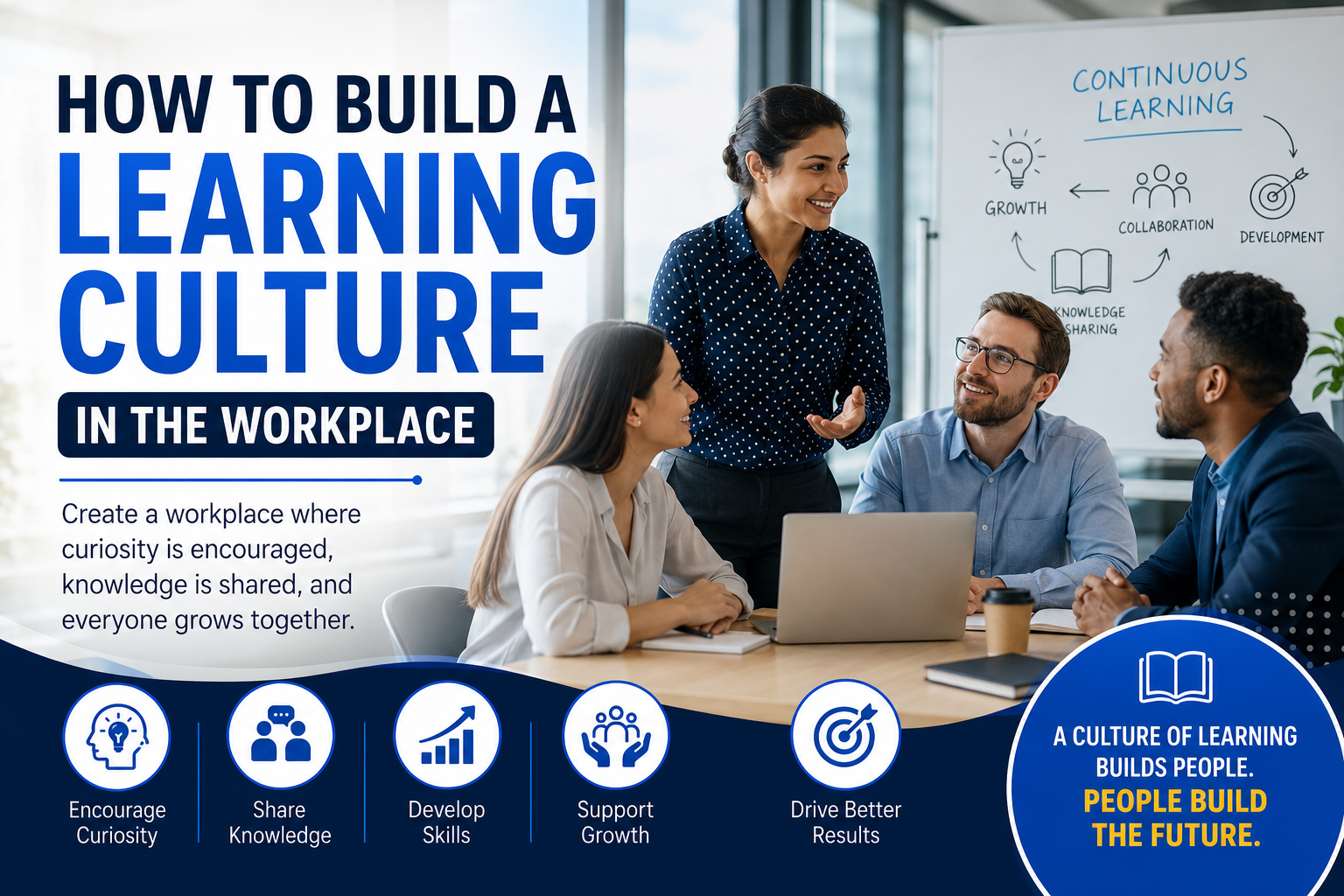
A learning culture is an organizational environment where continuous learning, knowledge sharing, innovation, and professional development are encouraged at every level of the business.
Rather than viewing learning as a one-time event or annual training program, organizations with a strong learning culture treat learning as an ongoing process integrated into daily work.
Employees are encouraged to continuously acquire new knowledge, improve existing skills, develop leadership capabilities, and adapt to changing business needs.
In organizations with a healthy learning culture:
- Employees actively seek new knowledge.
- Managers coach rather than simply supervise.
- Learning opportunities are available throughout the year.
- Knowledge sharing becomes part of everyday work.
- Mistakes are viewed as opportunities to learn.
- Innovation is encouraged through experimentation.
- Professional development aligns with business goals.
Building a learning culture goes beyond delivering classroom training. It involves creating an ecosystem where curiosity is valued, collaboration is encouraged, and continuous improvement becomes everyone’s responsibility.
Organizations that succeed in building this culture don’t rely solely on HR departments. Leaders, managers, employees, and executives all contribute to making learning a shared organizational value.
Why Learning Culture Matters More Than Ever
The workplace has changed dramatically over the last decade.
Digital transformation, hybrid work, Artificial Intelligence, automation, and rapidly changing customer expectations require organizations to continuously develop new skills.
The traditional approach of learning once and applying those skills throughout an entire career is no longer practical.
Today’s professionals must constantly upgrade their knowledge to remain effective and competitive.
1. Technology Is Changing Every Industry
Businesses are adopting AI-powered tools, automation platforms, advanced analytics, cloud technologies, and digital collaboration platforms at an unprecedented pace.
Organizations with strong learning cultures prepare employees to embrace these changes instead of fearing them.
2. Skills Have Shorter Lifespans
Many technical and business skills become outdated within just a few years. Continuous learning enables employees to remain relevant while helping organizations maintain a future-ready workforce.
3. Employees Expect Career Growth
Modern employees don’t simply look for competitive salaries. They also seek organizations that invest in their professional development.
Providing structured learning opportunities increases employee satisfaction, improves retention, and strengthens employer branding.
4. Innovation Requires Learning
Innovation happens when employees are encouraged to explore new ideas, challenge existing processes, and continuously expand their knowledge.
A strong learning culture creates an environment where innovation naturally thrives.
5. Better Leadership Development
Organizations with continuous learning programs develop future leaders more effectively. Employees gain confidence, broaden their capabilities, and become better prepared for larger responsibilities.
Leadership pipelines become stronger because learning is viewed as an ongoing journey rather than a promotion requirement.
Ultimately, organizations that learn faster than their competitors are often the organizations that outperform them.
10 Benefits of Building a Learning Culture in the Workplace
Organizations that make learning part of their everyday culture don’t just create knowledgeable employees—they build resilient, innovative, and future-ready businesses. A strong learning culture positively impacts every aspect of an organization, from employee engagement to customer satisfaction.
Here are the key benefits organizations experience when they invest in continuous learning.
1. Higher Employee Engagement
Employees are naturally more engaged when they feel their organization is investing in their personal and professional growth.
Learning opportunities demonstrate that the company values its people beyond their daily responsibilities. Employees become more motivated because they can clearly see opportunities to grow, acquire new skills, and advance their careers.
Highly engaged employees contribute more ideas, collaborate better with colleagues, and take greater ownership of their work.
2. Better Employee Retention
One of the primary reasons employees leave organizations is the lack of career development opportunities.
When organizations provide structured learning pathways, leadership development programs, coaching, mentoring, and skill enhancement initiatives, employees are more likely to stay for the long term.
Investing in employee learning often costs significantly less than replacing experienced professionals.
3. Increased Productivity
Employees with updated knowledge perform their work more efficiently and confidently.
Continuous learning helps employees adopt better work practices, improve decision-making, solve problems faster, and reduce costly mistakes.
As employees become more competent, overall organizational productivity naturally improves.
4. Stronger Innovation
Innovation rarely happens in organizations where employees fear failure or resist change.
A learning culture encourages experimentation, creative thinking, and continuous improvement.
Employees become comfortable testing new ideas, learning from failures, and identifying opportunities to improve products, services, and internal processes.
5. Improved Adaptability During Change
Business environments change constantly.
Organizations regularly adopt new technologies, restructure teams, enter new markets, and respond to evolving customer expectations.
Employees who embrace continuous learning adapt much faster because they view change as an opportunity rather than a threat.
6. Better Leadership Development
Future leaders are not developed overnight.
Organizations with strong learning cultures consistently prepare employees for greater responsibilities through leadership development, coaching, mentoring, communication training, and practical workplace experiences.
This creates a strong internal leadership pipeline and reduces dependency on external hiring.
7. Enhanced Collaboration Across Teams
Learning cultures encourage employees to share knowledge rather than work in isolated silos.
Knowledge-sharing sessions, cross-functional projects, mentoring, and collaborative learning improve communication while strengthening teamwork across departments.
Employees begin learning from one another instead of relying solely on formal training programs.
8. Higher Customer Satisfaction
Employees who continuously improve their knowledge provide better customer experiences.
Whether serving internal or external customers, better communication, stronger problem-solving skills, and updated industry knowledge lead to higher customer satisfaction.
9. Greater Organizational Agility
Organizations that continuously learn can respond more effectively to market disruptions, competitive pressures, and technological advancements.
Instead of reacting slowly to change, learning organizations proactively prepare employees for future business challenges.
10. Sustainable Business Growth
Ultimately, organizations that continuously develop their people are better positioned for long-term success.
Learning becomes a competitive advantage that supports innovation, leadership, productivity, employee satisfaction, and business performance.
Characteristics of Organizations with a Strong Learning Culture
Learning cultures don’t happen by accident. They are intentionally built through leadership commitment, employee participation, and consistent organizational practices.
Here are the common characteristics shared by successful learning organizations.
Learning Is Embedded into Daily Work
Employees don’t wait for annual training programs.
Learning occurs through projects, coaching conversations, mentoring, peer discussions, online learning, workshops, and daily problem-solving.
Leaders Lead by Example
Senior leaders actively participate in learning initiatives.
They attend workshops, seek feedback, develop new skills, and openly discuss their own learning journeys.
This encourages employees to view learning as an organizational priority.
Employees Feel Safe Asking Questions
Psychological safety plays a significant role in learning.
Employees should feel comfortable asking questions, seeking clarification, and sharing ideas without fear of criticism or embarrassment.
Knowledge Sharing Is Encouraged
Employees regularly exchange knowledge through internal presentations, mentoring programs, lunch-and-learn sessions, collaborative projects, and team discussions.
Knowledge becomes an organizational asset instead of remaining with individual employees.
Feedback Is Continuous
Constructive feedback supports continuous improvement.
Managers regularly coach employees, discuss development opportunities, and recognize learning achievements throughout the year.
Learning Goals Align with Business Goals
Successful organizations don’t offer random training programs.
Learning initiatives directly support business priorities such as leadership development, customer service excellence, digital transformation, innovation, or productivity improvement.
Common Challenges When Building a Learning Culture
Although many organizations recognize the importance of continuous learning, implementing a sustainable learning culture presents several challenges.
1. Employees Don’t Have Time
Heavy workloads often prevent employees from participating in learning activities.
Organizations must integrate learning into daily work rather than treating it as an additional responsibility.
2. Lack of Leadership Support
If leaders don’t actively participate in learning, employees are unlikely to prioritize it.
Leadership commitment is one of the strongest predictors of learning culture success.
3. Learning Is Viewed as a One-Time Event
Many organizations still rely solely on annual classroom training.
True learning cultures promote continuous development throughout the employee lifecycle.
4. Fear of Failure
Employees may avoid experimenting with new ideas because they fear making mistakes.
Organizations must create an environment where failures become valuable learning experiences instead of reasons for blame.
5. Limited Learning Resources
Some organizations believe building a learning culture requires large budgets.
In reality, mentoring, coaching, peer learning, knowledge-sharing sessions, job rotations, and internal workshops can create significant learning opportunities with minimal investment.
6. No Clear Measurement
Without measurable learning goals, organizations struggle to understand whether their initiatives are creating meaningful business impact.
Tracking participation, engagement, skill development, productivity improvements, leadership readiness, and employee feedback helps demonstrate the value of learning investments.
Recognizing these challenges early allows organizations to develop practical strategies that make learning sustainable rather than temporary.
How to Build a Learning Culture in the Workplace: An 8-Step Framework
Creating a learning culture doesn’t happen overnight. It requires a long-term commitment from leadership, managers, HR teams, and employees. Rather than treating learning as a standalone initiative, organizations should embed it into everyday work practices.
The following framework provides a practical roadmap that organizations of any size can use to build a sustainable learning culture.
Step 1: Make Learning a Business Priority
A learning culture begins with leadership commitment.
If employees see learning as an optional HR activity, participation will always remain low. However, when senior leaders actively promote continuous development and allocate time, budget, and resources for learning, employees recognize its importance.
Learning should be aligned with the organization’s business strategy. Whether the goal is improving customer experience, strengthening leadership capabilities, increasing innovation, or preparing employees for digital transformation, every learning initiative should support measurable business outcomes.
Organizations that treat learning as a strategic investment rather than an expense consistently outperform those that view training as a compliance activity.
Step 2: Encourage Leaders to Become Learning Champions
Employees observe what leaders do more than what leaders say.
Managers and senior executives who actively participate in workshops, read industry insights, attend conferences, seek feedback, and continuously improve their own skills create a powerful example for their teams.
Leaders can encourage learning by:
- Sharing books, podcasts, and articles with their teams.
- Discussing lessons learned after completing projects.
- Encouraging experimentation and innovation.
- Recognizing employees who demonstrate continuous learning.
- Supporting professional certifications and skill development.
When leaders openly discuss their own learning experiences, employees become more comfortable investing in their own development.
Step 3: Create Individual Learning Plans
Every employee has different strengths, career goals, and development needs.
Instead of providing identical training programs for everyone, organizations should develop Individual Learning Plans (ILPs).
Each plan should identify:
- Current competencies
- Skills required for future roles
- Learning objectives
- Recommended training programs
- Mentoring opportunities
- Progress milestones
Personalized learning journeys increase employee motivation because individuals clearly understand how learning supports their career growth.
Step 4: Make Learning Part of Everyday Work
One of the biggest misconceptions about learning is that it only happens inside classrooms.
In reality, the most effective learning often happens while employees are performing their daily responsibilities.
Organizations can integrate learning into everyday work through:
- Project-based learning
- Cross-functional assignments
- Job shadowing
- Stretch assignments
- Knowledge-sharing sessions
- After-action reviews
- Peer coaching
- Lunch-and-learn programs
These experiences allow employees to immediately apply new knowledge, making learning more practical and memorable.
Step 5: Promote Collaboration and Knowledge Sharing
Knowledge should never remain with just one individual.
Organizations with strong learning cultures actively encourage employees to share their expertise with colleagues.
Some effective knowledge-sharing practices include:
- Internal webinars
- Monthly knowledge-sharing sessions
- Communities of practice
- Mentorship programs
- Department learning forums
- Internal newsletters
- Innovation workshops
Knowledge sharing strengthens collaboration while reducing dependency on individual experts.
Step 6: Build a Feedback-Driven Culture
Continuous learning requires continuous feedback.
Employees improve faster when they receive regular, constructive feedback instead of waiting for annual performance reviews.
Managers should schedule regular coaching conversations that focus on:
- Strengths
- Areas for improvement
- Career aspirations
- Learning progress
- Development opportunities
Organizations should also encourage peer feedback, self-reflection, and 360-degree assessments to support continuous growth.
Step 7: Recognize and Reward Continuous Learning
Recognition reinforces desired behaviours.
Employees are more likely to invest in learning when organizations acknowledge their efforts.
Recognition does not always require financial rewards.
Organizations can celebrate learning by:
- Highlighting learning achievements during team meetings.
- Recognizing employees who complete certifications.
- Sharing success stories in internal communications.
- Offering career advancement opportunities.
- Providing digital badges and certificates.
- Creating annual learning awards.
Positive reinforcement helps transform learning into a long-term organizational habit.
Step 8: Measure, Review, and Improve Continuously
Learning cultures should evolve alongside business needs.
Organizations should regularly evaluate whether learning initiatives are delivering measurable results.
Useful metrics include:
- Training participation rates
- Employee engagement scores
- Leadership readiness
- Internal promotion rates
- Skill assessment improvements
- Employee retention
- Business performance indicators
Regular evaluation enables organizations to continuously improve their learning strategy and maximize return on investment.
The Role of Managers in Building a Learning Culture
Managers influence employee learning more than any training program.
Employees interact with their managers almost every day, making managers critical drivers of continuous development.
Effective managers:
- Coach employees instead of simply supervising them.
- Provide regular developmental feedback.
- Delegate challenging assignments that encourage growth.
- Create psychologically safe environments.
- Encourage employees to ask questions.
- Support experimentation and innovation.
- Celebrate learning achievements.
Organizations should therefore invest in leadership development programs that equip managers with coaching, communication, emotional intelligence, and mentoring skills.
The Role of HR and Learning & Development Teams
HR and Learning & Development (L&D) professionals serve as architects of organizational learning.
Rather than simply organizing training sessions, modern L&D teams design comprehensive learning ecosystems that align employee development with business objectives.
Key responsibilities include:
- Conducting learning needs assessments.
- Designing competency frameworks.
- Developing leadership pipelines.
- Implementing blended learning solutions.
- Facilitating coaching and mentoring programs.
- Measuring learning effectiveness.
- Supporting organizational change initiatives.
By working closely with business leaders, HR professionals can ensure learning initiatives contribute directly to organizational performance.
How Technology Supports a Learning Culture
Technology has made continuous learning more accessible than ever before.
Organizations can use digital learning platforms to provide employees with flexible, personalized learning experiences.
Popular learning technologies include:
- Learning Management Systems (LMS)
- Microlearning platforms
- Virtual instructor-led training
- AI-powered learning recommendations
- Mobile learning applications
- Learning analytics dashboards
- Collaboration platforms for peer learning
Technology should enhance learning rather than replace meaningful human interaction. The most successful organizations combine digital learning with coaching, mentoring, workshops, and collaborative learning experiences.
Real-World Example
Consider an organization introducing Artificial Intelligence tools across multiple departments.
Instead of conducting a single technical training session, the company develops a comprehensive learning journey that includes leadership briefings, role-specific workshops, peer learning groups, mentoring sessions, practical assignments, and monthly knowledge-sharing meetings.
Managers regularly coach employees on applying new skills while HR measures adoption rates, employee confidence, and business outcomes.
Within a year, employees become significantly more comfortable using AI tools, productivity improves, innovation increases, and the organization successfully adapts to technological change.
This illustrates that a learning culture is not created by one training event—it is built through continuous reinforcement, leadership support, and everyday learning experiences.
How to Measure the Success of a Learning Culture
Building a learning culture is an investment, and like any strategic investment, organizations should measure its impact. Tracking meaningful metrics helps HR leaders, Learning & Development teams, and business leaders understand whether learning initiatives are contributing to organizational success.
Rather than focusing only on the number of training sessions conducted, organizations should evaluate how learning influences employee behaviour, business performance, and long-term organizational growth.
Key Metrics to Track
- Employee Engagement Scores: Higher engagement often reflects stronger learning opportunities and career development.
- Learning Participation Rate: Measure how actively employees participate in workshops, online learning, coaching sessions, and development programs.
- Training Completion Rate: Evaluate whether employees complete assigned learning journeys and certifications.
- Employee Retention: Organizations with strong learning cultures generally experience lower voluntary turnover.
- Internal Promotion Rate: A growing percentage of internal promotions indicates successful capability development.
- Leadership Readiness: Assess how many employees are prepared to take on future leadership roles.
- Productivity Improvements: Compare operational performance before and after major learning initiatives.
- Innovation Metrics: Monitor employee-generated ideas, process improvements, and innovation initiatives.
- Customer Satisfaction: Better-trained employees often deliver improved customer experiences.
- Business Performance: Measure improvements in sales, quality, project delivery, operational efficiency, or customer retention where applicable.
Organizations that regularly review these metrics can continuously improve their learning strategy while demonstrating the business value of employee development.
Common Mistakes Organizations Should Avoid
Many organizations invest in learning programs but fail to build a true learning culture because they overlook several important factors.
1. Treating Training as a One-Time Event
Learning should never end after a single workshop.
Continuous reinforcement, coaching, mentoring, and practical application are essential for long-term behavioural change.
2. Focusing Only on Technical Skills
Technical knowledge is important, but organizations also need employees who can communicate effectively, collaborate with others, solve problems, adapt to change, and lead teams.
Soft skills and leadership capabilities should develop alongside technical expertise.
3. Ignoring Manager Involvement
Managers play a critical role in reinforcing learning.
If managers do not coach employees or encourage practical application, newly acquired skills often disappear within weeks.
4. Failing to Align Learning with Business Goals
Training programs should directly support organizational priorities.
Learning becomes far more impactful when employees understand how their development contributes to business success.
5. Not Recognizing Learning Achievements
Employees appreciate recognition.
Celebrating certifications, learning milestones, innovative ideas, and professional growth encourages others to actively participate in learning initiatives.
6. Measuring Attendance Instead of Impact
Completing a workshop does not automatically improve performance.
Organizations should evaluate behavioural change, productivity improvements, employee engagement, leadership readiness, and business outcomes instead of focusing solely on attendance.
Frequently Asked Questions (FAQs)
1. What is a learning culture in the workplace?
A learning culture is an organizational environment where continuous learning, knowledge sharing, innovation, and professional development are encouraged as part of everyday work rather than occasional training events.
2. Why is a learning culture important?
A strong learning culture improves employee engagement, productivity, innovation, leadership development, adaptability, and long-term business performance while helping organizations remain competitive.
3. How long does it take to build a learning culture?
Building a learning culture is an ongoing journey rather than a one-time project. While organizations may notice improvements within a few months, creating a sustainable learning culture often requires consistent effort over several years.
4. What role do managers play in creating a learning culture?
Managers coach employees, provide developmental feedback, encourage experimentation, support career growth, and create psychologically safe environments where learning becomes part of everyday work.
5. Can small businesses build a learning culture?
Absolutely.
Learning cultures do not require large budgets. Mentoring, coaching, peer learning, cross-functional projects, knowledge-sharing sessions, and regular feedback can be highly effective even in small organizations.
6. What is the difference between training and a learning culture?
Training is a structured learning activity designed to develop specific skills.
A learning culture is a long-term organizational mindset where continuous learning becomes embedded into daily work, leadership practices, and organizational values.
Final Thoughts
Organizations that succeed in the future will not necessarily be those with the largest budgets or the most advanced technology.
They will be the organizations that learn faster, adapt quicker, and continuously develop their people.
Building a learning culture is no longer optional. It has become a strategic necessity.
When employees are encouraged to learn, share knowledge, collaborate, and continuously improve, organizations become more innovative, resilient, and better prepared for future challenges.
Creating this culture requires commitment from everyone.
Leaders must inspire learning through their actions.
Managers must coach rather than simply supervise.
HR and Learning & Development teams must design meaningful learning experiences.
Employees must embrace curiosity and take ownership of their personal growth.
The journey may take time, but the rewards are significant—higher employee engagement, stronger leadership pipelines, improved business performance, increased innovation, and a workforce ready to thrive in an ever-changing world.
Organizations that invest in continuous learning today are building the leaders, innovators, and high-performing teams of tomorrow.
How InSITE Learning Solutions Can Help
At InSITE Learning Solutions, we believe that learning should create lasting behavioural change—not just deliver information.
Our corporate learning programs are designed to help organizations build high-performing teams by developing leadership capabilities, communication skills, emotional intelligence, interpersonal effectiveness, customer service excellence, and workplace competencies.
Every program is customized to align with your organization’s goals, culture, and business challenges, ensuring measurable learning outcomes and long-term impact.
Whether you’re developing first-time managers, strengthening leadership pipelines, improving employee engagement, or creating a culture of continuous learning, our experienced facilitators and evidence-based learning methodologies can help your organization succeed.