Anand Narayan | 🔗 LinkedIn Profile | Published: July 10, 2026
Artificial Intelligence (AI) is transforming industries across the globe, and corporate learning is no exception. From personalized learning recommendations to AI-powered coaching assistants, organizations are leveraging AI to make employee training more engaging, scalable, and effective.
However, despite the rapid adoption of AI technologies, one common concern continues to surface among learning professionals:
Will AI eventually replace human trainers?
The short answer is no.
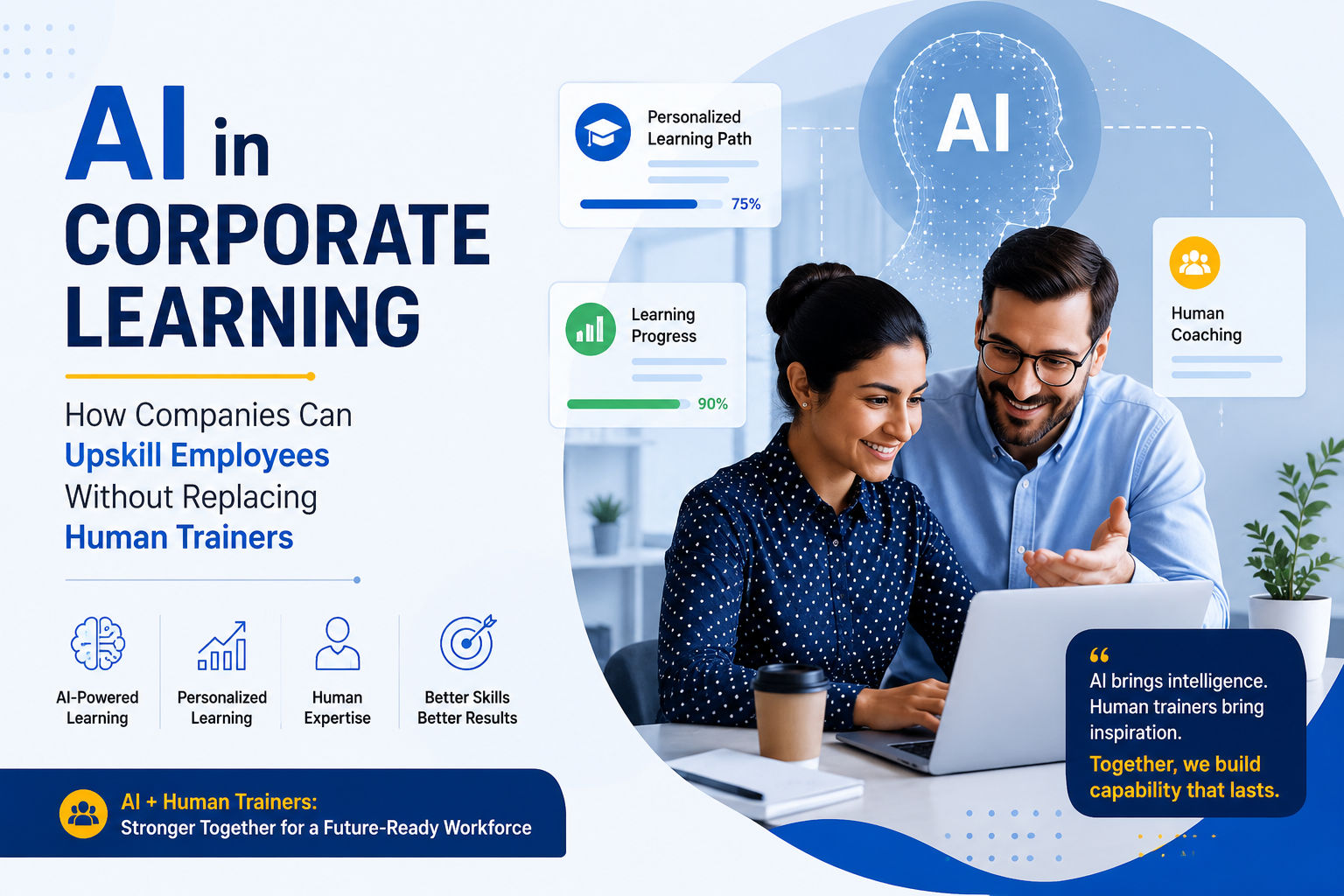
AI is changing how organizations deliver learning—not who delivers it. While AI can automate repetitive tasks, analyze learning data, personalize training paths, and provide instant learner support, it cannot replace the human qualities that make great trainers effective. Empathy, coaching, mentoring, storytelling, leadership, emotional intelligence, and real-world experience remain uniquely human capabilities.
Instead of replacing instructors, AI acts as a powerful learning companion that enables trainers to focus on higher-value activities such as facilitating discussions, coaching employees, solving business problems, and creating meaningful learning experiences.
Organizations that successfully combine AI-powered learning technologies with experienced trainers are creating highly personalized, data-driven, and engaging learning ecosystems that improve employee performance while supporting long-term business growth.
In this comprehensive guide, you'll learn:
- What AI in Corporate Learning really means
- Why AI is transforming workplace learning
- How AI supports—not replaces—human trainers
- The biggest benefits of AI-powered learning
- Real-world use cases across industries
- Best practices for implementing AI in Learning & Development
- The future of AI-enabled corporate learning
Table of Contents
- What is AI in Corporate Learning?
- Why AI is Changing Workplace Learning
- Can AI Replace Human Trainers?
- Benefits of AI-Powered Corporate Learning
- AI vs Human Trainers
- Industry Use Cases
- Challenges and Considerations
- Best Practices
- Future of AI in Learning
- Frequently Asked Questions
What is AI in Corporate Learning?
AI in Corporate Learning refers to the use of Artificial Intelligence technologies to enhance employee training, learning management, knowledge sharing, and skill development across an organization.
Rather than delivering the same learning experience to every employee, AI analyzes learner behavior, performance, job roles, career aspirations, and skill gaps to recommend personalized learning journeys.
Modern AI-powered learning platforms can automatically recommend relevant courses, generate quizzes, summarize learning materials, answer employee questions using intelligent chatbots, predict future skill requirements, and provide personalized coaching recommendations.
This creates a more engaging learning experience while enabling organizations to deliver training at scale without compromising quality.
Some of the most common AI technologies used in corporate learning include:
- Machine Learning
- Generative AI
- AI Chatbots
- Virtual Learning Assistants
- Adaptive Learning Engines
- Learning Analytics
- Natural Language Processing (NLP)
- Predictive Skill Analytics
Together, these technologies enable organizations to create learning experiences that are more relevant, interactive, and aligned with individual employee needs.
Why AI is Transforming Corporate Learning
Today's workplace is evolving faster than ever before. Digital transformation, automation, hybrid work models, and rapidly changing customer expectations require employees to continuously develop new skills.
Traditional training methods—such as classroom sessions conducted once or twice a year—are no longer sufficient to keep pace with changing business demands.
Employees now expect learning that is:
- Available anytime and anywhere
- Personalized to their role and experience
- Interactive and engaging
- Accessible on mobile devices
- Relevant to real workplace challenges
- Continuously updated with the latest knowledge
AI enables organizations to meet these expectations by delivering learning that adapts to each employee's unique needs.
Instead of assigning identical training modules to every learner, AI evaluates performance data and recommends content that addresses individual skill gaps. Employees receive targeted learning experiences, reducing unnecessary training time while improving knowledge retention and engagement.
For Learning & Development teams, AI also automates many administrative tasks such as assigning courses, generating assessments, monitoring learner progress, analyzing completion rates, and producing detailed learning reports. This allows trainers and L&D professionals to spend more time designing impactful learning experiences rather than managing repetitive administrative work.
Can AI Replace Human Trainers?
This is perhaps the most frequently asked question in modern Learning & Development.
While AI continues to become more sophisticated, the reality is that it is designed to augment human expertise—not replace it.
AI excels at processing large volumes of information, identifying learning patterns, recommending personalized content, and providing immediate responses to learner queries. However, learning is not just about delivering information—it is about inspiring people, encouraging behavioral change, facilitating discussions, and helping employees apply knowledge in real-world situations.
These are areas where experienced trainers bring exceptional value.
Human trainers understand organizational culture, business context, interpersonal dynamics, emotional intelligence, and leadership development. They can adapt their teaching style based on audience engagement, answer complex business questions, facilitate group collaboration, and mentor employees through challenging situations.
AI cannot fully replicate these human capabilities.
Instead, the most successful organizations use AI as a collaborative partner that empowers trainers to become more effective. AI handles repetitive and data-intensive tasks, while trainers focus on coaching, mentoring, critical thinking, and developing future leaders.
The future of corporate learning isn't AI versus human trainers—it's AI working alongside human trainers to create smarter, faster, and more personalized learning experiences.
Why Organizations Are Investing in AI-Powered Learning
Businesses across industries are increasingly investing in AI-driven learning solutions because they help address some of the biggest challenges facing Learning & Development teams today.
Some of the key drivers include:
- Rapidly evolving skill requirements
- Growing demand for personalized learning experiences
- Need to train distributed and hybrid workforces
- Limited availability of expert trainers
- Pressure to demonstrate learning effectiveness and business impact
- Increasing focus on continuous learning and employee development
- Need to reduce training costs while improving outcomes
AI enables organizations to scale learning initiatives efficiently while ensuring employees receive timely, relevant, and engaging training. Rather than replacing instructors, AI strengthens the overall learning ecosystem by making corporate training more adaptive, measurable, and learner-centric.
10 Ways AI Helps Companies Upskill Employees More Effectively
Artificial Intelligence is reshaping workplace learning by making employee development more personalized, data-driven, and scalable. Rather than replacing traditional learning methods, AI enhances every stage of the learning journey—from identifying skill gaps to recommending relevant content and measuring learning outcomes.
Below are ten practical ways organizations are using AI to build a future-ready workforce.
1. Personalized Learning Paths
Every employee has different responsibilities, career aspirations, experience levels, and learning preferences. Traditional training often delivers the same content to everyone, regardless of their individual needs.
AI eliminates this "one-size-fits-all" approach by creating personalized learning journeys based on each learner's role, previous training history, assessment scores, job performance, and competency gaps.
Instead of spending hours completing irrelevant courses, employees receive recommendations tailored specifically to their development needs, making learning more efficient and engaging.
2. Intelligent Skill Gap Analysis
One of AI's biggest strengths is its ability to analyze vast amounts of employee data quickly and accurately.
AI-powered learning platforms can compare an employee's current skills with the competencies required for their role or future career path. This enables organizations to identify critical skill gaps before they impact business performance.
Learning & Development teams can then design targeted training programs that address these gaps and prepare employees for evolving business requirements.
3. AI Learning Assistants and Chatbots
Employees often have questions while completing training modules or applying new concepts at work. Waiting for instructor support can slow down learning.
AI-powered virtual learning assistants provide instant answers, explain concepts, recommend resources, and guide employees through their learning journey at any time of the day.
These assistants improve learner engagement while reducing the administrative workload on trainers.
4. Adaptive Learning Experiences
AI continuously monitors learner progress and adjusts content difficulty based on individual performance.
For example, if an employee struggles with a concept, the platform can automatically recommend additional resources, videos, case studies, or practice exercises. High-performing learners may skip introductory topics and move directly to advanced content.
This adaptive approach keeps employees challenged without overwhelming them.
5. Automated Content Recommendations
Employees no longer need to search through hundreds of courses to find relevant learning materials.
Similar to how streaming platforms recommend movies, AI recommends articles, videos, certifications, webinars, microlearning modules, and learning paths based on learner interests, job roles, and career goals.
This significantly increases learning engagement and course completion rates.
6. AI-Powered Content Creation
Creating high-quality learning content traditionally requires significant time and effort.
Generative AI helps instructional designers accelerate content development by assisting with:
- Course outlines
- Assessment questions
- Knowledge summaries
- Learning scenarios
- Role-play exercises
- Microlearning scripts
- Interactive quizzes
Human experts still review and refine the content, ensuring accuracy, relevance, and alignment with organizational goals.
7. Real-Time Learning Analytics
AI enables Learning & Development teams to move beyond basic completion reports.
Modern learning platforms provide actionable insights into:
These analytics help organizations continuously improve learning programs while demonstrating business value.
8. Predictive Learning Insights
AI doesn't just analyze historical data—it predicts future learning needs.
By examining workforce trends, organizational goals, and employee performance, AI can identify emerging skill requirements and recommend proactive learning initiatives before competency gaps become business challenges.
This helps organizations stay competitive in rapidly changing industries.
9. Continuous Performance Support
Learning should not end after a training session.
AI provides employees with just-in-time learning support by delivering relevant resources exactly when they need them.
Whether an employee needs a quick product guide before meeting a customer or a compliance checklist during an audit, AI delivers contextual learning directly within the workflow.
10. Better Learning ROI
AI helps organizations maximize the return on their learning investments by improving learner engagement, reducing training costs, shortening learning cycles, and enabling more effective skill development.
Combined with robust learning analytics, AI makes it easier to measure training effectiveness and connect learning initiatives to measurable business outcomes.
Organizations can further evaluate these outcomes using structured ROI frameworks. Learn more in our guide on How to Measure Corporate Training ROI: KPIs, Metrics & Real Business Impact.
AI vs Human Trainers: A Collaborative Partnership
The future of workplace learning is not about choosing between AI and human trainers. Instead, organizations achieve the best results by combining AI's speed and intelligence with the expertise, empathy, and leadership of experienced trainers.
| AI Capabilities | Human Trainer Strengths |
|---|---|
| Personalized learning recommendations | Coaching and mentoring employees |
| Learning analytics | Building trust and relationships |
| Instant learner support | Facilitating discussions and collaboration |
| Adaptive learning paths | Developing leadership and soft skills |
| Automated assessments | Providing emotional support and motivation |
| Skill gap analysis | Sharing industry experience and practical insights |
| Content recommendations | Encouraging critical thinking and innovation |
| Performance dashboards | Driving behavioural change |
Organizations that combine these strengths create richer learning experiences than either AI or human trainers could deliver independently.
Real-World Applications Across Industries
AI-powered learning is transforming workforce development across industries by enabling personalized, scalable, and measurable training programs.
Information Technology
- Technical certification recommendations
- Personalized cloud and cybersecurity learning paths
- AI coding assistants for developer training
Healthcare
- Clinical knowledge updates
- Medical compliance training
- Patient communication simulations
Manufacturing
- Safety training
- Machine operation guidance
- Predictive maintenance learning
Retail & Consumer Goods
- Product knowledge training
- Customer service coaching
- Sales enablement programs
Banking & Financial Services
- Compliance and regulatory learning
- Risk management training
- Fraud prevention education
Business Benefits of AI-Powered Corporate Learning
Organizations implementing AI-enabled learning solutions report significant improvements across multiple areas of employee development and business performance.
- Higher learner engagement
- Faster employee onboarding
- Improved knowledge retention
- Personalized employee development
- Reduced administrative workload
- Lower training costs
- Improved learning effectiveness
- Scalable learning delivery
- Better decision-making using learning analytics
- Stronger workforce readiness for future skills
These benefits make AI an invaluable tool for organizations seeking to build a culture of continuous learning while maintaining the critical role of human trainers.
Challenges of Implementing AI in Corporate Learning
While Artificial Intelligence offers significant opportunities for improving workplace learning, successful implementation requires careful planning, strong governance, and a people-first approach. Organizations should view AI as an enabler rather than a replacement for human expertise.
Below are some of the most common challenges organizations should consider before implementing AI-powered learning solutions.
1. Data Privacy and Security
AI learning platforms often process employee information such as learning history, assessment results, skills, certifications, and performance data.
Organizations must ensure that employee data is collected, stored, and processed in compliance with applicable privacy regulations and internal security policies.
2. AI Bias and Fairness
AI systems are only as effective as the data used to train them. Poor-quality or biased data may result in inaccurate recommendations or unequal learning opportunities.
Regular audits, transparent algorithms, and human oversight help ensure AI supports fair and inclusive learning experiences.
3. Resistance to Change
Employees and trainers may initially be hesitant to adopt AI-powered learning tools due to concerns about job security or unfamiliar technology.
Organizations should communicate that AI is designed to support trainers, improve learning experiences, and reduce administrative work—not replace human expertise.
4. Content Quality and Accuracy
Generative AI can assist in creating learning materials, but AI-generated content should always be reviewed by subject matter experts before being shared with learners.
Human validation ensures that learning content remains accurate, relevant, compliant, and aligned with business objectives.
5. Integration with Existing Learning Systems
Many organizations already use Learning Management Systems (LMS), HR platforms, competency frameworks, and performance management systems.
To maximize value, AI solutions should integrate seamlessly with existing technology rather than operating in isolation.
Best Practices for Successfully Implementing AI in Learning & Development
Organizations that achieve the greatest success with AI adoption typically follow a structured implementation strategy that combines technology, business objectives, and human expertise.
- Start with clearly defined learning and business goals.
- Identify priority skill gaps using workforce data.
- Introduce AI gradually through pilot programs.
- Provide training for L&D teams and trainers on using AI effectively.
- Maintain human review for all AI-generated learning content.
- Measure learning effectiveness using analytics and business KPIs.
- Continuously refine AI recommendations based on learner feedback.
- Protect employee data with strong governance and security policies.
The Future of AI in Corporate Learning
The future of corporate learning is not about replacing instructors with technology—it is about creating intelligent learning ecosystems where AI and human expertise work together.
As AI technologies continue to evolve, organizations can expect learning experiences to become increasingly personalized, immersive, and data-driven.
Some emerging trends include:
- AI-powered career development assistants
- Hyper-personalized learning journeys
- Predictive workforce skill planning
- Virtual coaching assistants
- AI-generated multilingual learning content
- Immersive AI-supported simulations
- Real-time competency mapping
- Integrated AI learning within everyday work applications
Despite these advancements, human trainers will remain central to organizational learning. Leadership coaching, behavioural development, collaboration, creativity, emotional intelligence, negotiation, and strategic decision-making are areas where human interaction continues to be essential.
The organizations that succeed will be those that combine AI's efficiency with the experience, empathy, and expertise of learning professionals.
Frequently Asked Questions (FAQs)
What is AI in corporate learning?
AI in corporate learning refers to the use of Artificial Intelligence technologies to personalize employee training, automate learning administration, identify skill gaps, recommend learning content, and improve overall learning effectiveness.
Will AI replace corporate trainers?
No. AI is designed to enhance corporate learning by supporting trainers with automation, analytics, and personalized recommendations. Human trainers remain essential for coaching, mentoring, leadership development, and facilitating meaningful learning experiences.
How does AI improve employee learning?
AI improves employee learning by delivering personalized learning paths, adaptive content, intelligent recommendations, real-time feedback, skill gap analysis, learning analytics, and virtual learning support.
What are the benefits of AI in Learning & Development?
Organizations benefit from increased learner engagement, faster onboarding, personalized training, improved knowledge retention, better learning analytics, lower administrative effort, and scalable learning delivery.
Which industries use AI-powered corporate learning?
AI-enabled learning solutions are widely used across Information Technology, Manufacturing, Healthcare, Banking, Financial Services, Retail, Consumer Goods, Telecommunications, Logistics, and Professional Services.
How can organizations successfully implement AI in corporate learning?
Organizations should begin with clear learning objectives, integrate AI with existing learning platforms, involve trainers throughout the implementation process, ensure data privacy, validate AI-generated content, and continuously measure learning effectiveness using business KPIs.
Conclusion
Artificial Intelligence is reshaping the future of corporate learning by making employee development more personalized, scalable, and measurable. Rather than replacing human trainers, AI empowers learning professionals to focus on what they do best—coaching employees, facilitating meaningful conversations, encouraging innovation, and building future leaders.
The most successful organizations understand that technology alone cannot create a high-performing workforce. Sustainable learning success comes from combining AI-powered insights with human expertise, organizational culture, and business strategy.
As skill requirements continue to evolve, organizations that embrace AI responsibly while investing in their people will be better positioned to build agile, future-ready workforces capable of adapting to changing business needs.
Build Future-Ready Learning Experiences with Insite Learning Solutions
At Insite Learning Solutions, we help organizations combine innovative learning strategies with modern technologies to create impactful employee development programs. Whether you're exploring AI-enabled learning, leadership development, sales training, behavioural skills, or digital learning solutions, our experts can help you design programs that deliver measurable business results.
Our customized learning solutions are built around your people, business goals, and future workforce requirements—ensuring technology enhances human learning rather than replacing it.