Anand Narayan | 🔗 LinkedIn Profile | Published: July 15, 2026
Organizations today operate in an environment where business priorities, technology, and workforce expectations are constantly evolving. To remain competitive, companies need employees with the right combination of knowledge, technical expertise, behavioural skills, and leadership capabilities. However, many organizations struggle to clearly define what "good performance" looks like for different roles.
This is where a Competency Framework becomes invaluable.
A competency framework provides a structured approach to identifying the skills, behaviours, knowledge, and attributes employees need to perform successfully in their current roles while preparing for future responsibilities. Rather than relying on subjective performance evaluations, organizations can use competency frameworks to create consistent standards for hiring, onboarding, training, performance management, succession planning, and leadership development.
Whether you're building a competency framework for a small organization or a global enterprise, having clearly defined competencies enables managers and employees to understand expectations, identify skill gaps, and create targeted development plans.
A well-designed competency framework also strengthens Learning & Development initiatives by ensuring training programs are directly aligned with business objectives and measurable employee capabilities.
In this comprehensive guide, you'll learn:
- What a competency framework is
- Why every organization should have one
- The different types of competencies
- How competency frameworks support employee development
- The step-by-step process to build one
- Common mistakes to avoid
- Best practices for successful implementation
Table of Contents
- What is a Competency Framework?
- Why Organizations Need a Competency Framework
- Types of Employee Competencies
- Benefits of Competency Frameworks
- How to Build a Competency Framework (Step-by-Step)
- Competency Framework Example
- Common Challenges
- Best Practices
- Frequently Asked Questions
- Conclusion
What is a Competency Framework?
A competency framework is a structured model that defines the knowledge, skills, behaviours, abilities, and personal attributes employees need to perform effectively in specific roles within an organization.
Instead of evaluating employees based only on outcomes or years of experience, competency frameworks focus on how employees achieve results. They establish clear behavioural expectations and measurable capabilities for each role, helping organizations build a high-performing and future-ready workforce.
A competency framework serves as a common language across the organization by defining what success looks like at different job levels. It provides consistency across recruitment, onboarding, learning and development, performance management, promotions, and succession planning.
For example, while a Sales Executive may require competencies such as customer relationship management, negotiation, and communication skills, a Sales Manager may additionally require strategic thinking, coaching, decision-making, and leadership competencies.
By clearly defining these expectations, organizations ensure employees understand the skills and behaviours required to succeed and progress in their careers.
Why Every Organization Needs a Competency Framework
Many organizations invest heavily in employee training but struggle to demonstrate measurable improvements in performance. One of the primary reasons is the absence of clearly defined competencies that link learning initiatives with business outcomes.
Without a competency framework, organizations often face challenges such as inconsistent hiring decisions, unclear performance expectations, skill gaps, ineffective training programs, and limited career development opportunities.
A competency framework provides clarity for employees and managers by establishing standardized expectations across departments and job functions.
It helps answer important questions such as:
- What skills are required for this role?
- Which behaviours define high performance?
- What competencies should future leaders develop?
- Which employees are ready for promotion?
- What learning programs should be prioritized?
- Where do skill gaps exist across the organization?
By answering these questions, organizations can make more informed talent decisions while ensuring employees receive targeted learning opportunities that contribute directly to business success.
Benefits of a Competency Framework
A competency framework provides value across the entire employee lifecycle—from recruitment to leadership development. Instead of treating talent management activities as separate processes, it creates a unified approach to developing people and improving organizational performance.
Some of the key benefits include:
- Improves recruitment and hiring decisions
- Creates consistent job expectations
- Supports structured onboarding programs
- Identifies employee skill gaps
- Enables personalized learning and development plans
- Strengthens performance management
- Supports succession planning
- Improves leadership development initiatives
- Enhances employee engagement and career growth
- Aligns workforce capabilities with business strategy
Organizations with competency-based talent management practices are better positioned to build agile workforces capable of adapting to changing market conditions and future skill requirements.
Types of Competencies in a Competency Framework
Although competency frameworks vary across industries and organizations, most include multiple categories of competencies that collectively define employee success.
1. Core Competencies
Core competencies represent the behaviours and values expected from every employee, regardless of department or job role. They reflect the organization's culture and define how employees collaborate, communicate, and contribute to business objectives.
Examples include:
- Communication
- Integrity
- Collaboration
- Customer Focus
- Adaptability
- Problem Solving
- Innovation
- Accountability
2. Functional Competencies
Functional competencies refer to the technical knowledge, job-specific skills, and professional expertise required to perform particular roles effectively.
These competencies vary by department and job function.
Examples include:
- Financial Analysis
- Digital Marketing
- Project Management
- Software Development
- Sales Negotiation
- Data Analytics
- Supply Chain Management
- Quality Assurance
3. Leadership Competencies
Leadership competencies focus on the behaviours and capabilities required to lead teams, manage change, influence stakeholders, and drive organizational performance.
These competencies become increasingly important as employees move into supervisory and leadership roles.
Common leadership competencies include:
- Strategic Thinking
- Decision Making
- People Development
- Coaching and Mentoring
- Business Acumen
- Conflict Resolution
- Change Management
- Emotional Intelligence
How Competency Frameworks Support Learning & Development
A competency framework forms the foundation of an effective Learning & Development strategy. Rather than offering generic training programs, organizations can design learning experiences that directly address identified competency gaps.
For example, if assessments reveal that project managers need stronger stakeholder management skills, targeted leadership or communication programs can be introduced to address those specific competencies.
Competency-based learning also enables organizations to measure employee development more effectively by tracking progress against clearly defined behavioural and technical expectations.
When combined with structured learning pathways and regular assessments, competency frameworks create continuous development opportunities that improve both individual performance and organizational capability.
Organizations can also evaluate the business impact of competency-based learning initiatives using measurable performance indicators. Learn more in our guide on How to Measure Corporate Training ROI: KPIs, Metrics & Real Business Impact.
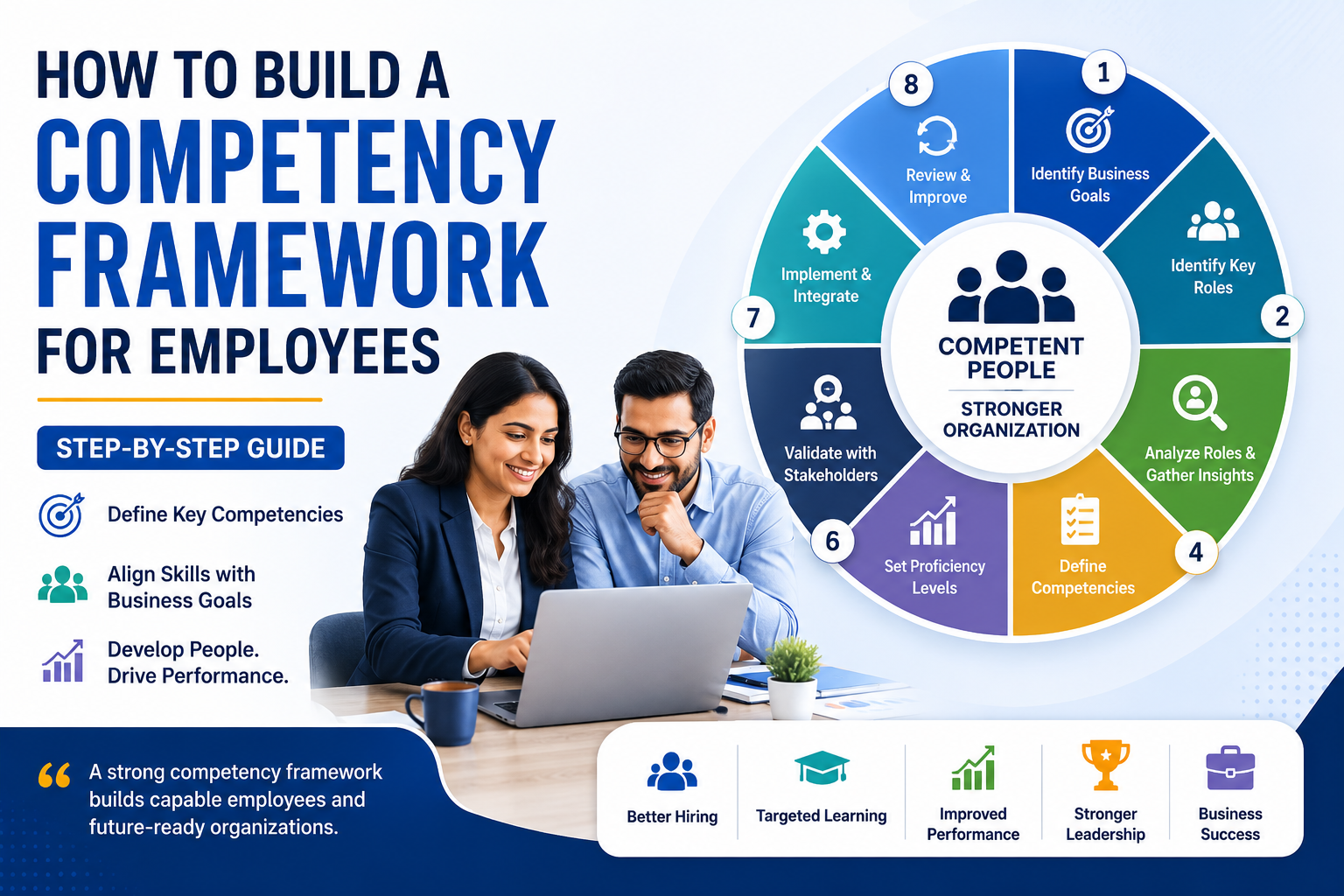
How to Build a Competency Framework for Employees (Step-by-Step)
Building a competency framework requires more than simply listing the skills employees should possess. It involves understanding business objectives, identifying critical capabilities, engaging stakeholders, and establishing measurable behavioural standards that support long-term organizational success.
The following step-by-step approach can help organizations design a competency framework that aligns talent development with business strategy.
Step 1: Define Your Business Objectives
Every competency framework should begin with a clear understanding of the organization's strategic goals. Before identifying competencies, ask:
- What business outcomes are we trying to achieve?
- Which capabilities will be critical over the next three to five years?
- How will employee competencies contribute to business success?
- Which future skills will support organizational growth?
Aligning competencies with business objectives ensures that talent development initiatives directly support organizational priorities rather than operating independently.
Step 2: Identify Key Roles Across the Organization
Not every role requires the same competencies. Begin by identifying critical positions across departments and documenting the responsibilities associated with each role.
This includes:
- Leadership roles
- People managers
- Technical specialists
- Sales and customer-facing teams
- Operations personnel
- Support functions
Grouping similar job roles simplifies competency mapping and helps maintain consistency across the organization.
Step 3: Conduct Job and Role Analysis
The next step is understanding what high-performing employees actually do differently.
Gather information through:
- Job descriptions
- Performance reviews
- Interviews with managers
- Focus groups
- Employee surveys
- Observation of top performers
- Customer feedback
This process helps identify the behaviours, technical expertise, and personal attributes that consistently contribute to successful performance.
Step 4: Define Core Competencies
Core competencies should apply to every employee regardless of department or seniority level.
These competencies typically reflect the organization's culture, values, and expected workplace behaviours.
Examples include:
- Communication
- Teamwork
- Integrity
- Customer Focus
- Innovation
- Continuous Learning
- Adaptability
- Accountability
Clearly define what each competency means and describe observable behaviours associated with different proficiency levels.
Step 5: Define Functional Competencies
Functional competencies describe the technical knowledge and professional expertise required for specific job functions.
For example:
| Department | Example Functional Competencies |
|---|---|
| Sales | Negotiation, Relationship Management, Sales Planning |
| Marketing | Digital Marketing, Brand Management, Market Research |
| Finance | Financial Analysis, Budgeting, Compliance |
| Human Resources | Talent Acquisition, Employee Relations, Performance Management |
| IT | Software Development, Cybersecurity, Cloud Computing |
These competencies should reflect both current business requirements and future workforce capabilities.
Step 6: Define Leadership Competencies
Leadership competencies focus on behaviours required to guide teams, drive change, and achieve organizational objectives.
Typical leadership competencies include:
- Strategic Thinking
- Decision Making
- People Development
- Business Acumen
- Coaching and Mentoring
- Influencing Skills
- Conflict Management
- Change Leadership
Organizations often create separate leadership competency models for first-line managers, middle managers, and senior executives.
Step 7: Create Proficiency Levels
Each competency should include measurable proficiency levels so managers can consistently evaluate employee capabilities.
A simple five-level competency scale may include:
| Level | Description |
|---|---|
| Level 1 | Basic Awareness |
| Level 2 | Working Knowledge |
| Level 3 | Proficient |
| Level 4 | Advanced |
| Level 5 | Expert / Strategic Leader |
Behavioural indicators should accompany each level to improve consistency during assessments and performance reviews.
Step 8: Validate with Business Leaders
Before implementation, review the competency framework with department heads, HR leaders, Learning & Development teams, and senior management.
Their feedback helps ensure competencies accurately reflect organizational priorities and real workplace expectations.
Step 9: Integrate with HR and Learning Processes
A competency framework delivers the greatest value when integrated across multiple talent management processes.
These include:
- Recruitment and Selection
- Employee Onboarding
- Learning & Development
- Performance Management
- Succession Planning
- Career Development
- Leadership Development
- Internal Mobility
Using one consistent competency framework across these activities improves alignment and strengthens workforce planning.
Sample Competency Framework Structure
| Competency Category | Examples | Applicable Employees |
|---|---|---|
| Core Competencies | Communication, Integrity, Collaboration | All Employees |
| Functional Competencies | Technical Skills, Industry Knowledge | Department Specific |
| Leadership Competencies | Strategic Thinking, Coaching, Decision Making | Managers & Leaders |
Example Competency Matrix
| Competency | Executive | Manager | Individual Contributor |
|---|---|---|---|
| Communication | ★★★★★ | ★★★★☆ | ★★★★☆ |
| Leadership | ★★★★★ | ★★★★☆ | ★★☆☆☆ |
| Problem Solving | ★★★★★ | ★★★★★ | ★★★★☆ |
| Technical Expertise | ★★★☆☆ | ★★★★☆ | ★★★★★ |
| Strategic Thinking | ★★★★★ | ★★★★☆ | ★★☆☆☆ |
Common Mistakes to Avoid
Many competency frameworks fail because they become overly complex or disconnected from business needs. Avoid these common mistakes:
- Creating too many competencies that are difficult to assess
- Using vague or subjective competency descriptions
- Ignoring behavioural indicators
- Failing to involve business leaders during development
- Not updating competencies as business needs evolve
- Treating the framework as an HR document instead of an organizational tool
- Not linking competencies with learning, performance, and career development
A practical, business-focused competency framework should be simple to understand, measurable, and regularly reviewed to ensure it remains relevant as organizational priorities change.
Best Practices for Building an Effective Competency Framework
A competency framework is not a one-time HR initiative—it is a strategic talent management tool that should evolve alongside your organization. To maximize its effectiveness, organizations should ensure the framework remains relevant, measurable, and aligned with changing business priorities.
The following best practices can help organizations build a competency framework that delivers long-term value.
- Align competencies with organizational vision, mission, and strategic objectives.
- Keep competency definitions simple, measurable, and easy to understand.
- Focus on observable behaviours instead of subjective traits.
- Engage business leaders, managers, and employees during framework development.
- Review and update competencies regularly as business needs evolve.
- Use competency assessments to identify learning and development priorities.
- Integrate the framework with recruitment, performance management, and succession planning.
- Support employees with competency-based learning journeys and career development plans.
Organizations that continuously refine their competency framework create a culture of continuous learning, improve employee engagement, and build stronger leadership pipelines.
How a Competency Framework Supports the Employee Lifecycle
One of the greatest strengths of a competency framework is its ability to support every stage of the employee lifecycle. Rather than existing as a standalone HR document, it becomes the foundation for multiple people management processes.
| Employee Lifecycle Stage | How Competency Framework Helps |
|---|---|
| Recruitment | Defines hiring criteria and interview questions based on required competencies. |
| Onboarding | Helps new employees understand role expectations and required capabilities. |
| Learning & Development | Identifies competency gaps and enables personalized learning programs. |
| Performance Management | Provides objective criteria for evaluating employee performance. |
| Career Development | Shows employees the competencies needed for future roles and promotions. |
| Succession Planning | Identifies high-potential employees and prepares future leaders. |
| Leadership Development | Supports structured leadership capability building. |
Real-World Example of a Competency Framework
Consider a technology company planning to expand its software development and customer success teams.
Rather than creating separate training programs without clear direction, the company first develops a competency framework for every role.
For software developers, competencies include programming expertise, problem-solving, collaboration, cybersecurity awareness, and continuous learning.
For customer success managers, competencies include communication, relationship management, product knowledge, customer empathy, negotiation, and conflict resolution.
Managers use competency assessments to identify strengths and development areas for each employee. Learning & Development teams then design targeted training programs based on competency gaps rather than generic training calendars.
Over time, employees gain role-specific skills, managers conduct more objective performance reviews, leadership pipelines become stronger, and the organization develops a workforce that is better prepared for future business challenges.
How Technology Supports Competency Frameworks
Modern Learning Management Systems (LMS), Learning Experience Platforms (LXP), and talent management solutions have made competency-based learning easier to implement and manage.
Organizations can use technology to:
- Map competencies to job roles
- Conduct competency assessments
- Track employee skill development
- Create personalized learning pathways
- Recommend training based on competency gaps
- Generate competency reports and dashboards
- Measure learning effectiveness
- Support succession planning decisions
When combined with AI-powered learning platforms, organizations can automatically recommend learning resources, monitor competency progression, and provide employees with continuous development opportunities.
Frequently Asked Questions (FAQs)
What is a competency framework?
A competency framework is a structured model that defines the knowledge, skills, behaviours, and attributes employees need to perform successfully in specific job roles. It provides a consistent approach to recruitment, learning, performance management, and career development.
Why is a competency framework important?
A competency framework helps organizations establish clear performance expectations, identify skill gaps, improve hiring decisions, design targeted learning programs, and develop future leaders while aligning employee capabilities with business goals.
What are the different types of competencies?
Most competency frameworks include three main categories:
- Core competencies
- Functional or technical competencies
- Leadership competencies
Who should be involved in developing a competency framework?
HR professionals, Learning & Development teams, business leaders, department managers, subject matter experts, and employees should all contribute to ensure the framework accurately reflects organizational needs and job expectations.
How often should a competency framework be updated?
Organizations should review competency frameworks at least annually or whenever significant business, technological, or organizational changes occur to ensure they remain relevant and aligned with future workforce requirements.
How does a competency framework support employee learning?
Competency frameworks identify skill gaps and help organizations design personalized learning pathways that improve employee capabilities, performance, and career progression while ensuring learning investments support business objectives.
Conclusion
A competency framework is one of the most valuable tools organizations can use to build a high-performing, future-ready workforce. By clearly defining the knowledge, skills, and behaviours required for success, organizations create consistency across recruitment, onboarding, learning, performance management, leadership development, and succession planning.
Rather than relying on assumptions or subjective evaluations, competency frameworks provide a structured, measurable approach to employee development. They enable organizations to identify skill gaps, design targeted learning initiatives, and prepare employees for evolving business challenges.
As industries continue to transform through digitalization and emerging technologies, organizations that invest in competency-based talent development will be better positioned to attract, develop, and retain skilled employees while maintaining a competitive advantage.
Build Future-Ready Talent with Insite Learning Solutions
At Insite Learning Solutions, we help organizations design competency-based learning strategies that align employee capabilities with business goals. From competency mapping and leadership development to customized corporate training and digital learning solutions, we partner with organizations to build skilled, engaged, and future-ready workforces.
Whether you're creating your first competency framework or strengthening an existing talent development strategy, our learning experts can help you implement practical, measurable, and business-focused solutions.