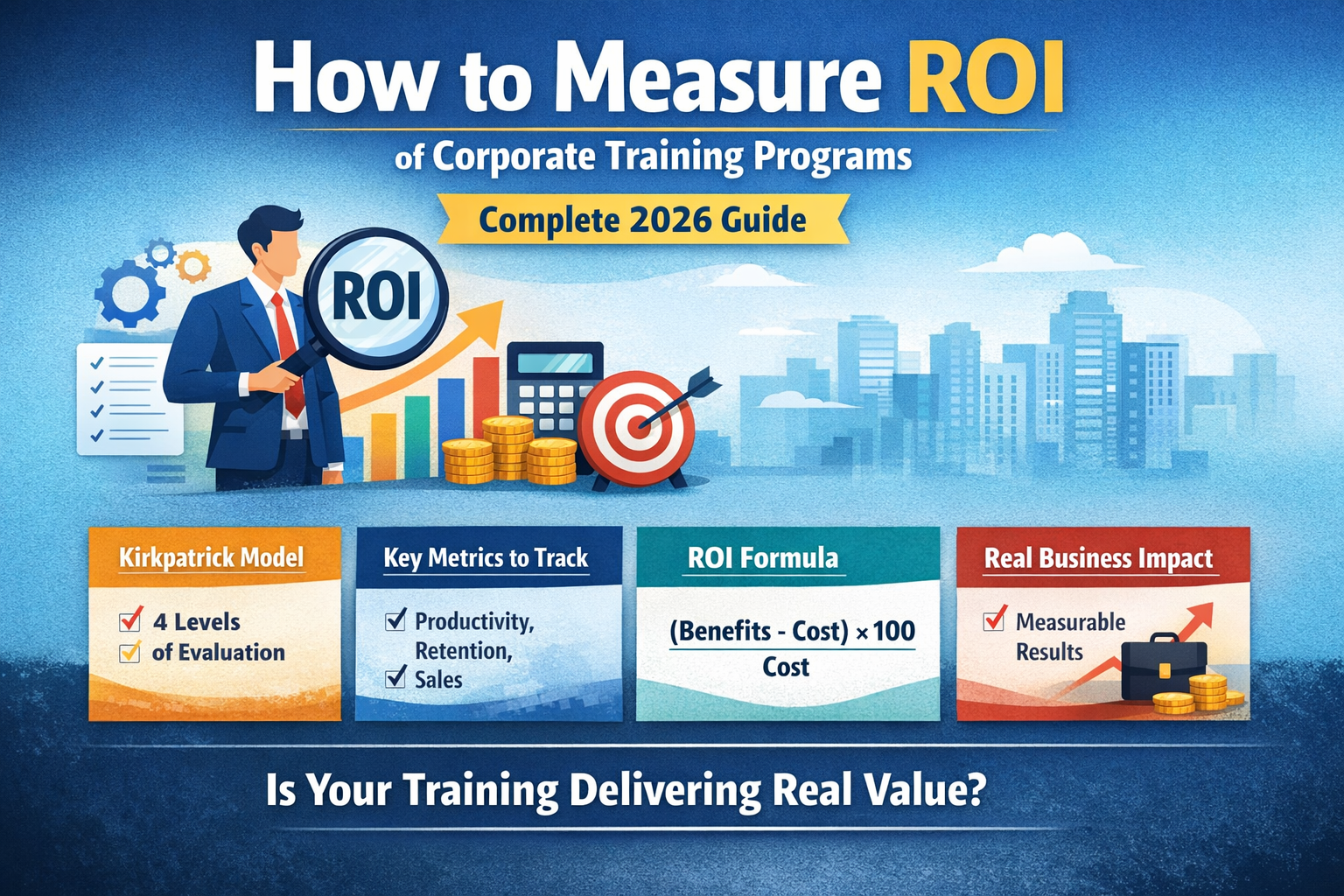
How to Measure ROI of Corporate Training Programs (Complete 2026 Guide)
Corporate training has become a strategic investment for organizations worldwide. Companies today invest heavily in leadership development, emotional intelligence, communication skills, and employee upskilling. However, one question continues to dominate conversations among CEOs, HR leaders, and business heads: How do we measure the ROI of corporate training?
As organizations move into 2026, training budgets are increasingly expected to deliver measurable results. Leaders are no longer satisfied with attendance reports and feedback forms. They want clear evidence that training programs improve productivity, reduce attrition, strengthen leadership, and contribute to business growth.
If you are an HR leader, L&D professional, or senior decision-maker looking to justify and measure the impact of your training investments, this guide will help you understand how to measure training effectiveness and connect learning outcomes to business performance.
Why Measuring Training ROI Is Now Essential
In the past, training success was often evaluated using simple feedback surveys. Participants were asked whether they enjoyed the session or found it useful. While positive feedback is encouraging, it does not demonstrate business impact.
Today’s organizations expect training to deliver measurable outcomes such as improved performance, higher engagement, better customer experiences, and stronger leadership pipelines. Without measurable impact, training budgets are often the first to face scrutiny.
Measuring training ROI ensures that learning initiatives are aligned with business goals and contribute directly to organizational success.
What Does ROI of Corporate Training Mean?
ROI, or Return on Investment, helps organizations understand the value generated from their training spend. It answers a simple but powerful question: For every rupee invested in training, how much value does the organization gain?
The basic formula used to calculate training ROI is:
ROI (%) = (Training Benefits − Training Cost) ÷ Training Cost × 100
While the formula is straightforward, the challenge lies in identifying and measuring the business benefits created by training programs.
The Kirkpatrick Model for Evaluating Training Effectiveness
The most widely used framework for measuring training ROI is the Kirkpatrick Four-Level Model. It provides a structured approach to evaluate training from participant reaction to business impact.
Level 1: Reaction – Participant Feedback
This level measures how participants feel about the training experience.
- Training satisfaction surveys
- Engagement levels
- Perceived relevance of the training
Although important, positive feedback alone does not indicate business results.
Level 2: Learning – Knowledge and Skill Improvement
This stage measures what participants have learned.
- Pre- and post-training assessments
- Skill evaluations
- Certification completion
This helps determine whether training has successfully built new knowledge or skills.
Level 3: Behavior – Application at Work
This level evaluates whether employees apply new skills in the workplace.
- Manager observations
- Performance reviews
- 360-degree feedback
This stage connects learning to real workplace behavior.
Level 4: Results – Business Impact
This is the most important level of evaluation. It measures the impact of training on business outcomes.
- Productivity improvements
- Employee retention
- Customer satisfaction
- Sales growth
At this stage, training becomes a measurable business investment.
Key Metrics Used to Measure Training ROI
Employee Productivity
Training improves efficiency, time management, and decision-making.
- Output per employee
- Task completion speed
- Error reduction
Employee Retention
Organizations that invest in employee development experience lower attrition and higher engagement.
- Attrition rate comparison
- Employee engagement scores
Leadership Effectiveness
Leadership training improves team performance and workplace culture.
- Manager effectiveness ratings
- Internal promotions
- Team engagement scores
Customer Experience
Soft skills training directly influences customer satisfaction.
- Customer satisfaction scores
- Complaint reduction
- Customer retention rates
Sales Performance
Training improves communication, negotiation, and customer engagement.
- Conversion rates
- Revenue growth
- Sales cycle reduction
Example of Training ROI Calculation
Consider an organization that invests ₹10,00,000 in leadership training.
- Reduced attrition saves ₹6,00,000
- Improved productivity adds ₹5,00,000 value
- Reduced customer complaints save ₹3,00,000
Total Benefits: ₹14,00,000
Training ROI: 40%
This demonstrates how training contributes directly to business results.
Common Mistakes in Measuring Training Impact
- Measuring results too early
- Focusing only on feedback surveys
- Lack of baseline performance data
- No post-training reinforcement
Best Practices to Maximize Training ROI
- Align training with business goals
- Define measurable KPIs before training
- Involve managers in reinforcement
- Track outcomes over time
Why Soft Skills Training Delivers Long-Term Value
Technical skills evolve quickly, but human skills create lasting impact. Leadership, communication, emotional intelligence, and collaboration drive long-term business performance.
Organizations that invest in these capabilities build stronger cultures, higher engagement, and better business outcomes.
Conclusion
Corporate training is no longer an optional expense. It is a strategic investment that drives productivity, engagement, and business growth. When measured correctly, training delivers clear and measurable ROI.
If your organization is ready to design training programs that deliver real business impact, we’re here to help.
Book a free consultation to explore how our corporate training programs can help your organization achieve measurable results.