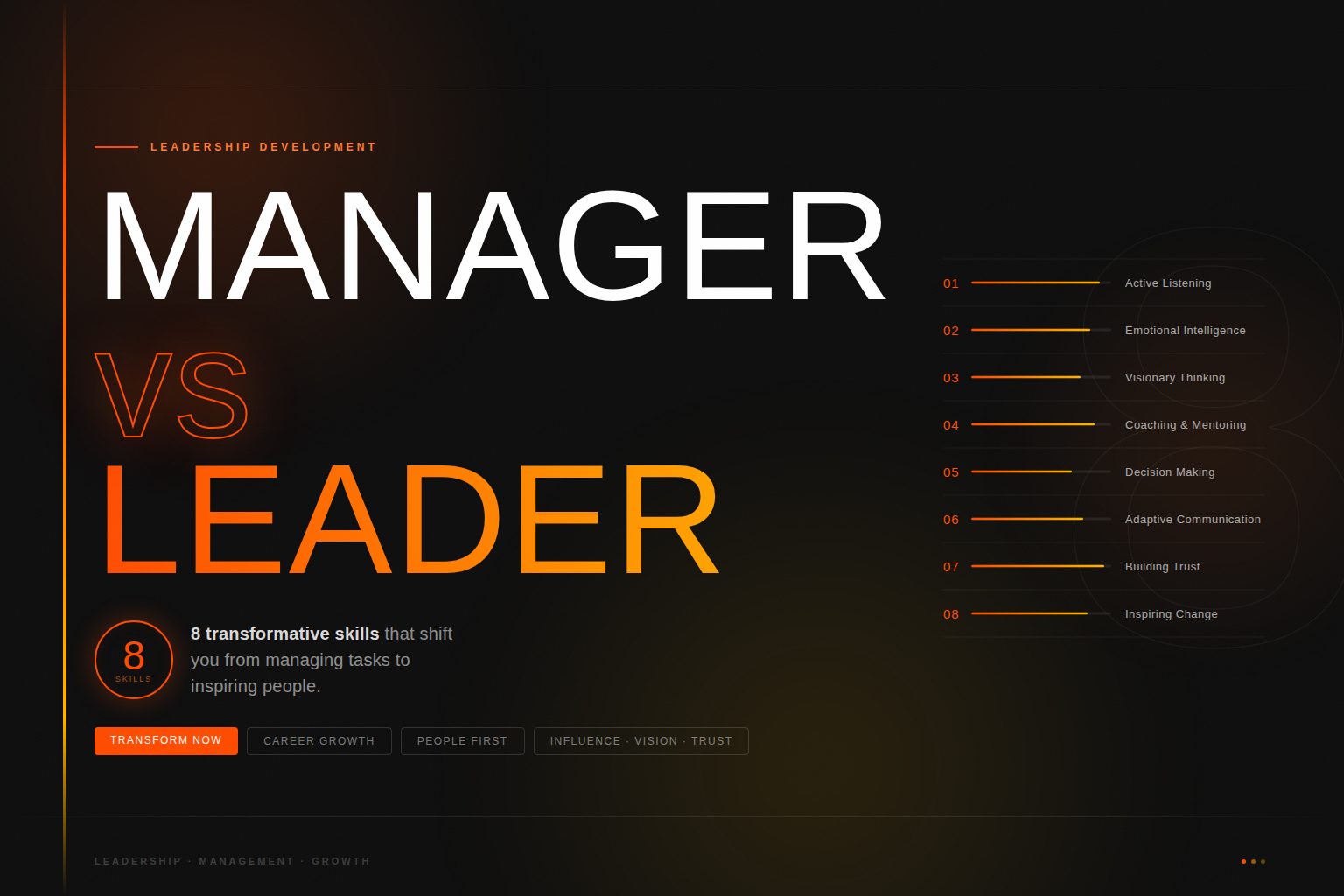
Manager vs Leader: 8 Leadership Skills That Transform Managers into Great Leaders
In today’s competitive and fast-changing business environment, organizations are realizing that management alone is not enough to build high-performing teams. Companies need leaders who can inspire employees, guide teams through uncertainty, and create a culture of collaboration and innovation.
Many professionals are promoted into managerial roles because of their technical expertise or operational excellence. However, managing tasks and leading people are two very different capabilities. While managers focus on processes, efficiency, and execution, leaders focus on vision, influence, and people development.
This distinction is why developing leadership skills for managers has become a top priority for organizations around the world. Managers who develop leadership capabilities are better equipped to motivate teams, handle complex workplace challenges, and drive sustainable organizational growth.
In this comprehensive guide, we will explore the difference between managing and leading, discuss the most important leadership skills managers must develop, and explain how organizations can help managers evolve into impactful leaders.
Difference Between Managing and Leading
The terms “manager” and “leader” are often used interchangeably, but they represent distinct approaches to guiding teams and achieving results.
What Does a Manager Do?
A manager is responsible for planning, organizing, and supervising work activities to ensure tasks are completed efficiently. Managers focus on maintaining operational stability, ensuring employees follow procedures, and meeting performance targets.
Typical responsibilities of managers include:
- Assigning tasks and responsibilities
- Monitoring employee performance
- Managing schedules and resources
- Ensuring processes are followed correctly
- Maintaining operational efficiency
Management is essential for maintaining structure and ensuring that daily operations run smoothly.
What Does a Leader Do?
Leadership, on the other hand, focuses on inspiring people, setting direction, and encouraging innovation. Leaders influence others to work toward a shared vision and empower teams to perform at their best.
Effective leaders typically:
- Create a compelling vision for the future
- Motivate and inspire employees
- Encourage innovation and creativity
- Develop and mentor team members
- Build trust and strong relationships
While managers focus on controlling processes, leaders focus on empowering people. The most successful professionals combine both management and leadership capabilities.
Why Leadership Skills for Managers Are Critical Today
The workplace has changed dramatically over the past decade. Organizations are dealing with digital transformation, global competition, remote work environments, and constantly evolving employee expectations.
In such a dynamic environment, simply managing tasks is not enough. Managers must develop leadership capabilities that help them guide teams through change, motivate employees, and create high-performance cultures.
Organizations that prioritize leadership development often experience several benefits:
- Higher employee engagement and satisfaction
- Stronger collaboration between teams
- Improved decision-making across departments
- Better adaptability during change and uncertainty
- Greater innovation and problem-solving capabilities
When managers develop leadership skills, they become catalysts for organizational growth.
8 Leadership Skills That Transform Managers into Leaders
To become effective leaders, managers must develop a range of interpersonal, strategic, and emotional competencies. Below are eight essential leadership skills that help managers transition into impactful leaders.
1. Communication Skills
Communication is the foundation of effective leadership. Leaders must clearly articulate goals, expectations, and organizational vision while also listening actively to their teams.
Strong communication skills allow leaders to:
- Provide clear instructions and direction
- Share organizational vision with employees
- Encourage open dialogue within teams
- Resolve conflicts effectively
- Build trust through transparency
Managers who communicate effectively create an environment where employees feel informed, valued, and motivated.
2. Vision and Strategic Thinking
Managers typically focus on short-term goals and daily operations. Leaders, however, must think strategically and plan for the long-term success of the organization.
Strategic thinking helps leaders anticipate challenges, identify opportunities, and guide teams toward future growth.
Leaders with strong strategic thinking capabilities can:
- Align team goals with organizational objectives
- Anticipate market trends and industry changes
- Make proactive decisions
- Guide teams through complex challenges
Strategic leaders help organizations remain competitive in rapidly evolving industries.
3. Emotional Intelligence
Emotional intelligence is the ability to understand and manage one's own emotions while recognizing and influencing the emotions of others.
Leaders with high emotional intelligence build stronger relationships, manage conflicts effectively, and create supportive workplace environments.
Key elements of emotional intelligence include:
- Self-awareness
- Self-regulation
- Empathy
- Social awareness
- Relationship management
Emotional intelligence enables leaders to connect with employees on a deeper level, which improves collaboration and engagement.
4. Coaching and Mentoring
Great leaders focus on developing their team members rather than simply directing them. Coaching involves guiding employees to discover solutions, build confidence, and improve performance.
Managers who adopt a coaching mindset can:
- Empower employees to take ownership of their work
- Encourage continuous learning
- Help employees develop new skills
- Build stronger professional relationships
Organizations that promote coaching leadership styles often experience higher levels of employee engagement and retention.
5. Decision-Making Skills
Leaders are frequently required to make complex decisions that impact teams, projects, and business outcomes. Effective decision-making involves evaluating data, considering multiple perspectives, and choosing the best course of action.
Strong decision-making skills allow leaders to:
- Handle uncertainty with confidence
- Address challenges quickly
- Minimize risks
- Guide teams toward effective solutions
Leaders who make thoughtful and timely decisions build credibility and trust within their teams.
6. Adaptability and Change Management
Modern organizations operate in environments of constant change. Leaders must be adaptable and capable of guiding teams through uncertainty.
Adaptable leaders:
- Embrace new technologies and ideas
- Encourage flexible thinking
- Support employees during change
- Maintain productivity during transitions
Organizations need leaders who can remain calm and focused even during periods of disruption.
7. Accountability and Ownership
Effective leaders take responsibility for both successes and failures. They create cultures where employees understand their responsibilities and take ownership of their work.
Leaders who demonstrate accountability inspire trust and encourage teams to perform at higher levels.
8. Building Trust and Collaboration
Trust is the foundation of strong leadership. Employees perform better when they trust their leaders and feel supported in their work.
Leaders build trust by:
- Demonstrating integrity and honesty
- Communicating openly with teams
- Recognizing employee contributions
- Supporting employees during challenges
Trust-based leadership creates positive workplace cultures where teams collaborate effectively.
Coaching vs Controlling Teams
One of the most important shifts managers must make when becoming leaders is moving from a controlling approach to a coaching approach.
Controlling Approach
Managers who rely heavily on control often focus on monitoring every detail of employee work. They provide strict instructions and expect employees to follow predefined processes.
While this approach may ensure short-term efficiency, it can reduce employee motivation and limit creativity.
Coaching Approach
Leaders adopt a coaching mindset that focuses on empowering employees rather than controlling them.
Coaching leaders:
- Encourage independent thinking
- Help employees develop problem-solving skills
- Provide guidance rather than commands
- Create environments where employees feel confident sharing ideas
Coaching leadership styles encourage innovation, collaboration, and continuous learning.
Strategic Thinking and Decision Making
Strategic thinking enables leaders to connect daily operations with long-term business objectives. Leaders who think strategically can evaluate opportunities, anticipate risks, and guide teams toward sustainable growth.
Strategic leaders focus on:
- Understanding market trends
- Analyzing business data
- Identifying new opportunities
- Aligning team efforts with organizational strategy
Decision-making is closely tied to strategic thinking. Leaders must evaluate information, consider multiple viewpoints, and choose the best path forward.
Organizations benefit greatly from leaders who can combine analytical thinking with sound judgment.
Emotional Intelligence in Leadership
Emotional intelligence is one of the most critical leadership competencies in the modern workplace. Leaders who understand emotions can build stronger relationships and manage workplace dynamics more effectively.
Emotionally intelligent leaders demonstrate empathy, patience, and awareness of how their behavior affects others.
They also:
- Recognize employee challenges and concerns
- Handle workplace conflicts constructively
- Create supportive work environments
- Encourage collaboration and respect
Organizations increasingly incorporate emotional intelligence training into leadership development programs.
Conclusion
The transition from manager to leader requires a shift in mindset, skills, and leadership approach. While management focuses on efficiency and task execution, leadership focuses on inspiring people, building trust, and driving long-term success.
Managers who develop leadership skills such as communication, emotional intelligence, strategic thinking, coaching, and decision-making can transform teams and organizations.
Companies that invest in leadership development programs not only build stronger leaders but also create cultures where employees feel motivated, engaged, and committed to organizational success.
Book a Demo
Looking to develop leadership capabilities within your organization?
Insite Learning Solutions offers customized leadership development programs designed to help managers build essential leadership skills, improve communication, and create high-performing teams.
Our expert trainers deliver practical, results-driven training programs tailored to the needs of your organization.