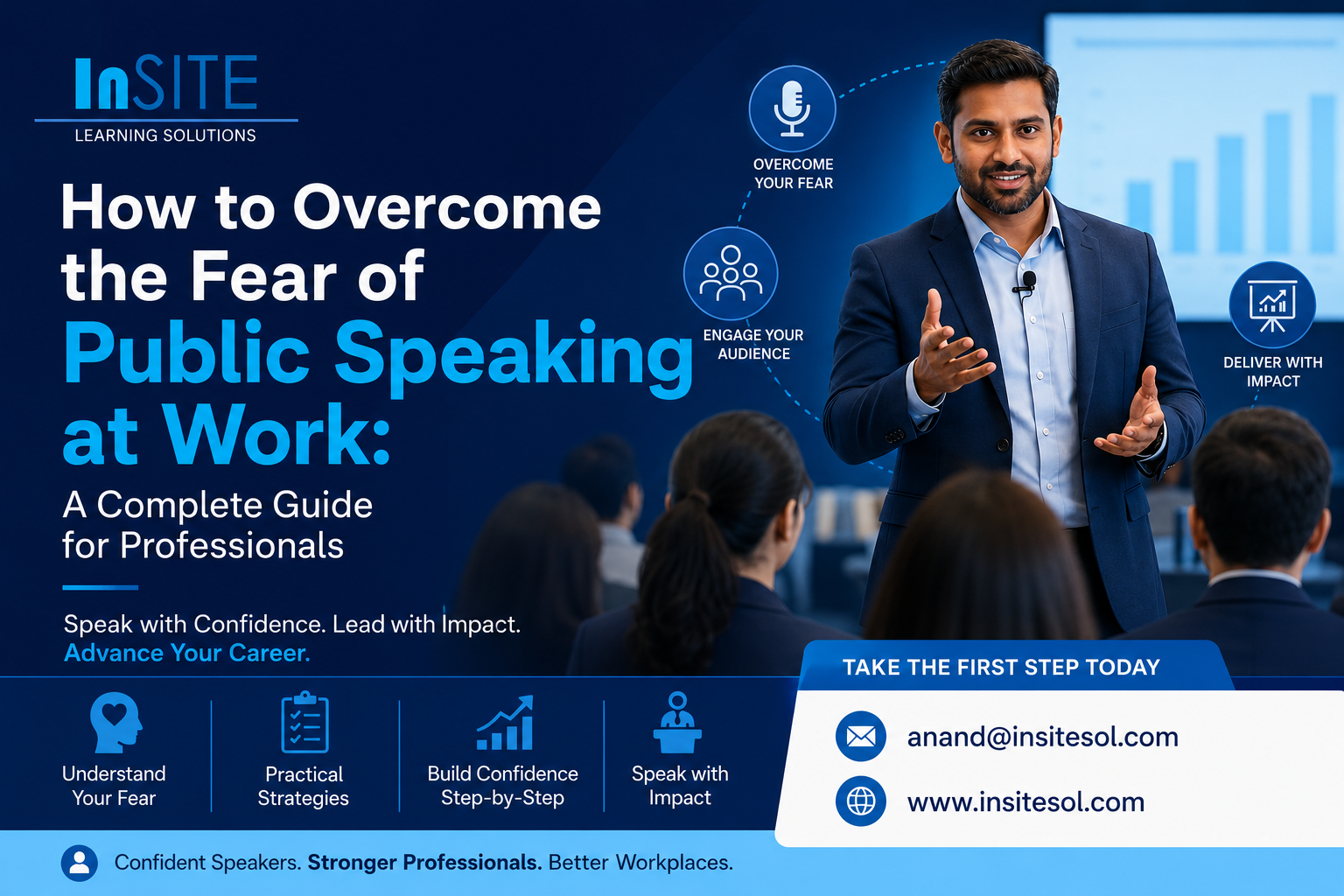
How to Overcome the Fear of Public Speaking at Work: A Complete Guide for Professionals
Anand Narayan | 🔗 LinkedIn Profile | Published: May 18, 2026
There is a moment that almost every working professional recognizes. You are sitting in a meeting room or on a video call, and someone asks you to present your update, explain your idea, or speak in front of a group. Your heart rate immediately increases. Your mind goes blank. You start wondering whether your voice will shake, whether you will forget what you planned to say, or whether people will judge you.
If this sounds familiar, you are not alone. The fear of public speaking — known clinically as glossophobia — is one of the most common anxieties among working professionals. Studies consistently show that more people fear public speaking than fear failure, financial loss, or even death.
But here is what most people do not realize: the fear of public speaking is not a fixed personality trait. It is a learnable skill gap. And with the right training, practice, and mindset shift, any professional can develop the confidence to speak clearly, persuasively, and with impact in any workplace setting.
This guide is for working professionals in Bangalore and across India who want to overcome their fear of public speaking, communicate with greater confidence, and unlock new career opportunities through stronger presentation skills.
Why Public Speaking Matters More Than Ever in Today's Workplace
In today's corporate environment, your ability to communicate ideas clearly and confidently directly influences how you are perceived, how quickly you advance in your career, and how much impact your work has on your organization.
Consider these situations that demand strong public speaking skills:
- Presenting project updates to senior leadership
- Pitching ideas in team meetings
- Leading training sessions or onboarding programs
- Representing your team in cross-functional discussions
- Conducting client presentations or sales pitches
- Speaking at industry events, seminars, or town halls
In each of these scenarios, your technical knowledge alone is not enough. How you communicate that knowledge — with clarity, confidence, and conviction — determines whether people trust you, follow your lead, and act on what you say.
Organizations increasingly recognize this reality. The ability to present ideas persuasively is now considered a core professional competency, not an optional soft skill. HR leaders and L&D managers actively look for professionals who can represent their teams and their organizations with confidence.
Understanding the Root Causes of Public Speaking Fear
Before you can overcome the fear of public speaking, it helps to understand where it comes from. For most professionals, the fear is not really about speaking — it is about being judged.
The underlying anxieties typically include:
Fear of Being Judged or Criticized
Many professionals worry excessively about what the audience thinks of them. They replay worst-case scenarios in their mind — stumbling over words, saying something wrong, or appearing incompetent in front of colleagues or senior leaders.
Perfectionism
High-performing professionals often hold themselves to impossibly high standards. They believe every presentation must be flawless, which creates enormous internal pressure that makes natural, confident speaking far harder.
Lack of Preparation Confidence
Sometimes the anxiety comes not from speaking itself but from uncertainty about the content. When professionals are unsure of their material, or have not structured their thoughts clearly, the fear of being exposed amplifies significantly.
Negative Past Experiences
A single bad experience — forgetting words during a presentation, receiving critical feedback, or being put on the spot unprepared — can create a lasting association between speaking and anxiety that persists for years.
Physical Symptoms Reinforcing the Fear
When the body experiences anxiety — a racing heart, dry mouth, or shaking hands — many professionals interpret these sensations as evidence that something is going wrong. This interpretation makes the anxiety worse, creating a self-reinforcing cycle.
Understanding these root causes is the first step. The next step is developing the skills and strategies to address them directly.
Proven Techniques to Overcome the Fear of Public Speaking
1. Shift Your Focus from Yourself to Your Audience
One of the most powerful mindset shifts in public speaking is moving your attention away from how you appear and toward how you can be useful to your audience.
When you walk into a presentation thinking "How will I come across?" you place enormous pressure on yourself. When you walk in thinking "What does this audience need to understand, and how can I help them understand it clearly?" you become audience-focused rather than self-focused.
This single shift dramatically reduces performance anxiety because you are no longer the subject of the presentation — your message is.
2. Structure Your Content Clearly Before You Speak
Much of the fear of public speaking disappears when you know exactly what you are going to say and in what order. A clear, logical structure gives you a mental map to follow, so you never feel lost even if nerves arise.
A simple structure that works well for most corporate presentations:
- Opening: Start with a key insight, a relevant question, or a brief story that connects to your audience's reality
- Context: Briefly explain why this topic matters right now
- Main Points: Cover three to five key ideas, each supported by evidence or an example
- So What: Explain clearly what the audience should think, feel, or do differently as a result
- Close: End with a memorable statement or a clear call to action
When your content is well-structured, your confidence increases naturally because you trust your preparation.
3. Practice Out Loud — Not Just in Your Head
One of the most common mistakes professionals make is rehearsing presentations silently in their minds. Mental rehearsal is useful, but it does not prepare your voice, your body language, or your pacing.
Practice out loud, ideally in front of a mirror or a trusted colleague. Record yourself on video and watch it back. This feels uncomfortable initially, but it is one of the fastest ways to identify habits you want to change — speaking too quickly, avoiding eye contact, using filler words — and correct them before the actual presentation.
4. Reframe Physical Symptoms as Energy
The physical sensations of nervousness — increased heart rate, heightened alertness, adrenaline — are physiologically identical to excitement. The only difference is how you interpret them.
Instead of telling yourself "I am nervous and something might go wrong," try telling yourself "I am energized and ready to give this everything." This reframing technique, supported by research in sports psychology and performance coaching, can significantly reduce the negative impact of pre-presentation anxiety.
5. Start Small and Build Progressively
Confidence in public speaking is built through repeated exposure, not through a single breakthrough moment. The most effective way to build this skill is to start with low-stakes situations and progressively increase the challenge.
Practical ways to do this in a corporate environment:
- Speak up more frequently in small team meetings
- Volunteer to present project updates even for brief items
- Join internal presentations before external client-facing ones
- Ask to lead sections of workshops or training sessions
Each positive experience — however small — builds the evidence base that tells your brain public speaking is safe.
6. Work on Your Voice, Pace, and Body Language
Confident public speaking is not just about what you say. It is about how you say it. Three non-verbal elements have a disproportionate impact on how your audience perceives your confidence and credibility:
- Voice: Speak at a comfortable volume, vary your pace deliberately, and pause intentionally rather than filling silence with filler words like "um," "uh," or "you know"
- Eye Contact: Make genuine eye contact with individuals in your audience rather than scanning the room or staring at your notes
- Posture and Gestures: Stand tall with open body language. Deliberate gestures that match what you are saying reinforce your message and signal confidence
7. Seek Expert Feedback and Structured Training
Self-practice is valuable, but it has limits. Without expert feedback, many professionals develop habits they cannot see themselves — habits that undermine the impact of their communication.
Structured presentation skills training with an experienced facilitator accelerates development significantly. A skilled trainer can identify specific patterns in your speaking style, give you targeted exercises to address them, and create a safe practice environment where you can take risks and receive constructive feedback.
The Career Impact of Strong Presentation Skills
Professionals who develop strong public speaking and presentation skills consistently experience measurable career benefits:
- Greater visibility with leadership: When you communicate confidently in high-stakes meetings, you become known as a credible and capable professional
- Faster progression into leadership roles: The ability to inspire, persuade, and influence others is a core leadership competency — and presenting well is a visible demonstration of this ability
- Stronger professional relationships: Clear, confident communicators build trust more quickly with colleagues, clients, and stakeholders
- More influence over decisions: Ideas presented with structure and conviction are far more likely to be accepted, funded, and acted upon than the same ideas communicated hesitantly
What Effective Presentation Skills Training Looks Like
Not all presentation skills training is the same. Generic workshops that teach theoretical frameworks without providing real practice opportunities rarely create lasting change.
Effective presentation skills training for corporate professionals typically includes:
- Individual assessment: Understanding each participant's specific patterns, fears, and development areas before training begins
- Structured practice sessions: Multiple opportunities to speak, present, and receive feedback in a supportive environment
- Video feedback: Watching yourself on video is one of the most powerful self-awareness tools available in presentation training
- Targeted coaching: Working on specific habits — vocal variety, pacing, eye contact, body language — with expert guidance
- Real-world scenarios: Practicing presentations that reflect the actual situations participants face in their work — team meetings, client presentations, leadership briefings
At Insite Learning Solutions, our Presenting Skills program is built around this approach. We create a safe, high-energy environment where professionals at every level can discover their natural speaking style, build genuine confidence, and develop the technical skills to communicate with clarity and impact in any corporate setting.
Common Questions About Public Speaking Fear
Can public speaking fear be completely eliminated?
For most professionals, the goal is not to eliminate nerves entirely — it is to develop the skills and confidence to perform well despite them. Experienced speakers still feel nervous before important presentations. The difference is that they have developed the ability to channel that nervous energy productively rather than letting it derail their performance.
How long does it take to become a confident public speaker?
With structured training and regular practice, most professionals experience meaningful improvement within four to eight weeks. Sustainable, deep confidence builds over months of consistent practice and progressively challenging speaking opportunities.
Does online speaking count as public speaking?
Absolutely. In today's hybrid work environment, the ability to communicate confidently on video calls, virtual presentations, and online town halls is just as important as in-person speaking. The same principles apply — structure, preparation, eye contact with the camera, vocal clarity — with some additional considerations specific to the virtual medium.
Conclusion
The fear of public speaking holds back thousands of talented professionals in Bangalore and across India every single day. It prevents good ideas from being heard, capable people from being promoted, and organizations from benefiting from the full potential of their teams.
But public speaking confidence is not a gift that some people are born with. It is a skill that can be learned, developed, and strengthened through the right training, structured practice, and expert guidance.
If you are ready to stop letting the fear of public speaking limit your career and your contribution, the first step is to decide that developing this skill is a priority — and then to find the right training partner to help you do it.
At Insite Learning Solutions, our Presenting Skills program has helped hundreds of professionals across Bangalore develop the confidence and competence to communicate powerfully in any setting. Whether you are a technical professional stepping into a leadership role, a manager preparing for high-stakes client presentations, or an individual contributor who wants to contribute more visibly in team discussions, we have a program designed for you.