Anand Narayan | 🔗 LinkedIn Profile | Published: July 20, 2026
Transitioning from an individual contributor to a first-time manager is one of the most significant milestones in a professional career. While high-performing employees are often promoted because of their technical expertise or exceptional performance, managing people requires an entirely new set of skills. Success is no longer measured solely by personal achievements but by the ability to inspire, guide, and empower others to achieve shared goals.
Many organizations assume that excellent performers will naturally become effective leaders. However, leadership is a learned capability that requires continuous development, practical experience, coaching, and self-awareness. Without proper guidance, first-time managers often struggle with delegation, communication, conflict resolution, performance management, decision-making, and team motivation.
A structured leadership development roadmap helps new managers transition confidently into leadership roles. It equips them with the skills, behaviours, and mindset required to build high-performing teams while aligning employee performance with organizational objectives.
Investing in leadership development benefits not only new managers but also the organization as a whole. Effective leaders improve employee engagement, increase productivity, reduce turnover, strengthen collaboration, and build future leadership pipelines.
In this comprehensive guide, you'll learn:
- What leadership development means
- Why first-time managers need structured leadership development
- The biggest challenges faced by new managers
- The essential leadership competencies every manager should develop
- A practical roadmap for becoming an effective leader
- Best practices for long-term leadership success
Table of Contents
- What is Leadership Development?
- Why Leadership Development Matters for First-Time Managers
- Common Challenges New Managers Face
- Essential Leadership Competencies
- Leadership Development Roadmap
- 90-Day Leadership Plan
- Common Mistakes to Avoid
- Best Practices
- Frequently Asked Questions
- Conclusion
What is Leadership Development?
Leadership development is the continuous process of building the knowledge, skills, behaviours, and mindset required to effectively lead individuals, teams, and organizations. It goes beyond managing daily tasks and focuses on developing leaders who can inspire others, make informed decisions, drive organizational change, and achieve long-term business goals.
Unlike technical training, leadership development emphasizes behavioural competencies such as communication, emotional intelligence, coaching, strategic thinking, conflict management, decision-making, and relationship building.
Leadership development is not limited to senior executives. Organizations that invest in leadership development at every level create stronger succession pipelines, improve employee engagement, and foster a culture of continuous learning and innovation.
For first-time managers, leadership development provides the foundation needed to transition successfully from being an individual contributor to becoming a people leader.
Why Leadership Development Matters for First-Time Managers
The transition from employee to manager often comes with unexpected responsibilities. First-time managers must balance operational goals while supporting the growth and wellbeing of their team members.
Without proper leadership development, new managers may struggle to build trust, delegate responsibilities effectively, manage difficult conversations, provide constructive feedback, or motivate employees during challenging situations.
Organizations that provide structured leadership training help managers develop confidence and practical leadership skills early in their careers.
Effective leadership development enables first-time managers to:
- Build trust with team members
- Improve communication across teams
- Delegate responsibilities effectively
- Develop coaching and mentoring skills
- Manage employee performance objectively
- Handle workplace conflicts professionally
- Make informed business decisions
- Create a positive and collaborative work environment
- Increase employee engagement and productivity
- Prepare for future leadership roles
Organizations with strong leadership development programs consistently report higher employee retention, stronger team performance, and improved business outcomes because managers become capable of developing people—not just managing tasks.
Common Challenges Faced by First-Time Managers
Almost every new manager experiences challenges during the early stages of leadership. Recognizing these challenges is the first step toward overcoming them.
1. Transitioning from Peer to Manager
Managing former colleagues can be uncomfortable. New managers often struggle to balance professional relationships while establishing credibility, authority, and accountability.
2. Delegating Work Effectively
Many first-time managers continue doing work themselves because they fear losing control or believe they can complete tasks more efficiently. Effective delegation is essential for developing team capability and allowing managers to focus on strategic priorities.
3. Providing Constructive Feedback
Giving performance feedback is one of the most challenging aspects of leadership. Managers must learn to deliver feedback that is honest, respectful, timely, and focused on employee growth.
4. Managing Conflict
Disagreements between employees are inevitable. Strong leaders address conflicts early, encourage open communication, and help teams resolve issues professionally while maintaining positive working relationships.
5. Balancing Technical and Leadership Responsibilities
New managers often spend too much time on technical work and not enough time leading people. Leadership requires shifting focus from individual performance to enabling the success of the entire team.
6. Building Team Trust
Trust is the foundation of effective leadership. Employees are more likely to follow leaders who demonstrate integrity, transparency, consistency, and genuine concern for their team's success.
Essential Leadership Competencies Every First-Time Manager Needs
Successful leaders combine technical knowledge with strong behavioural and interpersonal skills. Developing these competencies enables managers to lead confidently and create high-performing teams.
| Leadership Competency | Why It Matters |
|---|---|
| Communication | Builds clarity, alignment, and trust within teams. |
| Emotional Intelligence | Helps leaders understand, manage, and respond to emotions effectively. |
| Decision Making | Supports timely and informed business decisions. |
| Coaching & Mentoring | Develops employee capability and long-term performance. |
| Delegation | Empowers employees while improving productivity. |
| Conflict Resolution | Maintains healthy workplace relationships. |
| Strategic Thinking | Aligns team activities with business objectives. |
| Adaptability | Enables leaders to manage change effectively. |
Developing these competencies early helps first-time managers become confident leaders capable of guiding their teams through changing business environments.
Organizations can accelerate leadership readiness by combining structured training, coaching, mentoring, practical experience, and continuous feedback. Leadership development becomes even more effective when aligned with a well-defined Competency Framework for Employees, ensuring managers develop the behaviours and capabilities required for long-term success.
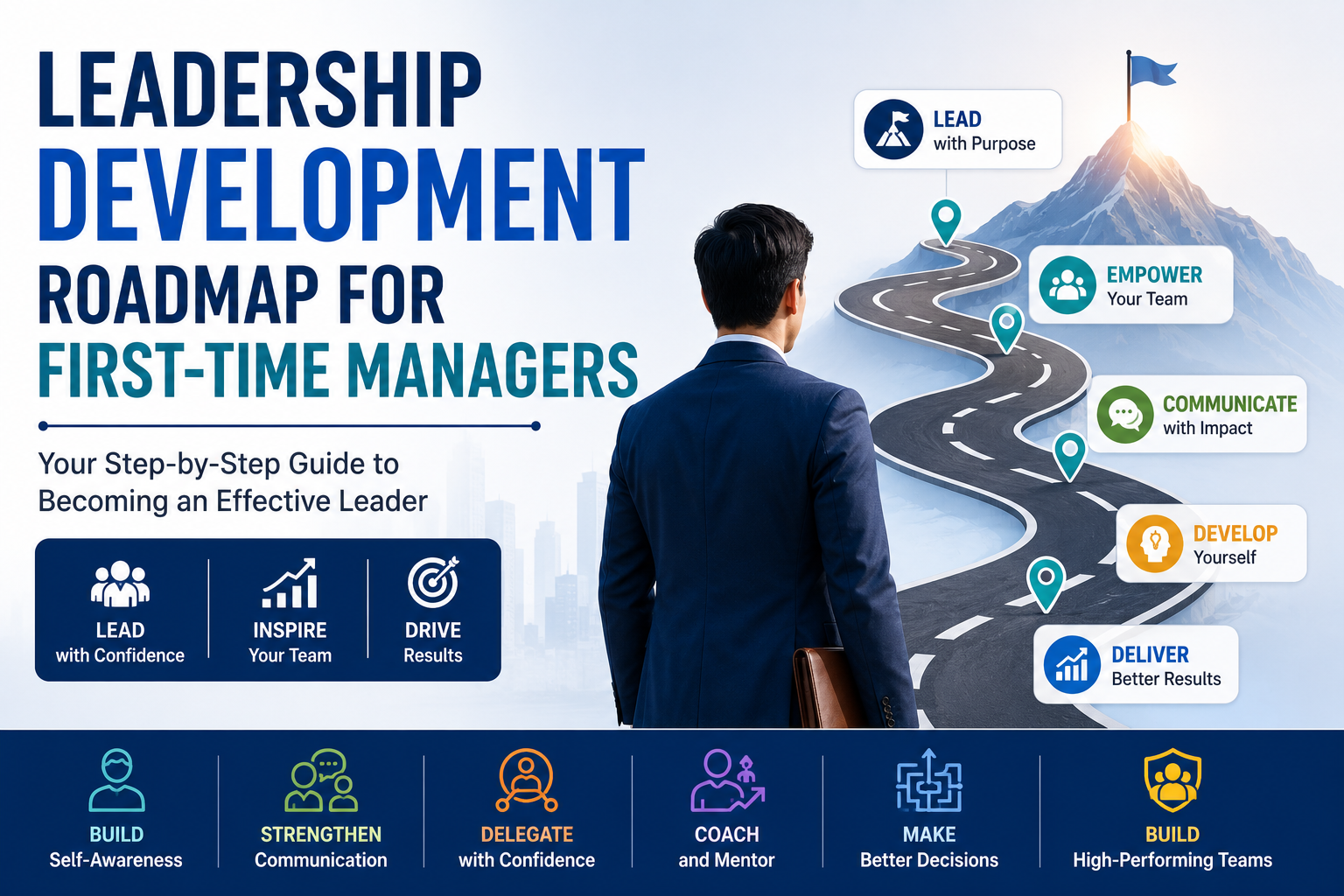
Leadership Development Roadmap for First-Time Managers
Developing effective leaders doesn't happen overnight. Leadership is a journey that requires continuous learning, practical experience, coaching, and self-reflection. A structured roadmap helps first-time managers build confidence while developing the competencies needed to lead high-performing teams.
The following step-by-step roadmap provides a practical framework for organizations and new managers to accelerate leadership development.
Step 1: Develop Self-Awareness
Great leadership begins with understanding yourself. First-time managers should identify their strengths, development areas, communication style, leadership preferences, and emotional triggers.
Self-awareness helps managers:
- Understand their leadership style
- Recognize personal biases
- Improve emotional intelligence
- Respond rather than react during difficult situations
- Build authentic leadership
Tools such as personality assessments, 360-degree feedback, self-reflection journals, and coaching conversations can help managers strengthen self-awareness.
Step 2: Build Strong Communication Skills
Communication is one of the most important leadership competencies. New managers must learn to communicate expectations clearly while actively listening to team members.
Effective leadership communication includes:
- Active listening
- Clear goal setting
- Regular one-on-one meetings
- Constructive feedback
- Difficult conversations
- Transparent decision-making
Managers who communicate openly create stronger employee engagement and reduce misunderstandings within teams.
Step 3: Learn to Delegate Effectively
One of the biggest mindset shifts for new managers is moving from "doing the work" to "getting work done through others."
Delegation is not simply assigning tasks—it involves empowering employees with responsibility, authority, and accountability while providing the support they need to succeed.
Effective delegation allows managers to:
- Develop employee capabilities
- Improve productivity
- Increase employee ownership
- Focus on strategic priorities
- Reduce micromanagement
Step 4: Build Trust and Relationships
Trust is earned through consistent actions, fairness, honesty, and reliability.
Employees perform better when they trust their manager and believe their leader genuinely supports their professional growth.
Managers can strengthen trust by:
- Keeping commitments
- Recognizing employee contributions
- Being approachable
- Showing empathy
- Treating everyone fairly
- Encouraging open communication
Step 5: Master Coaching and Mentoring
Modern leaders are coaches rather than supervisors. Instead of simply providing answers, effective managers help employees develop problem-solving skills and become more independent.
Coaching conversations should focus on:
- Performance improvement
- Career development
- Skill development
- Goal setting
- Continuous learning
Regular coaching creates higher engagement and stronger employee performance.
Step 6: Strengthen Decision-Making Skills
Managers make decisions every day that affect employees, customers, and business outcomes.
Effective leaders:
- Gather relevant information
- Consider multiple perspectives
- Evaluate risks
- Make timely decisions
- Take accountability for outcomes
Strong decision-making builds confidence within teams and improves organizational performance.
Step 7: Develop Emotional Intelligence
Technical expertise alone does not make a successful leader.
Managers with high emotional intelligence understand their own emotions while recognizing and responding appropriately to the emotions of others.
Key components include:
- Self-awareness
- Self-regulation
- Empathy
- Relationship management
- Social awareness
Emotionally intelligent leaders build healthier workplace cultures and stronger employee relationships.
Step 8: Create a Continuous Learning Mindset
Leadership development never ends.
The best leaders continuously invest in learning through formal training, mentoring, reading, networking, coaching, and practical experience.
Organizations should encourage managers to build personalized leadership development plans aligned with both individual career goals and organizational objectives.
30-60-90 Day Leadership Development Plan
The first three months in a leadership role are critical. A structured 30-60-90 day plan helps new managers transition successfully while building credibility with their teams.
| Timeline | Primary Focus | Key Activities |
|---|---|---|
| First 30 Days | Learn & Observe | Meet team members, understand business goals, build relationships, listen actively, understand existing processes. |
| 31–60 Days | Lead & Coach | Set expectations, delegate responsibilities, provide feedback, conduct one-on-one meetings, identify development opportunities. |
| 61–90 Days | Optimize & Grow | Improve team performance, solve challenges, implement improvements, strengthen collaboration, measure progress. |
Leadership Skills Checklist
First-time managers should continuously assess and strengthen the following leadership skills:
- Communication
- Emotional Intelligence
- Strategic Thinking
- Decision Making
- Delegation
- Conflict Resolution
- Performance Management
- Coaching & Mentoring
- Problem Solving
- Time Management
- Team Building
- Adaptability
- Accountability
- Business Acumen
- Change Leadership
Common Mistakes First-Time Managers Should Avoid
Many leadership challenges arise from avoidable mistakes made during the transition into management.
Some of the most common mistakes include:
- Trying to do everything independently instead of delegating.
- Micromanaging team members.
- Avoiding difficult conversations.
- Providing unclear expectations.
- Delaying performance feedback.
- Making decisions without employee input.
- Focusing only on technical work instead of people development.
- Failing to recognize employee achievements.
- Ignoring work-life balance for themselves and their team.
- Stopping their own learning after becoming a manager.
Avoiding these mistakes helps managers establish credibility faster while creating a positive and high-performing work environment.
Leadership capability grows through continuous learning and measurable development. Organizations can further strengthen leadership effectiveness by measuring learning outcomes and business impact. Read our guide on How to Measure Corporate Training ROI to understand how leadership programs can be evaluated effectively.
Best Practices for Developing First-Time Managers
Leadership development is most effective when it is treated as a continuous journey rather than a one-time training event. Organizations that consistently invest in developing new managers create stronger leadership pipelines, improve employee engagement, and build resilient teams capable of adapting to changing business needs.
The following best practices can help organizations develop confident and capable first-time managers.
- Provide structured leadership development programs during the first year of management.
- Assign experienced mentors or leadership coaches to support new managers.
- Encourage regular one-on-one meetings with team members.
- Create personalized leadership development plans.
- Offer continuous learning through workshops, e-learning, and coaching.
- Promote a culture of open feedback and psychological safety.
- Measure leadership effectiveness using employee feedback and business outcomes.
- Recognize and reward leadership behaviours that align with organizational values.
Organizations that prioritize leadership development early significantly improve managerial confidence, employee satisfaction, and long-term business performance.
Leadership Development Tools and Methods
Effective leadership development combines multiple learning methods rather than relying solely on classroom training. Different learning experiences help managers build practical leadership skills while applying new knowledge in real workplace situations.
| Development Method | Purpose |
|---|---|
| Leadership Training Programs | Develop foundational leadership knowledge and skills. |
| Executive Coaching | Improve self-awareness and leadership effectiveness. |
| Mentoring | Learn from experienced leaders through practical guidance. |
| 360-Degree Feedback | Receive feedback from managers, peers, and team members. |
| Stretch Assignments | Build leadership capability through challenging projects. |
| Job Rotation | Develop cross-functional business understanding. |
| Peer Learning Groups | Share leadership experiences and best practices. |
| Digital Learning Platforms | Support continuous, self-paced leadership development. |
How to Measure Leadership Development Success
Leadership development should deliver measurable business value. Organizations need to evaluate whether leadership programs improve employee performance, engagement, productivity, and organizational capability.
Some commonly used leadership metrics include:
- Employee engagement scores
- Manager effectiveness ratings
- Employee retention rates
- Internal promotion rates
- Leadership competency assessment scores
- 360-degree feedback improvements
- Team productivity and performance metrics
- Employee satisfaction survey results
- Training completion and application rates
- Business KPI improvements
Measuring these indicators helps organizations continuously refine leadership development programs while demonstrating their contribution to organizational success.
Leadership Development and Organizational Growth
Strong leadership directly influences organizational performance. Managers who communicate effectively, develop people, and build high-performing teams create positive workplace cultures that encourage innovation, accountability, and continuous improvement.
Organizations with effective leadership development programs often experience:
- Higher employee engagement
- Improved productivity
- Better collaboration across teams
- Reduced employee turnover
- Stronger succession planning
- Faster decision-making
- Greater organizational agility
- Improved customer satisfaction
Leadership development should therefore be viewed as a strategic investment rather than simply a training initiative.
Frequently Asked Questions (FAQs)
What is leadership development?
Leadership development is the process of improving the knowledge, behaviours, and skills individuals need to effectively lead teams, make decisions, manage change, and achieve organizational goals.
Why is leadership development important for first-time managers?
First-time managers often transition from technical roles into people leadership positions. Leadership development equips them with essential skills such as communication, delegation, coaching, conflict resolution, emotional intelligence, and decision-making.
What skills should every first-time manager develop?
Key leadership skills include communication, emotional intelligence, delegation, coaching, decision-making, problem-solving, strategic thinking, adaptability, performance management, and relationship building.
How long does leadership development take?
Leadership development is an ongoing process. While structured programs may last several months, effective leaders continue learning throughout their careers through coaching, mentoring, practical experience, and continuous professional development.
How can organizations measure leadership effectiveness?
Organizations can evaluate leadership effectiveness using employee engagement surveys, performance reviews, competency assessments, retention rates, productivity metrics, 360-degree feedback, and business KPIs.
How does leadership development support employee engagement?
Managers who communicate effectively, provide coaching, recognize employee contributions, and create psychologically safe work environments significantly improve employee engagement, motivation, and retention.
Conclusion
Becoming a first-time manager is an exciting career milestone, but it also brings new responsibilities and expectations. Technical expertise alone is no longer enough—effective leadership requires strong communication, emotional intelligence, coaching, decision-making, and the ability to inspire others toward shared goals.
A structured leadership development roadmap helps new managers transition successfully into leadership roles while building the confidence and competencies needed to lead high-performing teams. By investing in continuous learning, mentorship, feedback, and practical experience, organizations can develop leaders who drive employee engagement, strengthen organizational culture, and deliver sustainable business results.
Leadership is not about authority—it's about empowering people, developing talent, and creating an environment where individuals and teams can thrive. Organizations that prioritize leadership development today are building the leaders who will shape tomorrow's success.
Develop Future Leaders with Insite Learning Solutions
At Insite Learning Solutions, we partner with organizations to build confident, capable, and future-ready leaders. Our customized leadership development programs combine instructor-led workshops, experiential learning, coaching, digital learning, and competency-based development to help first-time managers successfully transition into leadership roles.
Whether you're developing emerging leaders, strengthening managerial capabilities, or building a leadership pipeline, our experts can design learning solutions tailored to your organization's goals and culture.